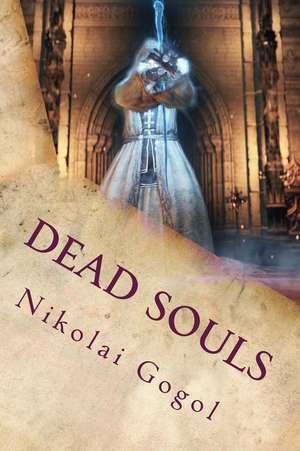
Dead Souls
Autor Nikolai Gogolen Limba Engleză Paperback
Preț: 42.64 lei
Puncte Express: 64
Carte disponibilă
Livrare economică 18 noiembrie-02 decembrie
Livrare prin curier în România Termenul estimat este afișat lângă disponibilitate.
Transport gratuit de la 400.00 lei Plată online sau ramburs, în funcție de opțiunile comenzii.
Retur gratuit în 14 zile Comandă securizată și suport în română.
Specificații
ISBN-13: 9781535327633
ISBN-10: 1535327634
Pagini: 130
Dimensiuni: 152 x 229 x 8 mm
Greutate: 0.2 kg
ISBN-10: 1535327634
Pagini: 130
Dimensiuni: 152 x 229 x 8 mm
Greutate: 0.2 kg
V-ar putea interesa
-
 Notes From UndergroundFyodor Dostoevsky-27%Preț: 51.59 lei71.05 lei
 -
 -35%Preț: 60.71 lei93.70 lei
 -
 Diary of a Young Girl: Anne FrankAnne Frank-17%Preț: 54.32 lei65.72 lei
 -
 NoseNikolay Gogol-38%Preț: 17.63 lei28.47 lei
 -
 Plays and Petersburg Tales: Petersburg Tales, Marriage, The Government InspectorNikolai Vasilyevich Gogol-17%Preț: 54.99 lei65.92 lei
 -
 Preț: 52.81 lei
 -
 -27%Preț: 67.67 lei92.31 lei
 -
 The Collected Tales of Nikolai GogolNikolai GogolPreț: 114.43 lei
 -
 The Overcoat and Other Short StoriesNikolai Gogol-18%Preț: 29.43 lei35.86 lei
 -
 The Night Before ChristmasNikolai GogolPreț: 56.14 lei
 -
 OblomovIvan GoncharovPreț: 37.37 lei
 -
 Dead Souls: 1-16Nikolai Vasil'evich GogolPreț: 102.11 lei
 -
 All God's CreaturesAnthony GardnerPreț: 107.87 lei
 -
 -27%Preț: 68.02 lei93.11 lei
 -
 Reminiscences of Tolstoy, Chekhov and AndreevMaxim GorkyPreț: 107.33 lei
 -
 And the Earth Will Sit on the MoonNikolai GogolPreț: 78.87 lei
 -
 Nikolai GogolVladimir Nabokov-26%Preț: 58.05 lei78.60 lei
 -
 Collected Tales Of Nikolai GogolNikolai Vasilievich GogolPreț: 94.29 lei
 -
 Petersburg Tales: New TranslationNikolai GogolPreț: 50.55 lei
 -
 House of the Dead: New TranslationFyodor DostoevskyPreț: 66.66 lei
 -
 -8%Preț: 58.24 lei63.38 lei
 -
 The Village of Stepanchikovo and Its InhabitantsFyodor DostoevskyPreț: 65.69 lei
 -
 The IdiotFyodor DostoevskyPreț: 40.12 lei
Descriere
Descriere de la o altă ediție sau format:
'Rus! Russ!...Everything within you is open, desolate, and flat; your squat towns barely protrude above the level of your wide plains, marking them like little dots, like specks; here is nothing to entice and fascinate the onlooker's gaze. Yet whence this unfathomable, uncanny force that draws me to you?' Although Dead Souls (1842) was largely composed by Gogol during self-imposed exile in Italy in the late 1830s, his last work remains to this day the most essentially Russian of all the great novels in Russian literature. As we follow its hero Chichikov, a dismissed civil servant turned unscrupulous confidence man, about the Russian countryside in pursuit of his shady enterprise, there unfolds before us a gallery of characters worthy in comic range of Chaucer, Rabelais, Fielding and Sterne. With its rich and ebullient language, ironic twists and startling juxtapositions, Dead Souls stands as one of the most dazzling and poetic masterpieces of the nineteenth century. This brilliant new translation by Christopher English is complemented by a superb introductory essay by the pre-eminent Gogol scholar, Robert Maguire. ABOUT THE SERIES: For over 100 years Oxford World's Classics has made available the widest range of literature from around the globe. Each affordable volume reflects Oxford's commitment to scholarship, providing the most accurate text plus a wealth of other valuable features, including expert introductions by leading authorities, helpful notes to clarify the text, up-to-date bibliographies for further study, and much more.
'Rus! Russ!...Everything within you is open, desolate, and flat; your squat towns barely protrude above the level of your wide plains, marking them like little dots, like specks; here is nothing to entice and fascinate the onlooker's gaze. Yet whence this unfathomable, uncanny force that draws me to you?' Although Dead Souls (1842) was largely composed by Gogol during self-imposed exile in Italy in the late 1830s, his last work remains to this day the most essentially Russian of all the great novels in Russian literature. As we follow its hero Chichikov, a dismissed civil servant turned unscrupulous confidence man, about the Russian countryside in pursuit of his shady enterprise, there unfolds before us a gallery of characters worthy in comic range of Chaucer, Rabelais, Fielding and Sterne. With its rich and ebullient language, ironic twists and startling juxtapositions, Dead Souls stands as one of the most dazzling and poetic masterpieces of the nineteenth century. This brilliant new translation by Christopher English is complemented by a superb introductory essay by the pre-eminent Gogol scholar, Robert Maguire. ABOUT THE SERIES: For over 100 years Oxford World's Classics has made available the widest range of literature from around the globe. Each affordable volume reflects Oxford's commitment to scholarship, providing the most accurate text plus a wealth of other valuable features, including expert introductions by leading authorities, helpful notes to clarify the text, up-to-date bibliographies for further study, and much more.
Recenzii
Praise for previous translations by Richard Pevear and Larissa Volokhonsky, winners of the PEN/Book-of-the-Month Club Prize
The Brothers Karamazov
“One finally gets the musical whole of Dostoevsky’s original.” –New York Times Book Review
“It may well be that Dostoevsky’s [world], with all its resourceful energies of life and language, is only now–and through the medium of [this] new translation–beginning to come home to the English-speaking reader.” –New York Review of Books
Crime and Punishment
“The best [translation] currently available…An especially faithful re-creation…with a coiled-spring kinetic energy… Don’t miss it.” –Washington Post Book World
“Reaches as close to Dostoevsky’s Russian as is possible in English…The original’s force and frightening immediacy is captured…The Pevear and Volokhonsky translation will become the standard version.” –Chicago Tribune
Demons
“The merit in this edition of Demons resides in the technical virtuosity of the translators…They capture the feverishly intense, personal explosions of activity and emotion that manifest themselves in Russian life.” –New York Times Book Review
“[Pevear and Volokhonsky] have managed to capture and differentiate the characters’ many voices…They come into their own when faced with Dostoevsky’s wonderfully quirky use of varied speech patterns…A capital job of restoration.” –Los Angeles Times
With an Introduction by Richard Pevear
From the Hardcover edition.
The Brothers Karamazov
“One finally gets the musical whole of Dostoevsky’s original.” –New York Times Book Review
“It may well be that Dostoevsky’s [world], with all its resourceful energies of life and language, is only now–and through the medium of [this] new translation–beginning to come home to the English-speaking reader.” –New York Review of Books
Crime and Punishment
“The best [translation] currently available…An especially faithful re-creation…with a coiled-spring kinetic energy… Don’t miss it.” –Washington Post Book World
“Reaches as close to Dostoevsky’s Russian as is possible in English…The original’s force and frightening immediacy is captured…The Pevear and Volokhonsky translation will become the standard version.” –Chicago Tribune
Demons
“The merit in this edition of Demons resides in the technical virtuosity of the translators…They capture the feverishly intense, personal explosions of activity and emotion that manifest themselves in Russian life.” –New York Times Book Review
“[Pevear and Volokhonsky] have managed to capture and differentiate the characters’ many voices…They come into their own when faced with Dostoevsky’s wonderfully quirky use of varied speech patterns…A capital job of restoration.” –Los Angeles Times
With an Introduction by Richard Pevear
From the Hardcover edition.
Notă biografică
Nikolai Vasilevich Gogolwas born in 1809; his family were small gentry of Ukrainian cossack extraction, and his father was the author of a number of plays based on Ukrainian popular tales. He attended school in Nézhin and gained a reputation for his theatrical abilities. He went to St Petersburg in 1829 and with the help of a friend gained a post in one of the government ministries. Gogol was introduced to Zhukovsky, the romantic poet, and to Pushkin, and with the publication ofEvenings on a Farm near Dikanka (1831) he had an entrée to all the leading literary salons. He even managed for a short period to be Professor of History at the University of St. Petersburg (1834-5).Diary of a MadmanandThe Story of the Quarrel between Ivan Ivanovich and Ivan Nikiforovichappeared in 1934,The Nosein 1836, andThe Overcoatin 1842. Gogol also wrote the playThe Inspector(1836),Dead Souls(1842), and several moralizing essays defending the Tsarist regime, to the horror of his liberal and radical friends. He lived a great deal abroad, mostly in Rome, and in his last years became increasingly prey to religious mania and despair. He made a pilgrimage to Jerusalem in 1848, but was bitterly disappointed in the lack of feeling that the journey kindled. He returned to Russia and fell under the influence of a spiritual director who told him to destroy his writings as they were sinful. He burned the second part ofDead Souls, and died in 1852 after subjecting himself to a severe regime of fasting.