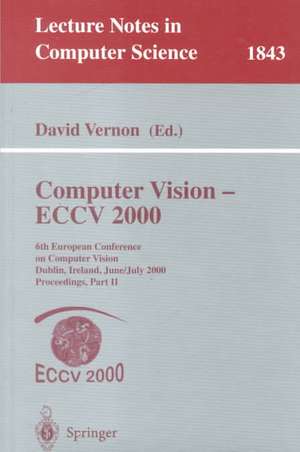
Computer Vision - ECCV 2000: 6th European Conference on Computer Vision Dublin, Ireland, June 26 - July 1, 2000, Proceedings, Part II: Lecture Notes in Computer Science, cartea 1843
Editat de David Vernonen Limba Engleză Paperback – 19 iun 2000
Din seria Lecture Notes in Computer Science
- 20%
 Preț: 558.53 lei
 - 20%
 Preț: 571.88 lei
 - 20%
 Preț: 675.83 lei
 - 20%
 Preț: 1020.28 lei
 - 20%
 Preț: 620.33 lei
 - 20%
 Preț: 560.93 lei
 - 20%
 Preț: 633.70 lei
 - 20%
 Preț: 731.82 lei
 - 20%
 Preț: 1359.66 lei
 - 20%
 Preț: 560.93 lei
 - 20%
 Preț: 733.68 lei
 - 20%
 Preț: 828.44 lei
 - 15%
 Preț: 558.12 lei
 - 20%
 Preț: 793.92 lei
 - 20%
 Preț: 560.93 lei
 - 20%
 Preț: 748.63 lei
 - 20%
 Preț: 562.49 lei
 - 20%
 Preț: 1246.46 lei
 - 20%
 Preț: 449.81 lei
 - 20%
 Preț: 556.96 lei
 - 20%
 Preț: 562.49 lei
 - 20%
 Preț: 851.78 lei
 - 20%
 Preț: 313.10 lei
 - 18%
 Preț: 945.44 lei
 - 20%
 Preț: 314.86 lei
 - 20%
 Preț: 560.93 lei
 - 20%
 Preț: 606.22 lei
 - 20%
 Preț: 1033.45 lei
 - 20%
 Preț: 563.29 lei
 - 20%
 Preț: 733.68 lei
 - 20%
 Preț: 1137.10 lei
 - 20%
 Preț: 735.28 lei
 - 20%
 Preț: 1079.23 lei
 - 20%
 Preț: 584.42 lei
 - 20%
 Preț: 854.16 lei
 - 15%
 Preț: 672.87 lei
 - 20%
 Preț: 1032.47 lei
 - 20%
 Preț: 617.17 lei
 - 20%
 Preț: 1022.15 lei
 - 20%
 Preț: 984.64 lei
 - 20%
 Preț: 620.33 lei
 - 20%
 Preț: 402.28 lei
 - 20%
 Preț: 316.28 lei
 - 20%
 Preț: 663.69 lei
 - 20%
 Preț: 320.24 lei
 - 20%
 Preț: 343.12 lei
 - 20%
 Preț: 313.87 lei
Preț: 703.35 lei
Preț vechi: 879.19 lei
-20%
Puncte Express: 1055
Carte tipărită la comandă
Livrare economică 28 noiembrie-04 decembrie
Livrare prin curier în România Termenul estimat este afișat lângă disponibilitate.
Transport gratuit pentru acest produs Plată online sau ramburs, în funcție de opțiunile comenzii.
Retur gratuit în 14 zile Comandă securizată și suport în română.
Specificații
ISBN-13: 9783540676867
ISBN-10: 3540676864
Pagini: 904
Ilustrații: XXXVI, 882 p.
Dimensiuni: 155 x 235 x 54 mm
Ediția:2000
Editura: Springer Berlin, Heidelberg
Colecția Springer
Seria Lecture Notes in Computer Science
Locul publicării:Berlin, Heidelberg, Germany
ISBN-10: 3540676864
Pagini: 904
Ilustrații: XXXVI, 882 p.
Dimensiuni: 155 x 235 x 54 mm
Ediția:2000
Editura: Springer Berlin, Heidelberg
Colecția Springer
Seria Lecture Notes in Computer Science
Locul publicării:Berlin, Heidelberg, Germany
V-ar putea interesa
-
 Foundations of Computer VisionAntonio Torralba-25%Preț: 619.01 lei823.02 lei
 -
 Computer Vision: Challenges, Trends, and OpportunitiesMd Atiqur Rahman Ahad-20%Preț: 1086.86 lei1358.57 lei
 -
 -20%Preț: 1153.31 lei1441.65 lei
 -
 Computer Vision Research ProgressZhongkai Zhu-35%Preț: 789.25 lei1213.40 lei
 -
 Computer VisionRichard Szeliski-20%Preț: 445.89 lei557.35 lei
 -
 Handbook of Image Processing and Computer VisionArcangelo Distante-20%Preț: 1471.45 lei1839.31 lei
 -
 Preț: 434.53 lei
 -
 Computer Analysis of Images and PatternsModesto Castrillón-Santana-20%Preț: 327.69 lei409.62 lei
 -
 -20%Preț: 534.25 lei667.82 lei
 -
 -20%Preț: 327.54 lei409.42 lei
 -
 -20%Preț: 637.64 lei797.05 lei
 -
 -20%Preț: 335.91 lei419.89 lei
 -
 -20%Preț: 632.89 lei791.11 lei
 -
 -20%Preț: 325.79 lei407.24 lei
 -
 -20%Preț: 1015.83 lei1269.78 lei
 -
 -20%Preț: 322.61 lei403.26 lei
 -
 Computer Vision and GraphicsLeonard Bolc-20%Preț: 346.30 lei432.88 lei
 -
 Computer VisionRoberto Cipolla-20%Preț: 1280.88 lei1601.11 lei
 -
 Computer Vision, Pattern Recognition, Image Processing, and GraphicsSantanu Chaudhury-20%Preț: 644.26 lei805.32 lei
Public țintă
ResearchCuprins
Recognition & Modelling I.- Partitioned Sampling, Articulated Objects, and Interface-Quality Hand Tracking.- Real-Time Tracking of Multiple Articulated Structures in Multiple Views.- Pedestrian Detection from a Moving Vehicle.- Vision-Based Guidance and Control of Robots in Projective Space.- Stereoscopic Vision.- A General Method for Unsupervised Segmentation of Images Using a Multiscale Approach.- Image Segmentation by Nonparametric Clustering Based on the Kolmogorov-Smirnov Distance.- Euclidean Group Invariant Computation of Stochastic Completion Fields Using Shiftable-Twistable Functions.- Recognition & Modelling / Stereoscopic Vision / Texture, Shading, & Colour.- Bootstrap Initialization of Nonparametric Texture Models for Tracking.- Quasi-Random Sampling for Condensation.- Tracking Discontinuous Motion Using Bayesian Inference.- Direction Control for an Active Docking Behaviour Based on the Rotational Component of Log-Polar Optic Flow.- The Construction of 3 Dimensional Models Using an Active Computer Vision System.- Significantly Different Textures: A Computational Model of Pre-attentive Texture Segmentation.- Calibrating Parameters of Cost Functionals.- Coupled Geodesic Active Regions for Image Segmentation: A Level Set Approach.- Level Lines as Global Minimizers of Energy Functionals in Image Segmentation.- A Probabilistic Interpretation of the Saliency Network.- Layer Extraction with a Bayesian Model of Shapes.- Model-Based Initialisation for Segmentation.- Statistical Foreground Modelling for Object Localisation.- Nautical Scene Segmentation Using Variable Size Image Windows and Feature Space Reclustering.- A Probabilistic Background Model for Tracking.- On the Performance Characterisation of Image Segmentation Algorithms: A Case Study.- Statistical Significance as an Aid to System Performance Evaluation.- New Algorithms for Controlling Active Contours Shape and Topology.- Motion Segmentation by Tracking Edge Information over Multiple Frames.- Data-Driven Extraction of Curved Intersection Lanemarks from Road Traffic Image Sequences.- Tracking and Characterization of Highly Deformable Cloud Structures.- Calibration.- A Unifying Theory for Central Panoramic Systems and Practical Implications.- Binocular Self-Alignment and Calibration from Planar Scenes.- The Rôle of Self-Calibration in Euclidean Reconstruction from Two Rotating and Zooming Cameras.- Hand-Eye Calibration from Image Derivatives.- Medical Image Understanding.- Multimodal Elastic Matching of Brain Images.- A Physically-Based Statistical Deformable Model for Brain Image Analysis.- Minimal Paths in 3D Images and Application to Virtual Endoscopy.- Calibration / Medical Image Understanding / Visual Motion.- Kruppa Equation Revisited: Its Renormalization and Degeneracy.- Registration with a Moving Zoom Lens Camera for Augmented Reality Applications.- Calibration of a Moving Camera Using a Planar Pattern: Optimal Computation, Reliability Evaluation, and Stabilization by Model Selection.- Multi-view Constraints between Collineations: Application to Self-Calibration from Unknown Planar Structures.- Stereo Autocalibration from One Plane.- Can We Calibrate a Camera Using an Image of a Flat,Textureless Lambertian Surface?.- Underwater Camera Calibration.- On Weighting and Choosing Constraints for Optimally Reconstructing the Geometry of Image Triplets.- Computation of the Mid-Sagittal Plane in 3D Images of the Brain.- Stochastic Tracking of 3D Human Figures Using 2D Image Motion.- Monocular Perception of Biological Motion - Clutter and Partial Occlusion.- 3-D Motion and Structure from 2-D Motion Causally Integrated over Time: Implementation.- Non-parametric Model for Background Subtraction.- Qualitative Spatiotemporal Analysis Using an Oriented Energy Representation.- Regularised Range Flow.- Visual Encoding of Tilt from Optic Flow: Psychophysics and Computational Modelling.- Visual Motion.- IMPSAC: Synthesis of Importance Sampling and Random Sample Consensus.- Egomotion Estimation Using Quadruples of Collinear Image Points.- Geometric Driven Optical Flow Estimation and Segmentation for 3D Reconstruction.- Camera Pose Estimation and Reconstruction from Image Profiles under Circular Motion.