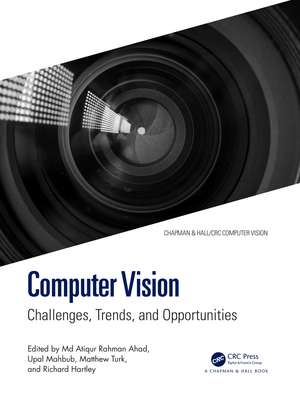
Computer Vision: Challenges, Trends, and Opportunities: Chapman & Hall/CRC Computer Vision
Editat de Md Atiqur Rahman Ahad, Upal Mahbub, Matthew Turk, Richard Hartleyen Limba Engleză Hardback – 30 iul 2024
This book highlights various core challenges as well as solutions by leading researchers in the field. It covers such important topics as data-driven AI, biometrics, digital forensics, healthcare, robotics, entertainment and XR, autonomous driving, sports analytics, and neuromorphic computing, covering both academic and industry R&D perspectives. Providing a mix of breadth and depth, this book will have an impact across the fields of computer vision, imaging, and AI.
Computer Vision: Challenges, Trends, and Opportunities covers timely and important aspects of computer vision and its applications, highlighting the challenges ahead and providing a range of perspectives from top researchers around the world. A substantial compilation of ideas and state-of-the-art solutions, it will be of great benefit to students, researchers, and industry practitioners.
Preț: 1086.86 lei
Preț vechi: 1358.57 lei
-20%
Puncte Express: 1630
Carte disponibilă
Livrare economică 05-19 noiembrie
Livrare express 21-27 octombrie pentru 57.82 lei
Livrare prin curier în România Termenul estimat este afișat lângă disponibilitate.
Transport gratuit pentru acest produs Plată online sau ramburs, în funcție de opțiunile comenzii.
Retur gratuit în 14 zile Comandă securizată și suport în română.
Specificații
ISBN-13: 9781032317052
ISBN-10: 1032317051
Pagini: 360
Ilustrații: 308
Dimensiuni: 210 x 280 x 24 mm
Greutate: 1.16 kg
Ediția:1
Editura: CRC Press
Colecția Chapman and Hall/CRC
Seria Chapman & Hall/CRC Computer Vision
Locul publicării:Boca Raton, United States
ISBN-10: 1032317051
Pagini: 360
Ilustrații: 308
Dimensiuni: 210 x 280 x 24 mm
Greutate: 1.16 kg
Ediția:1
Editura: CRC Press
Colecția Chapman and Hall/CRC
Seria Chapman & Hall/CRC Computer Vision
Locul publicării:Boca Raton, United States
V-ar putea interesa
-
 Foundations of Computer VisionAntonio Torralba-25%Preț: 618.65 lei823.02 lei
 -
 Driving Intelligence: The Green Book: Routes to AutonomyJ. Mark Bishop-20%Preț: 297.95 lei372.44 lei
 -
 -20%Preț: 1153.31 lei1441.65 lei
 -
 Machine Vision - How Algorithms are Changing the Way We See the WorldJill Walker RettbergPreț: 139.26 lei
 -
 Computer Vision Research ProgressZhongkai Zhu-35%Preț: 789.25 lei1213.40 lei
 -
 Computer VisionSota R Yoshida-35%Preț: 1530.00 lei2369.66 lei
 -
 Deep Learning Crash CourseGiovanni Volpe-35%Preț: 290.84 lei445.88 lei
 -
 Advances in AI for Cloud, Edge, and Mobile Computing ApplicationsShrikaant Kulkarni-20%Preț: 1296.62 lei1620.78 lei
 -
 -5%Preț: 405.75 lei427.11 lei
 -
 Computer VisionRichard Szeliski-20%Preț: 445.89 lei557.35 lei
 -
 Advances in Computational Vision and RoboticsGeorge A. Tsihrintzis-18%Preț: 1342.60 lei1637.32 lei
 -
 -20%Preț: 1173.91 lei1467.39 lei
 -
 High Performance Vision IntelligenceAparajita Nanda-20%Preț: 612.21 lei765.26 lei
 -
 Computer Vision and RoboticsPraveen Kumar Shukla-24%Preț: 1475.69 lei1941.69 lei
 -
 -5%Preț: 1240.38 lei1305.66 lei
 -
 Machine Vision and Augmented IntelligenceKoushlendra Kumar Singh-20%Preț: 1161.23 lei1451.54 lei
 -
 Deep Learning and Visual Artificial IntelligenceVishal Goar-20%Preț: 1415.96 lei1769.95 lei
 -
 Computer Vision, Pattern Recognition, Image Processing, and GraphicsSantanu Chaudhury-20%Preț: 644.26 lei805.32 lei
 -
 -20%Preț: 1411.50 lei1764.38 lei
Public țintă
Postgraduate and ProfessionalCuprins
Foreword by Takeo Kanade
1 Some Challenges and Solutions in Data-Driven AI
Rama Chellappa, Jiang Liu, Chun Pong Lau, and Prithviraj Dhar
2 Challenges of Computer Vision Research from an Industry Perspective
Fatih Porikli
3 Soft Biometrics for Human Identication
Mark S. Nixon and Emad Sami Jaha
4 Exploring Causes of Demographic Variations in Face Recognition Accuracy
Gabriella Pangelinan, K.S. Krishnapriya, Vitor Albiero, Grace Bezold, Kai Zhang, Kushal Vangara,
Michael C. King, and Kevin W. Bowyer
5 AI Knows What You Did Last Summer: Applications in Digital Forensics
Jing Yang, José Nascimento, Gabriel Bertocco, Antonio Theophilo, Rafael Padilha, Aurea Soriano-Vargas, Fernanda A. Andaló, and Anderson Rocha
6 Advances in Computer Vision for Home-Based Stroke Rehabilitation
7 U-Net-based Medical Image Segmentation: A Comparative Analysis and Future Trends
Sidike Paheding, Abel A. Reyes-Angulo, and Mohammad S. Alam
8 Robot-Mediated Assistance: Opportunities and Challenges in Computer Vision and Human—Robot Interaction
Md Alimoor Reza and Syed Masum Billah
9 Computer Vision Applications in Underwater Robotics and Oceanography
Md Jahidul Islam, Alberto Quattrini Li, Yogesh A Girdhar, and Ioannis Rekleitis
10 Applications of Computer Vision in Entertainment and Media Industry
Mahmudul Hasan, Kishan Shamsundar Athrey, Arfeen Khalid, Danfeng Xie, Ehsan Younessian, and Tony Braskich
11 Quality Assessment in Media and Entertainment: Challenges and Trends
Abhinau K. Venkataramanan, Zaixi Shang, Joshua P. Ebenezer, Meixu Chen, Zhengzhong Tu, and Alan C. Bovik
12 Immersive User Experiences: Trends and Challenges of Using XR Technologies
Vasudev Bhaskaran and Upal Mahbub
Kowshik Thopalli, Niccolo Meniconi, Tamim Ahmed, Sai Krishna Yeshala, Aisling Kelliher, Thanassis Rikakis, and Pavan Turaga
13 Multi-camera Bird's Eye View Perception for Autonomous Driving
David Unger, Nikhil Gosala, Varun Ravi Kumar, Shubhankar Borse, Abhinav Valada, and Senthil Yogamani
14 The (Computer) Vision of Sports: Recent Trends in Research and Commercial Systems for Sport Analytics
Rikke Gade, Michele Merler, Graham Thomas, and Thomas B. Moeslund
15 Spike-Based Neuromorphic Computing for Next-Generation Computer Vision
Md Sakib Hasan, Catherine D. Schuman, Zhongyang Zhang, Tauhidur Rahman, and Garrett S. Rose
1 Some Challenges and Solutions in Data-Driven AI
Rama Chellappa, Jiang Liu, Chun Pong Lau, and Prithviraj Dhar
2 Challenges of Computer Vision Research from an Industry Perspective
Fatih Porikli
3 Soft Biometrics for Human Identication
Mark S. Nixon and Emad Sami Jaha
4 Exploring Causes of Demographic Variations in Face Recognition Accuracy
Gabriella Pangelinan, K.S. Krishnapriya, Vitor Albiero, Grace Bezold, Kai Zhang, Kushal Vangara,
Michael C. King, and Kevin W. Bowyer
5 AI Knows What You Did Last Summer: Applications in Digital Forensics
Jing Yang, José Nascimento, Gabriel Bertocco, Antonio Theophilo, Rafael Padilha, Aurea Soriano-Vargas, Fernanda A. Andaló, and Anderson Rocha
6 Advances in Computer Vision for Home-Based Stroke Rehabilitation
7 U-Net-based Medical Image Segmentation: A Comparative Analysis and Future Trends
Sidike Paheding, Abel A. Reyes-Angulo, and Mohammad S. Alam
8 Robot-Mediated Assistance: Opportunities and Challenges in Computer Vision and Human—Robot Interaction
Md Alimoor Reza and Syed Masum Billah
9 Computer Vision Applications in Underwater Robotics and Oceanography
Md Jahidul Islam, Alberto Quattrini Li, Yogesh A Girdhar, and Ioannis Rekleitis
10 Applications of Computer Vision in Entertainment and Media Industry
Mahmudul Hasan, Kishan Shamsundar Athrey, Arfeen Khalid, Danfeng Xie, Ehsan Younessian, and Tony Braskich
11 Quality Assessment in Media and Entertainment: Challenges and Trends
Abhinau K. Venkataramanan, Zaixi Shang, Joshua P. Ebenezer, Meixu Chen, Zhengzhong Tu, and Alan C. Bovik
12 Immersive User Experiences: Trends and Challenges of Using XR Technologies
Vasudev Bhaskaran and Upal Mahbub
Kowshik Thopalli, Niccolo Meniconi, Tamim Ahmed, Sai Krishna Yeshala, Aisling Kelliher, Thanassis Rikakis, and Pavan Turaga
13 Multi-camera Bird's Eye View Perception for Autonomous Driving
David Unger, Nikhil Gosala, Varun Ravi Kumar, Shubhankar Borse, Abhinav Valada, and Senthil Yogamani
14 The (Computer) Vision of Sports: Recent Trends in Research and Commercial Systems for Sport Analytics
Rikke Gade, Michele Merler, Graham Thomas, and Thomas B. Moeslund
15 Spike-Based Neuromorphic Computing for Next-Generation Computer Vision
Md Sakib Hasan, Catherine D. Schuman, Zhongyang Zhang, Tauhidur Rahman, and Garrett S. Rose
Recenzii
“This book contains fifteen chapters written by academic leaders and seasoned industrial practitioners of Computer Vision. They cover the diversity of today’s application areas. Each chapter presents a comprehensive overview of existing systems and state of the art methodologies as well as future trends. This timely book will be enjoyed by today’s researchers, practitioners, and students of Computer Vision.” --Takeo Kanade, U. A. and Helen Whitaker University Professor, Carnegie Mellon University
Notă biografică
Md Atiqur Rahman Ahad, Ph.D., Senior Member, IEEE, Senior Member, OPTICA (formerly OSA), is a Professor of Electrical & Electronic Engineering, University of Dhaka (DU). He is currently working as a specially appointed Associate Professor at Osaka University, Japan. He works on computer vision, imaging, IoT, healthcare, etc. He was awarded the prestigious UGC Gold Medal (handed by Honorable President of Bangladesh in 2018), JSPS Postdoctoral Fellowship, and a no. of awards/scholarships. He was a Visiting Researcher at KIT. He has published over ten books and ~200 journal articles, conference papers and book chapters. He has received ~40 international awards in various conferences/journals/societies. Ahad was invited as keynote/invited speakers ~110 times in different conferences/universities. He has established several international MOU/collaborations (e.g., Clemson University, University of Hyogo, RCCIIT, Fukuoka Women University, Kyushu University, etc.). Website: http://ahadVisionLab.com
Upal Mahbub, Ph.D., Senior Member IEEE, is currently working as a Senior Engineer at the Multimedia R&D Lab at Qualcomm Technologies Inc., San Diego, California, USA. He received his Ph.D. (2018) and an M.Sc. (2017) degrees in Electrical and Computer Engineering from the University of Maryland College Park. Before joining the Ph.D. program, Dr. Mahbub was an Assistant Professor at the Dept. of EEE, Bangladesh University of Engineering and Technology, Dhaka, Bangladesh. Upal Mahbub is the recipient of the best paper award at IEEE UEMCON 2016, the best poster award at BTAS 2016, the best paper award at ICCIT 2011, and a distinguished graduate fellowship from the A. James Clark School of Engineering at the University of Maryland. He has published over thirty articles in international conferences and prestigious journals, recently published an edited book entitled “Contactless Human Activity Analysis”, served as editor in international journals (guest editor of PRL special issue AHAAGR 2021, associate editor of IJCVSP), presented his research at numerous conferences, and served in the technical and/or program committees of ICIEV (2012-2021), IVPR (track chair 202, program chair 2021), ICECE (2010 & 2012), and ABC (2019, 2020, 2021).
Matthew Turk, Ph.D., Fellow, IEEE; Fellow, Fellow IAPR, is the President of the Toyota Technological Institute at Chicago (TTIC) and an emeritus professor in computer science at the University of California, Santa Barbara, where he co-directed the UCSB Four Eyes Lab. He received a PhD from the Massachusetts Institute of Technology. He has worked at Martin Marietta Aerospace, LIFIA/ENSIMAG (Grenoble, France), Teleos Research, and Microsoft Research, where he was a founder of the Vision Technology Group. He has served as General or Program Chair of several major conferences, including the ACM Multimedia Conference, the IEEE Conference on Automatic Face and Gesture Recognition, the ACM International Conference on Multimodal Interaction, the IEEE Conference on Computer Vision and Pattern Recognition, and the IEEE Winter Conference on Applications of Computer Vision. He co-founded an augmented reality startup company in 2014 that was acquired by PTC Vuforia in 2016. Dr. Turk has received several best paper awards, and he is an ACM Fellow, an IEEE Fellow, an IAPR Fellow, and the recipient of the 2011-2012 Fulbright-Nokia Distinguished Chair in Information and Communications Technologies.
Richard Hartley, Ph.D., Fellow, IEEE; Fellow, Australian Academy of Science; Fellow, Australian Mathematical Society, is a member of the computer vision group in the Department of Information Engineering, at the Australian National University, where he has been since January 2001. He did his doctoral research in Mathematics at the University of Toronto, Canada in 1976. He also received an MSc in Mathematics from the same university in 1972 and another MSc in Computer Science from Stanford University in 1985. Dr. Hartley worked at the General Electric Research and Development Center from 1985 to 2001. During the period 1985-1988, he was involved in the design and implementation of Computer-Aided Design tools for electronic design and created a very successful design system called the Parsifal Silicon Compiler. In 1991 he was awarded GE's Dushman Award for this work.
Upal Mahbub, Ph.D., Senior Member IEEE, is currently working as a Senior Engineer at the Multimedia R&D Lab at Qualcomm Technologies Inc., San Diego, California, USA. He received his Ph.D. (2018) and an M.Sc. (2017) degrees in Electrical and Computer Engineering from the University of Maryland College Park. Before joining the Ph.D. program, Dr. Mahbub was an Assistant Professor at the Dept. of EEE, Bangladesh University of Engineering and Technology, Dhaka, Bangladesh. Upal Mahbub is the recipient of the best paper award at IEEE UEMCON 2016, the best poster award at BTAS 2016, the best paper award at ICCIT 2011, and a distinguished graduate fellowship from the A. James Clark School of Engineering at the University of Maryland. He has published over thirty articles in international conferences and prestigious journals, recently published an edited book entitled “Contactless Human Activity Analysis”, served as editor in international journals (guest editor of PRL special issue AHAAGR 2021, associate editor of IJCVSP), presented his research at numerous conferences, and served in the technical and/or program committees of ICIEV (2012-2021), IVPR (track chair 202, program chair 2021), ICECE (2010 & 2012), and ABC (2019, 2020, 2021).
Matthew Turk, Ph.D., Fellow, IEEE; Fellow, Fellow IAPR, is the President of the Toyota Technological Institute at Chicago (TTIC) and an emeritus professor in computer science at the University of California, Santa Barbara, where he co-directed the UCSB Four Eyes Lab. He received a PhD from the Massachusetts Institute of Technology. He has worked at Martin Marietta Aerospace, LIFIA/ENSIMAG (Grenoble, France), Teleos Research, and Microsoft Research, where he was a founder of the Vision Technology Group. He has served as General or Program Chair of several major conferences, including the ACM Multimedia Conference, the IEEE Conference on Automatic Face and Gesture Recognition, the ACM International Conference on Multimodal Interaction, the IEEE Conference on Computer Vision and Pattern Recognition, and the IEEE Winter Conference on Applications of Computer Vision. He co-founded an augmented reality startup company in 2014 that was acquired by PTC Vuforia in 2016. Dr. Turk has received several best paper awards, and he is an ACM Fellow, an IEEE Fellow, an IAPR Fellow, and the recipient of the 2011-2012 Fulbright-Nokia Distinguished Chair in Information and Communications Technologies.
Richard Hartley, Ph.D., Fellow, IEEE; Fellow, Australian Academy of Science; Fellow, Australian Mathematical Society, is a member of the computer vision group in the Department of Information Engineering, at the Australian National University, where he has been since January 2001. He did his doctoral research in Mathematics at the University of Toronto, Canada in 1976. He also received an MSc in Mathematics from the same university in 1972 and another MSc in Computer Science from Stanford University in 1985. Dr. Hartley worked at the General Electric Research and Development Center from 1985 to 2001. During the period 1985-1988, he was involved in the design and implementation of Computer-Aided Design tools for electronic design and created a very successful design system called the Parsifal Silicon Compiler. In 1991 he was awarded GE's Dushman Award for this work.
Descriere
The book highlights various core challenges, constructive criticism, and solutions by leading researchers in the field. It covers timely and important aspects of computer vision and its applications, highlighting the challenges ahead and providing a range of perspectives, from top researchers around the world.