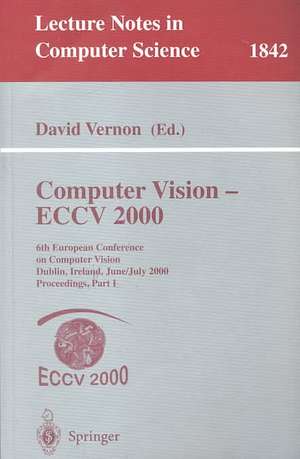
Computer Vision - ECCV 2000: 6th European Conference on Computer Vision Dublin, Ireland, June 26 - July 1, 2000 Proceedings, Part I: Lecture Notes in Computer Science, cartea 1842
Editat de David Vernonen Limba Engleză Paperback – 19 iun 2000
Din seria Lecture Notes in Computer Science
- 20%
 Preț: 558.53 lei
 - 20%
 Preț: 571.88 lei
 - 20%
 Preț: 675.83 lei
 - 20%
 Preț: 1020.28 lei
 - 20%
 Preț: 620.33 lei
 - 20%
 Preț: 560.93 lei
 - 20%
 Preț: 633.70 lei
 - 20%
 Preț: 731.82 lei
 - 20%
 Preț: 1359.66 lei
 - 20%
 Preț: 560.93 lei
 - 20%
 Preț: 733.68 lei
 - 20%
 Preț: 828.44 lei
 - 15%
 Preț: 558.12 lei
 - 20%
 Preț: 793.92 lei
 - 20%
 Preț: 560.93 lei
 - 20%
 Preț: 748.63 lei
 - 20%
 Preț: 562.49 lei
 - 20%
 Preț: 1246.46 lei
 - 20%
 Preț: 449.81 lei
 - 20%
 Preț: 556.96 lei
 - 20%
 Preț: 562.49 lei
 - 20%
 Preț: 851.78 lei
 - 20%
 Preț: 313.10 lei
 - 18%
 Preț: 945.44 lei
 - 20%
 Preț: 314.86 lei
 - 20%
 Preț: 560.93 lei
 - 20%
 Preț: 606.22 lei
 - 20%
 Preț: 1033.45 lei
 - 20%
 Preț: 563.29 lei
 - 20%
 Preț: 733.68 lei
 - 20%
 Preț: 1137.10 lei
 - 20%
 Preț: 735.28 lei
 - 20%
 Preț: 1079.23 lei
 - 20%
 Preț: 584.42 lei
 - 20%
 Preț: 854.16 lei
 - 15%
 Preț: 672.87 lei
 - 20%
 Preț: 1032.47 lei
 - 20%
 Preț: 617.17 lei
 - 20%
 Preț: 1022.15 lei
 - 20%
 Preț: 984.64 lei
 - 20%
 Preț: 620.33 lei
 - 20%
 Preț: 402.28 lei
 - 20%
 Preț: 316.28 lei
 - 20%
 Preț: 663.69 lei
 - 20%
 Preț: 320.24 lei
 - 20%
 Preț: 343.12 lei
 - 20%
 Preț: 313.87 lei
Preț: 652.70 lei
Preț vechi: 815.88 lei
-20%
Puncte Express: 979
Carte tipărită la comandă
Livrare economică 02-16 decembrie
Livrare prin curier în România Termenul estimat este afișat lângă disponibilitate.
Transport gratuit pentru acest produs Plată online sau ramburs, în funcție de opțiunile comenzii.
Retur gratuit în 14 zile Comandă securizată și suport în română.
Specificații
ISBN-13: 9783540676850
ISBN-10: 3540676856
Pagini: 955
Ilustrații: XXXVI, 955 p.
Dimensiuni: 155 x 235 x 38 mm
Greutate: 1.34 kg
Ediția:2000
Editura: Springer Berlin, Heidelberg
Colecția Springer
Seria Lecture Notes in Computer Science
Locul publicării:Berlin, Heidelberg, Germany
ISBN-10: 3540676856
Pagini: 955
Ilustrații: XXXVI, 955 p.
Dimensiuni: 155 x 235 x 38 mm
Greutate: 1.34 kg
Ediția:2000
Editura: Springer Berlin, Heidelberg
Colecția Springer
Seria Lecture Notes in Computer Science
Locul publicării:Berlin, Heidelberg, Germany
V-ar putea interesa
-
 Foundations of Computer VisionAntonio Torralba-25%Preț: 619.01 lei823.02 lei
 -
 Computer Vision: Challenges, Trends, and OpportunitiesMd Atiqur Rahman Ahad-20%Preț: 1086.86 lei1358.57 lei
 -
 -20%Preț: 1153.31 lei1441.65 lei
 -
 Computer Vision Research ProgressZhongkai Zhu-35%Preț: 789.25 lei1213.40 lei
 -
 Computer VisionRichard Szeliski-20%Preț: 445.89 lei557.35 lei
 -
 Handbook of Image Processing and Computer VisionArcangelo Distante-20%Preț: 1471.45 lei1839.31 lei
 -
 Preț: 434.53 lei
 -
 Computer Analysis of Images and PatternsModesto Castrillón-Santana-20%Preț: 327.69 lei409.62 lei
 -
 -20%Preț: 534.25 lei667.82 lei
 -
 -20%Preț: 327.54 lei409.42 lei
 -
 -20%Preț: 637.64 lei797.05 lei
 -
 -20%Preț: 335.91 lei419.89 lei
 -
 -20%Preț: 632.89 lei791.11 lei
 -
 -20%Preț: 325.79 lei407.24 lei
 -
 -20%Preț: 1015.83 lei1269.78 lei
 -
 -20%Preț: 322.61 lei403.26 lei
 -
 Computer Vision and GraphicsLeonard Bolc-20%Preț: 346.30 lei432.88 lei
 -
 Computer VisionRoberto Cipolla-20%Preț: 1280.88 lei1601.11 lei
 -
 Computer Vision, Pattern Recognition, Image Processing, and GraphicsSantanu Chaudhury-20%Preț: 644.26 lei805.32 lei
Public țintă
ResearchCuprins
Recognition & Modelling I.- Non-linear Bayesian Image Modelling.- Unsupervised Learning of Models for Recognition.- Learning over Multiple Temporal Scales in Image Databases.- Colour Image Retrieval and Object Recognition Using the Multimodal Neighbourhood Signature.- Stereoscopic Vision.- Approximate N-View Stereo.- A Minimal Set of Constraints for the Trifocal Tensor.- Intrinsic Images for Dense Stereo Matching with Occlusions.- Recognition & Modelling / Stereoscopic Vision / Texture, Shading, & Colour.- Local Scale Selection for Gaussian Based Description Techniques.- Anti-Faces for Detection.- Combining Elastic and Statistical Models of Appearance Variation.- Object Recognition Using Coloured Receptive Fields.- Learning Similarity for Texture Image Retrieval.- Parametric View-Synthesis.- Least Committment Graph Matching by Evolutionary Optimisation.- Predicting Disparity Windows for Real-Time Stereo.- On the Estimation of the Fundamental Matrix: A Convex Approach to Constrained Least-Squares.- Velocity-Guided Tracking of Deformable Contours in Three Dimensional Space.- Model Based Pose Estimator Using Linear-Programming.- Measuring the Self-Consistency of Stereo Algorithms.- Log-Polar Stereo for Anthropomorphic Robots.- Contour-Based Correspondence for Stereo.- Color and Scale: The Spatial Structure of Color Images.- Constrained Dichromatic Colour Constancy.- Objective Colour from Multispectral Imaging.- Colour by Correlation in a Three-Dimensional Colour Space.- Improvements to Gamut Mapping Colour Constancy Algorithms.- Gray Scale and Rotation Invariant Texture Classification with Local Binary Patterns.- Adapting Spectral Scale for Shape from Texture.- Recognition & Modelling II.- Learning to Recognize 3D Objects with SNoW.- Region-Based Object Recognition Using Shape-from-Shading.- Recognizing Walking People.- A Probabilistic Sensor for the Perception and the Recognition of Activities.- Structure from Motion I.- Homography Tensors: On Algebraic Entities ThatRepresent Three Views of Static or Moving Planar Points.- Plane + Parallax, Tensors and Factorization.- Factorization with Uncertainty.- Estimating the Jacobian of the Singular Value Decomposition: Theory and Applications.- Shape.- Diffeomorphic Matching Problems in One Dimension: Designing and Minimizing Matching Functionals.- Level Sets and Distance Functions.- Divergence-Based Medial Surfaces.- Structure from Motion / Shape / Image Features.- 3D Reconstruction from Tangent-of-Sight Measurements of a Moving Object Seen from a Moving Camera.- A Six Point Solution for Structure and Motion.- Reconstruction from Uncalibrated Sequences with a Hierarchy of Trifocal Tensors.- Characterizing Depth Distortion Due to Calibration Uncertainty.- On Calibration and Reconstruction from Planar Curves.- How Does CONDENSATION Behave with a Finite Number of Samples?.- On the Structure and Properties of the Quadrifocal Tensor.- Geotensity Constraint for 3D Surface Reconstruction under Multiple Light Sources.- Noise-Resistant Affine Skeletons of Planar Curves.- Shape and Radiance Estimation from the Information Divergence of Blurred Images.- Surface Matching with Large Deformations and Arbitrary Topology: A Geodesic Distance Evolution Scheme on a 3-Manifold.- Duals, Invariants, and the Recognition of Smooth Objects from Their Occluding Contour.- On Utilising Template and Feature-based Correspondence in Multi-view Appearance Models.- Wide Baseline Point Matching Using Affine Invariants Computed from Intensity Profiles.- Determining Correspondences for Statistical Models of Appearance.- Approximation and Processing of Intensity Images with Discontinuity-Preserving Adaptive Triangular Meshes.- Scale Dependent Differential Geometry for the Measurement of Center Line and Diameter in 3D Curvilinear Structures.- Fast Selective Detection of Rotational Symmetries Using Normalized Inhibition.- Structure from Motion II.- Multibody Structure and Motion: 3-D Reconstruction of Independently MovingObjects.- Integrating Local Affine into Global Projective Images in the Joint Image Space.- Ambiguous Configurations for 3-View Projective Reconstruction.- On the Reprojection of 3D and 2D Scenes without Explicit Model Selection.