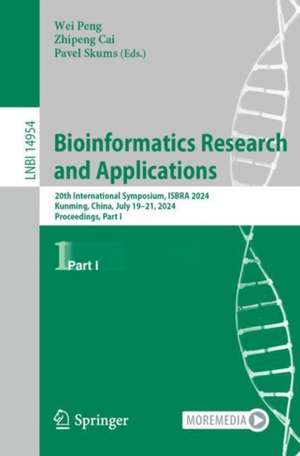
Bioinformatics Research and Applications: Lecture Notes in Computer Science, cartea 14954
Editat de Wei Peng, Zhipeng Cai, Pavel Skumsen Limba Engleză Paperback – 12 iul 2024
Recomandăm acest volum studenților la masterat și doctorat, cercetătorilor în bioinformatică și practicienilor din industria biotehnologică ce urmăresc implementarea algoritmilor de ultimă oră în fluxuri de lucru reale. Bioinformatics Research and Applications, editat de Wei Peng, Zhipeng Cai și Pavel Skums, reprezintă actele oficiale ale celui de-al 20-lea Simpozion Internațional ISBRA 2024. Această ediție marchează un punct de maturitate pentru disciplina care integrează biologia computațională cu inteligența artificială aplicată.
Observăm o structură riguroasă a celor 93 de lucrări, care progresează de la analiza datelor de secvențiere la nivel de celulă unică (scRNA-seq) până la optimizări hardware critice, precum proiectul RabbitTrim pentru platforme multi-core. Această abordare tehnică completează perspectiva oferită de Intelligent Computing Theories and Application, adăugând o specializare profundă pe zona de biologie moleculară și histopatologie pe care volumul generalist de computație inteligentă o tratează doar tangențial. Totodată, lucrarea se distinge de Research in Computational Molecular Biology prin accentul pus pe aplicațiile clinice imediate, cum ar fi utilizarea FedKD-DTI pentru interacțiunea medicament-țintă prin învățare federată.
Editorul Zhipeng Cai continuă linia de cercetare începută în lucrări precum AI 2017: Advances in Artificial Intelligence, însă aici metodologiile de tip Graph Attention Networks și Knowledge Transfer sunt calibrate specific pentru provocările biologice. Remarcăm prezența unor soluții pentru platforme eterogene CPU-GPU, indicând o orientare clară către eficiența computațională necesară în procesarea volumelor masive de date genomice actuale. Ediția 2024 din seria Lecture Notes in Computer Science reușește să ofere nu doar teorie, ci și instrumente software optimizate pentru cercetarea contemporană.
Din seria Lecture Notes in Computer Science
- 20%
 Preț: 558.53 lei
 - 20%
 Preț: 617.17 lei
 - 20%
 Preț: 571.88 lei
 - 20%
 Preț: 1020.28 lei
 - 20%
 Preț: 851.78 lei
 - 20%
 Preț: 560.93 lei
 - 20%
 Preț: 633.70 lei
 - 20%
 Preț: 675.83 lei
 - 20%
 Preț: 1359.66 lei
 - 20%
 Preț: 620.33 lei
 - 20%
 Preț: 733.68 lei
 - 18%
 Preț: 945.44 lei
 - 15%
 Preț: 558.12 lei
 - 20%
 Preț: 793.92 lei
 - 20%
 Preț: 560.93 lei
 - 20%
 Preț: 748.63 lei
 - 20%
 Preț: 562.49 lei
 - 20%
 Preț: 1032.47 lei
 - 20%
 Preț: 731.82 lei
 - 20%
 Preț: 556.96 lei
 - 20%
 Preț: 1022.15 lei
 - 20%
 Preț: 562.49 lei
 - 20%
 Preț: 560.93 lei
 - 20%
 Preț: 313.10 lei
 - 20%
 Preț: 828.44 lei
 - 20%
 Preț: 560.93 lei
 - 20%
 Preț: 314.86 lei
 - 20%
 Preț: 1033.45 lei
 - 20%
 Preț: 563.29 lei
 - 20%
 Preț: 733.68 lei
 - 20%
 Preț: 1137.10 lei
 - 20%
 Preț: 735.28 lei
 - 20%
 Preț: 1079.23 lei
 - 20%
 Preț: 584.42 lei
 - 20%
 Preț: 854.16 lei
 - 15%
 Preț: 672.87 lei
 - 20%
 Preț: 606.22 lei
 - 20%
 Preț: 1246.46 lei
 - 20%
 Preț: 449.81 lei
 - 20%
 Preț: 984.64 lei
 - 20%
 Preț: 620.33 lei
 - 20%
 Preț: 402.28 lei
 - 20%
 Preț: 316.28 lei
 - 20%
 Preț: 663.69 lei
 - 20%
 Preț: 320.24 lei
 - 20%
 Preț: 343.12 lei
 - 20%
 Preț: 313.87 lei
Preț: 631.20 lei
Preț vechi: 742.59 lei
-15%
Carte disponibilă
Livrare economică 07-21 noiembrie
Specificații
ISBN-10: 9819751276
Pagini: 540
Ilustrații: XXII, 511 p. 178 illus., 168 illus. in color.
Dimensiuni: 155 x 235 x 29 mm
Greutate: 0.81 kg
Ediția:2024
Editura: Springer
Colecția Lecture Notes in Computer Science
Seria Lecture Notes in Computer Science
Locul publicării:Singapore, Singapore
V-ar putea interesa
-
 Sabiston Textbook of Surgery: The Biological Basis of Modern Surgical PracticeDouglas Scott Tyler-29%Preț: 1168.66 lei1644.95 leiRecomandat
 -
 -9%Preț: 1453.19 lei1596.91 lei
 -
 Recent Developments in Microbiology, Biotechnology and Pharmaceutical SciencesB. Sundaravadivazhagan-5%Preț: 538.56 lei566.91 lei
 -
 Multimodal Data Fusion for Bioinformatics AIAbhishek Kumar-23%Preț: 1298.27 lei1686.06 lei
 -
 -5%Preț: 1373.96 lei1446.27 lei
 -
 -18%Preț: 771.93 lei941.37 lei
 -
 Deep Learning Crash CourseGiovanni Volpe-35%Preț: 290.92 lei445.81 lei
 -
 Bioinformatics and Biomedical EngineeringIgnacio Rojas-18%Preț: 740.15 lei902.62 lei
 -
 Information Management and Big DataJuan Antonio Lossio-Ventura-20%Preț: 792.54 lei990.68 lei
 -
 Advances in Intelligent Disease Diagnosis and TreatmentChee-Peng Lim-20%Preț: 1236.64 lei1545.80 lei
 -
 -20%Preț: 491.85 lei614.82 lei
 -
 Computational Intelligence in Data ScienceMieczyslaw Lech Owoc-20%Preț: 694.32 lei867.90 lei
 -
 -20%Preț: 317.08 lei396.35 lei
 -
 -20%Preț: 1173.91 lei1467.39 lei
 -
 Machine Learning in Protein ScienceJinjin Li-23%Preț: 778.57 lei1011.12 lei
 -
 -20%Preț: 662.85 lei828.56 lei
 -
 Preț: 387.82 lei
 -
 Data Science and ApplicationsSatyasai Jagannath Nanda-18%Preț: 1327.69 lei1619.13 lei
 -
 -5%Preț: 1240.38 lei1305.66 lei
 -
 Federated LearningMei Kobayashi-20%Preț: 932.57 lei1165.71 lei
 -
 -5%Preț: 1451.35 lei1527.74 lei
 -
 Multiobjective Optimization Algorithms for BioinformaticsAnirban Mukhopadhyay-20%Preț: 1064.17 lei1330.21 lei
 -
 Intelligent InformaticsSankar K. Pal-18%Preț: 1451.44 lei1770.05 lei
 -
 -20%Preț: 1648.37 lei2060.47 lei
 -
 ICT for Intelligent SystemsJyoti Choudrie-20%Preț: 1413.59 lei1766.98 lei
 -
 Computational Modeling and Sustainable EnergyBrajesh Kumar Jha-20%Preț: 1435.30 lei1794.12 lei
 -
 Proceedings of Second International Conference on Intelligent SystemJoão Manuel R. S. Tavares-24%Preț: 1325.22 lei1743.71 lei
 -
 Fourth Congress on Intelligent SystemsSandeep Kumar-20%Preț: 1331.31 lei1664.13 lei
 -
 -18%Preț: 1179.90 lei1438.89 lei
De ce să citești această carte
Cercetătorii și inginerii software din domeniul medical vor găsi în acest volum soluții concrete pentru optimizarea alinierii secvențelor genomice și modele avansate de Deep Learning pentru predicția interacțiunilor moleculare. Cartea oferă acces la cele mai noi metodologii validate de experți internaționali la ISBRA 2024, fiind o resursă esențială pentru cei care dezvoltă instrumente de diagnosticare bazate pe AI și histopatologie digitală.
Descriere scurtă
The 93 full papers included in this book were carefully reviewed and selected from 236 submissions. The symposium provides a forum for the exchange of ideas and results among researchers, developers, and practitioners working on all aspects of bioinformatics and computational biology and their applications.
Cuprins
.- MSMK: Multiscale module kernel for identifying disease-related genes.
.- Flat and Nested Protein Name Recognition Based on BioBERT and Biaffine Decoder.
.- RFIR: A Lightweight Network for Retinal Fundus Image Restoration.
.- Gaussian Beltrami-Klein Model for Protein Sequence Classification: A Hyperbolic Approach.
.- stEnTrans: Transformer-based deep learning for spatial transcriptomics enhancement.
.- Contrastive Masked Graph Autoencoders for Spatial Transcriptomics Data Analysis.
.- Spatial gene expression prediction from histology images with STco.
.- Exploration and Visualization Methods for Chromatin Interaction Data.
.- A Geometric Algorithm for Blood Vessel Reconstruction from Skeletal Representation.
.- UFGOT: unbalanced filter graph alignment with optimal transport for cancer subtyping based on multi-omics data.
.- Dendritic SE-ResNet Learning for Bioinformatic Classification.
.- GSDRP: Fusing Drug Sequence Features with Graph Features to Predict Drug Response.
.- CircMAN: Multi-channel Attention Networks Based on Feature Fusion for CircRNA-binding Site Prediction.
.- Machine Learning-Driven Discovery of Quadruple-Negative Breast Cancer Subtypes from Gene Expression Data.
.- A novel Combined Embedding Model based on Heterogeneous Network for Inferring Microbe-Metabolite Interactions.
.- Central Feature Network Enables Accurate Detection of Both Small and Large Particles in Cryo-Electron Tomography.
.- LncRNA-disease association prediction based on integrated application of matrix decomposition and graph contrastive learning.
.- Predictive Score-Guided Mixup for Medical Text Classification.
.- CHASOS: A novel deep learning approach for chromatin loop predictions.
.- A deep metric learning based method for predicting miRNA-disease associations.
.- Learning an adaptive self-expressive fusion model for multi-omics cancer subtype prediction.
.- IFNet: An Image-Enhanced Cross-Modal Fusion Network for Radiology Report Generation.
.- Hybrid Attention Knowledge Fusion Network for Automated Medical Code Assignment.
.- Variable-length Promoter Strength Prediction based on Graph Convolution.
.- scMOGAE: A Graph Convolutional Autoencoder-Based Multi-omics Data Integration Framework for Single-Cell Clustering.
.- VM-UNET-V2: Rethinking Vision Mamba UNet for Medical Image Segmentation.
.- Fighting Fire with Fire: Medical AI Models Defend Against Backdoor Attacks via Self-Learning.
.- An In-depth Assessment of Sequence Clustering softares in Bioinformatics.
.- Novel Fine-tuning Strategy on Pre-trained Protein Model Enhances ACP functional Type Classfication.
.- Enhancing Privacy and Preserving Accuracy in Medical Image Classification with Limited Labeled Samples.
.- gaBERT: an Interpretable Pretrained Deep Learning Framework for Cancer Gene Marker Discovery.
.- Hybrid CNN and Low-Complexity Transformer Network with Attention-based Feature Fusion for Predicting Lung Cancer Tumor after Neoadjuvant Chemoimmunotherapy.
.- Deep Hyper-Laplacian Regularized Self-Representation Learning based Structured Association Analysis for Brain Imaging Genetics.
.- IntroGRN: Gene Regulatory Network Inference from single-cell RNA Data Based on Introspective VAE.
.- Identification of Potential SARS-CoV-2 Main Protease Inhibitors Using Drug Repurposing and Molecular Modeling.
.- An Ensemble Learning Model for Predicting Unseen TCR-Epitope Interactions.
.- Deep Learning Approach to Identify Protein’s Secondary Structure Elements.
.- Modeling single-cell ATAC- seq data based on contrastive learning.
.- Continuous Identification of Sepsis-Associated Acute Heart Failure Patients: An Integrated LSTM-Based Algorithm.
.- A novel approach for subtype identification via multi-omics data using adversarial autoencoder.