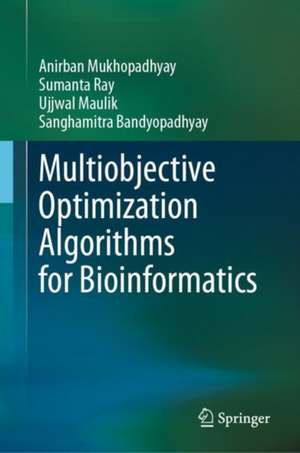
Multiobjective Optimization Algorithms for Bioinformatics
Autor Anirban Mukhopadhyay, Sumanta Ray, Ujjwal Maulik, Sanghamitra Bandyopadhyayen Limba Engleză Hardback – 29 mai 2024
Cititorul care a aplicat deja conceptele fundamentale din Multiobjective Genetic Algorithms for Clustering de Ujjwal Maulik va găsi în această nouă lucrare o extensie tehnică riguroasă, orientată spre provocări actuale din biologia computațională. În timp ce lucrările anterioare puneau bazele clustering-ului multiobiectiv, volumul de față, Multiobjective Optimization Algorithms for Bioinformatics, rafinează aceste metodologii pentru a aborda specificitatea datelor de expresie genetică și a rețelelor biologice complexe. Apreciem în mod deosebit modul în care autorii reușesc să integreze rigoarea matematică a algoritmilor genetici cu necesitățile practice ale mineritului de date biologice.
Structura cărții este una progresivă și aplicativă. Primele capitole stabilesc cadrul teoretic prin introducerea clustering-ului fuzzy și a agregării de rang, esențiale pentru prioritizarea genelor. Ulterior, progresia conținutului ne conduce către aplicații de o importanță critică în medicină, precum detecția markerilor MicroRNA asociați cancerului sau analiza rețelelor de interacțiune proteină-proteină în contextul HIV-1. Față de Multi-Objective Optimization de Jyotsna K. Mandal, care oferă o perspectivă largă asupra diverselor platforme de calcul, această lucrare se concentrează strict pe nișa bioinformaticii, oferind soluții concrete pentru predicția locațiilor subcelulare și detecția complexelor proteice.
Subliniem importanța notelor teoretice care însoțesc fiecare capitol, facilitând înțelegerea unor procese precum biclustering-ul multiobiectiv. Această abordare reflectă expertiza autorilor, vizibilă și în alte lucrări de referință precum Analysis of Biological Data: A Soft Computing Approach, însă aici accentul cade pe optimizarea simultană a mai multor funcții obiectiv, o necesitate în interpretarea datelor biologice ambigue și voluminoase.
Preț: 1007.00 lei
Preț vechi: 1258.75 lei
-20%
Carte disponibilă
Livrare economică 16-30 octombrie
Specificații
ISBN-10: 9819716306
Pagini: 238
Ilustrații: XV, 238 p. 56 illus., 49 illus. in color.
Dimensiuni: 155 x 235 mm
Greutate: 0.52 kg
Ediția:2024
Editura: Springer Nature Singapore
Colecția Springer
Locul publicării:Singapore, Singapore
V-ar putea interesa
-
 -39%Preț: 385.64 lei636.10 lei
 -
 Evolutionary Computing in Advanced ManufacturingManoj Tiwari-5%Preț: 939.67 lei989.13 lei
 -
 Understanding BioinformaticsMarketa Zvelebil-27%Preț: 745.07 lei1020.63 lei
 -
 -9%Preț: 1453.19 lei1596.91 lei
 -
 Bioinformatics and Functional GenomicsJonathan Pevsner-23%Preț: 823.39 lei1069.33 lei
 -
 -23%Preț: 1277.04 lei1658.50 lei
 -
 Data Clustering: Algorithms and ApplicationsCharu C. Aggarwal-9%Preț: 1139.23 lei1251.90 lei
 -
 Bioinformatics: A One Semester CourseKhalid SayoodPreț: 308.89 lei
 -
 Statistics for ScientistsUmberto Michelucci-20%Preț: 275.88 lei344.84 lei
 -
 Preț: 376.75 lei
 -
 -20%Preț: 662.85 lei828.56 lei
 -
 Preț: 371.20 lei
 -
 Evolutionary Computation, Machine Learning and Data Mining in BioinformaticsLeonardo VanneschiPreț: 340.18 lei
 -
 Soft Computing for Biological SystemsHemant J. Purohit-18%Preț: 956.95 lei1167.01 lei
 -
 Optimization Methods and AlgorithmsAnand J. Kulkarni-15%Preț: 559.55 lei658.30 lei
 -
 -15%Preț: 631.20 lei742.59 lei
 -
 Solving with BeesKhalid Raza-20%Preț: 1121.29 lei1401.61 lei
De ce să citești această carte
Recomandăm această lucrare cercetătorilor și studenților avansați care doresc să stăpânească algoritmii de optimizare multiobiectiv aplicați în bioinformatică. Cartea oferă un avantaj competitiv prin prezentarea unor soluții matematice pentru probleme reale, de la identificarea markerilor tumorali la modelarea interacțiunilor virale, transformând teoria algoritmilor genetici într-un instrument de diagnostic și analiză biologică de înaltă precizie.
Despre autor
Echipa de autori este formată din specialiști de renume în domeniul inteligenței computaționale. Ujjwal Maulik și Sanghamitra Bandyopadhyay sunt recunoscuți pentru contribuțiile lor fundamentale în soft computing și mineritul datelor biologice, având o experiență vastă în publicarea de studii de referință la edituri prestigioase precum Springer. Expertiza lor acoperă o arie largă, de la algoritmi evolutivi la modele generative profunde, fiind implicați activ în organizarea unor evenimente științifice internaționale majore în domeniul rezilienței sustenabile și al procesării imaginilor medicale.
Descriere scurtă
The book offers a valuable asset for a broad range of readers – from undergraduate to postgraduate, and as a textbook or reference work. Researchers and professionals can use the book not only to enrich their knowledge of multiobjective optimization and bioinformatics, but also as a comprehensive reference guide to applying and devising novel methods in bioinformatics and related domains.
Cuprins
Notă biografică
Dr. Sumanta Ray is currently an associate professor in the Department of Computer Science and Engineering at Ghani Khan Choudhury Institute of Engineering & Technology (GKCIET), Malda, India. He earned his PhD in Computer Science and Engineering from Jadavpur University in 2017. Dr. Ray received an ERCIM (European Research Consortium for Informatics and Mathematics) grant to pursue postdoctoral research at CENTRUM WISKUNDE and INFORMATICA (CWI), the Netherlands, from 2019 to 2020. He was a recipient of the DST Inspire Fellowship from the Government of India and also received the Senior Research Fellowship from CSIR (Council of Scientific and Industrial Research), MHRD, Government of India. Previously, Dr. Ray served as a Junior Professor at Universität Bielefeld, Bielefeld, Germany, and as an Assistant Professor at the Department of Computer Science and Engineering, Aliah University, Kolkata. He is currently on lien from Aliah University. Dr. Ray has co-authored more than 40 research papers in various journals and conferences. His research interests include bioinformatics, soft and evolutionary computing, multiobjective optimization, deep learning, and pattern recognition.
Dr. Ujjwal Maulik is a professor in the Department of Computer Science and Engineering, Jadavpur University, Kolkata, India since 2004. He was also the former head of the same Department. He also held the position of the principal in charge and the head of the Department of Computer Science and Engineering, Kalyani Government Engineering College, Kalyani, India. Dr. Maulik has worked in many universities and research laboratories around the world as visiting professor/scientist including Los Alamos National Laboratory, USA; University of New South Wales, Australia; University of Texas at Arlington, USA; University of Maryland at Baltimore County, USA; Fraunhofer Institute for Autonomous Intelligent Systems, St. Augustin, Germany; Tsinghua University, China; Sapienza University, Rome, Italy; University of Heidelberg, Germany; German Cancer Research Center (DKFZ), Germany; Grenoble INP, France; University of Warsaw; University of Padova, Italy; Corvinus University, Budapest; University of Ljubljana, Slovenia; InternationalCenter for Theoretical Physics (ICTP), Trieste, Italy. He is the recipient of Alexander von Humboldt Fellowship during 2010, 2011 and 2012 and Senior Associate of ICTP, Italy during 2012–2018. He is the fellow of Indian National Academy of Engineers (INAE), India, National Academy of Science India (NASI), Asia Pacific Artificial Intelligence Association (AAIA), Singapore, International Association for Pattern Recognition (IAPR), USA and the Institute of Electrical and Electronics Engineers (IEEE), USA. He is also a distinguish member of the ACM. He is distinguish speaker of IEEE as well as ACM. His research interests include machine learning, pattern analysis, data science, bioinformatics, multiobjective optimization, social networking, IoT and autonomous cars. In these areas, he has published ten books, more than four hundred research papers, mentored several start-ups, filed several patents and already guided twenty five doctoral students. His other interest include outdoor sports and classical music.
Dr. Sanghamitra Bandyopadhyay joined the Machine Intelligence Unit of the Indian Statistical Institute as a faculty member in 1999, after completing her PhD from the same institute. She was the Director of the Institute from August 2015 to July 2020 and is currently on her second tenure as Director from September 2020 onwards. Dr. Bandyopadhyay has worked in various universities and institutes world-wide and has received several awards and fellowships, including the Bhatnagar Prize, Infosys Award, TWAS Prize, JC Bose Fellowship, Swarnajayanti Fellowship and Humboldt Fellowship. She was a senior associate of ICTP and elected Fellow of all Indian National Science and Engineering Academies as well as of IEEE, TWAS and IAPR. Dr. Bandyopadhyay received the prestigious Padma Shri Award from Government of India in 2022. She is currently a member of the Science, Technology and Innovation Advisory Council of the Prime Minister of India (PM-STIAC). The research interests of Prof. Sanghamitra Bandyopadhyay include computational biology and bioinformatics, soft and evolutionary computation, pattern recognition and data mining. She has authored/co-authored more than 300 research article in international journals, conferences and book chapters, and published six authored and edited books. She has also edited journals special issues in the area of soft computing, data mining and bioinformatics.