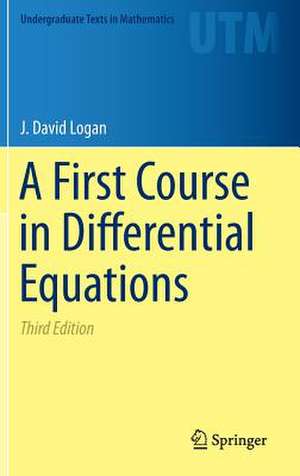
A First Course in Differential Equations: Undergraduate Texts in Mathematics
Autor J. David Loganen Limba Engleză Hardback – 16 iul 2015
Observăm în literatura academică dedicată analizei matematice o tendință către volume enciclopedice, adesea prea dense pentru un curs introductiv de un semestru. A First Course in Differential Equations vine să completeze exact această lacună, oferind o alternativă concisă și riguroasă la textele voluminoase de pe piață. Subliniem faptul că această a treia ediție publicată de Springer în prestigioasa serie Undergraduate Texts in Mathematics rafinează prezentarea teoretică prin integrarea unui număr sporit de exemple practice și exerciții de rutină, esențiale pentru fixarea conceptelor de bază. Structura volumului este una progresivă, debutând cu modelarea prin ecuații diferențiale și soluții analitice, trecând prin ecuații de ordinul al doilea și transformate Laplace, pentru a culmina cu studiul sistemelor liniare și neliniare. Această organizare permite instructorilor să adapteze materialul, primele capitole fiind suficiente pentru o introducere solidă. Descoperim aici o abordare centrată pe aplicații, unde matematica nu este un scop în sine, ci un instrument de rezolvare a problemelor din fizică, economie sau bioștiințe. Recomandăm acest volum ca o alternativă la Differential Equations de Merle Potter pentru cursurile de analiză matematică, având avantajul unei structuri mai aerisite și al includerii unor anexe tehnice valoroase pentru MATLAB și Maple. În contextul operei sale, J. David Logan continuă aici direcția aplicativă stabilită în Applied Partial Differential Equations. Dacă în lucrări precum Transport Modeling in Hydrogeochemical Systems autorul explora intersecția dintre matematică și hidrogeologie, în acest curs introductiv el distilează complexitatea în metode de soluționare accesibile, menținând totodată rigoarea necesară nivelului universitar.
Din seria Undergraduate Texts in Mathematics
-
 Preț: 439.07 lei
 -
 Preț: 419.51 lei
 - 15%
 Preț: 480.86 lei
 - 15%
 Preț: 391.13 lei
 - 15%
 Preț: 409.46 lei
 - 15%
 Preț: 409.62 lei
 -
 Preț: 394.05 lei
 -
 Preț: 397.74 lei
 - 20%
 Preț: 494.55 lei
 -
 Preț: 440.44 lei
 - 15%
 Preț: 480.13 lei
 -
 Preț: 435.26 lei
 - 15%
 Preț: 503.86 lei
 - 19%
 Preț: 390.93 lei
 - 19%
 Preț: 516.82 lei
 -
 Preț: 316.63 lei
 -
 Preț: 383.31 lei
 -
 Preț: 379.51 lei
 - 15%
 Preț: 552.56 lei
 - 15%
 Preț: 468.69 lei
 -
 Preț: 367.33 lei
 -
 Preț: 394.72 lei
 - 24%
 Preț: 378.45 lei
 -
 Preț: 380.99 lei
 -
 Preț: 419.04 lei
 -
 Preț: 404.38 lei
 -
 Preț: 382.22 lei
 -
 Preț: 401.95 lei
 -
 Preț: 427.91 lei
 - 15%
 Preț: 470.34 lei
 - 15%
 Preț: 507.99 lei
 -
 Preț: 407.65 lei
 -
 Preț: 440.55 lei
 -
 Preț: 488.06 lei
 - 13%
 Preț: 312.91 lei
 -
 Preț: 377.12 lei
 -
 Preț: 398.59 lei
 -
 Preț: 402.57 lei
 - 17%
 Preț: 414.76 lei
 - 15%
 Preț: 463.77 lei
 - 20%
 Preț: 326.42 lei
 - 15%
 Preț: 440.08 lei
 -
 Preț: 388.04 lei
 -
 Preț: 370.46 lei
 -
 Preț: 322.89 lei
Preț: 436.53 lei
Carte disponibilă
Livrare economică 28 octombrie-11 noiembrie
Specificații
ISBN-10: 3319178512
Pagini: 384
Ilustrații: XIII, 369 p. 101 illus., 13 illus. in color.
Dimensiuni: 160 x 241 x 27 mm
Greutate: 0.74 kg
Ediția:3rd edition 2015
Editura: Springer
Colecția Undergraduate Texts in Mathematics
Seria Undergraduate Texts in Mathematics
Locul publicării:Cham, Switzerland
V-ar putea interesa
-
 Applied MathematicsJ. David Logan-27%Preț: 834.11 lei1142.62 lei
 -
 Asymptotic Chaos Expansions in FinanceDavid NicolayPreț: 389.52 lei
 -
 A Qualitative Approach to Inverse Scattering TheoryFioralba Cakoni-15%Preț: 623.01 lei732.96 lei
 -
 Mathematical and Numerical Foundations of Turbulence Models and ApplicationsTomás Chacón Rebollo-18%Preț: 929.33 lei1133.32 lei
 -
 Handbook of Functional EquationsThemistocles M. Rassias-15%Preț: 663.81 lei780.96 lei
 -
 Analysis and Topology in Nonlinear Differential EquationsDjairo G. de Figueiredo-15%Preț: 659.16 lei775.48 lei
 -
 -18%Preț: 946.09 lei1153.77 lei
 -
 Variational Methods in Nonlinear Field EquationsVieri BenciPreț: 392.84 lei
 -
 Preț: 395.45 lei
 -
 New Perspectives on Approximation and Sampling TheoryAhmed I. ZayedPreț: 410.21 lei
Public țintă
Lower undergraduateDe ce să citești această carte
Recomandăm această carte studenților de la facultățile de profil tehnic sau științific care au nevoie de o introducere clară și aplicată în ecuații diferențiale. Cititorul câștigă o înțelegere practică a fenomenelor modelate matematic, beneficiind de exemple rezolvate pas cu pas și coduri MATLAB gata de utilizare. Este instrumentul ideal pentru a trece de la calculul diferențial teoretic la rezolvarea problemelor reale de inginerie și fizică.
Despre autor
J. David Logan este un matematician american recunoscut pentru contribuțiile sale în domeniul matematicii aplicate și al modelării matematice. Activitatea sa academică se concentrează pe aplicarea ecuațiilor diferențiale în domenii diverse, de la dinamica fluidelor la ecologie și hidrogeologie. Este autorul mai multor manuale de referință, printre care Applied Partial Differential Equations, volum care completează studiul ecuațiilor diferențiale ordinare prezentat în lucrarea de față. Experiența sa didactică este reflectată în stilul concis și structura logică a textelor sale, menite să faciliteze tranziția studenților de la nivelul de licență către cercetarea aplicată.
Cuprins
Notă biografică
Textul de pe ultima copertă
This edition contains a healthy increase over earlier editions in the number of worked examples and exercises, particularly those routine in nature. Two appendices include a review with practice problems, and a MATLAB® supplement that gives basic codes and commands for solving differential equations. MATLAB® is not required; students are encouraged to utilize available software to plot many of their solutions. Solutions to even-numbered problems are available on springer.com.
From the reviews of the second edition:
“The coverage of linear systems in the plane is nicely detailed and illustrated. …Simple numerical methods are illustrated and the use of Maple and MATLAB is encouraged. …select Dave Logan’s new and improved text for my course.”
—Robert E. O’Malley, Jr., SIAM Review, Vol. 53 (2), 2011
“Aims to provide material for a one-semester course that emphasizes the basic ideas, solution methods, and an introduction to modeling. …The book that results offers a concise introduction to the subject for students of mathematics, science and engineering who have completed the introductory calculus sequence. …This book is worth a careful look as a candidate text for the next differential equations course you teach.”
—William J. Satzer,MAA Reviews, January, 2011