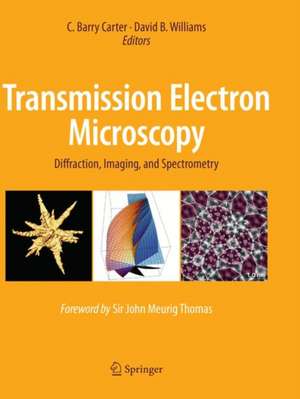
Transmission Electron Microscopy
Editat de C. Barry Carter, David B. Williamsen Limba Engleză Paperback – 12 iun 2018
ABORDAREA PRACTICĂ: Găsim în acest volum un echilibru tehnic riguros între fundamentul teoretic al microscopiei electronice de transmisie (TEM) și aplicabilitatea sa imediată în laborator. Spre deosebire de textele pur teoretice, Transmission Electron Microscopy pune accent pe instrucțiunile „hands-on”, oferind cititorului un ghid metodologic pentru caracterizarea materialelor. Recomandăm această a doua ediție pentru modul în care integrează peste 1200 de întrebări și exerciții, transformând o disciplină complexă într-un proces de învățare structurat. Complementar lui Transmission Electron Microscopy and Diffractometry of Materials de Brent Fultz, care explorează în detaliu interacțiunea undelor cu materia și difracția de raze X, volumul de față se concentrează mult mai aplicat pe arhitectura instrumentului și pe tehnici specifice de operare, precum Kikuchi diffraction sau CBED. Structura cărții este segmentată logic pentru a facilita progresia: de la componentele fizice (lentile, pompe, surse de electroni) și pregătirea riguroasă a specimenelor, până la tehnici avansate de imagistică și analiză cantitativă prin spectrometrie de raze X. În contextul operei autorilor, lucrarea reprezintă vârful de lance al expertizei lor în știința materialelor. C. Barry Carter face trecerea de la studiul structurilor cristaline și al defectelor, teme centrale în Ceramic Materials, la instrumentația de înaltă rezoluție necesară pentru a le observa. Dacă în volumele de conferință precum Applications of Microscopy in Materials and Life Sciences accentul cade pe noutățile din domeniu, acest manual rămâne resursa fundamentală pentru înțelegerea mecanismelor de contrast și a simulării de imagine, fiind esențial pentru orice cercetător care operează un microscop electronic.
Preț: 577.53 lei
Preț vechi: 713.00 lei
-19%
Carte tipărită la comandă
Livrare economică 03-08 august
Specificații
ISBN-10: 3319799886
Pagini: 552
Ilustrații: XXXIII, 518 p. 300 illus.
Dimensiuni: 210 x 279 x 28 mm
Greutate: 1.49 kg
Ediția:Softcover reprint of the original 1st edition 2016
Editura: Springer
Locul publicării:Cham, Switzerland
V-ar putea interesa
-
 -24%Preț: 1363.61 lei1791.54 lei
 -
 Essentials of Light MicroscopyJeremy Sanderson-12%Preț: 297.77 lei339.98 lei
 -
 High-Resolution Electron MicroscopyJohn C. H. Spence-30%Preț: 369.29 lei527.38 lei
 -
 Characterisation Methods in Inorganic ChemistryMark T. Weller-22%Preț: 390.00 lei497.59 lei
 -
 Chirality in Transition Metal ChemistryHani Amouri-8%Preț: 458.32 lei498.17 lei
 -
 Topics in Electron Diffraction and Microscopy of MaterialsPeter. B Hirsch-9%Preț: 1352.58 lei1486.35 lei
 -
 -5%Preț: 519.45 lei546.79 lei
 -
 NanocharacterisationAngus I Kirkland-14%Preț: 1367.16 lei1589.73 lei
 -
 Preț: 421.79 lei
 -
 XAFS for EveryoneScott Calvin-9%Preț: 747.59 lei821.52 lei
 -
 Chemical AnalysisFrancis Rouessac-19%Preț: 471.04 lei581.53 lei
 -
 Inorganic ChemistryCatherine Housecroft-9%Preț: 584.29 lei642.08 lei
 -
 Electron Backscatter Diffraction in Materials ScienceAdam J. Schwartz-24%Preț: 1698.38 lei2234.71 lei
 -
 Scanning Electron Microscopy and X-Ray MicroanalysisJoseph Goldstein-15%Preț: 745.33 lei876.87 lei
 -
 Scanning Electron Microscopy and X-Ray MicroanalysisJoseph I. Goldstein-19%Preț: 671.99 lei829.63 lei
 -
 MicrocosmosBrandon BrollPreț: 139.37 lei
 -
 NanocharacterisationAngus I Kirkland-14%Preț: 1296.92 lei1508.06 lei
 -
 Springer Handbook of MicroscopyPeter W. Hawkes-18%Preț: 2092.64 lei2552.00 lei
 -
 -11%Preț: 508.35 lei571.17 lei
 -
 Inorganic Experiments 3eJD Woollins-11%Preț: 421.37 lei473.45 lei
 -
 Characterization of Condensed MatterYujun Song-14%Preț: 654.40 lei760.93 lei
 -
 Image Analysis in Earth SciencesRenée Heilbronner-18%Preț: 942.03 lei1148.83 lei
 -
 Electron Microscopy in Science and EngineeringKrishanu Biswas-18%Preț: 974.98 lei1189.00 lei
 -
 Microstructural Characterisation TechniquesGunturi Venkata Sitarama SastryPreț: 374.09 lei
 -
 In-Situ Transmission Electron MicroscopyLitao Sun-24%Preț: 982.14 lei1292.28 lei
 -
 Electron Holography for Electromagnetic MaterialsDaisuke Shindo-18%Preț: 914.55 lei1115.31 lei
De ce să citești această carte
Recomandăm această carte cercetătorilor și studenților la master sau doctorat care au nevoie de o bază solidă, dar practică, în utilizarea TEM. Câștigați acces la o metodologie clară de pregătire a probelor și interpretare a diagramelor de difracție. Este un instrument de lucru indispensabil în laborator, oferind soluții concrete pentru problemele de imagistică și analiză chimică prin spectrometrie, susținute de un suport vizual de excepție.
Despre autor
C. Barry Carter și David B. Williams sunt figuri proeminente în comunitatea științifică internațională. Carter este profesor distins, cunoscut pentru contribuțiile sale majore în domeniul materialelor ceramice și al microscopiei, fiind implicat activ în organizarea conferințelor de profil din Asia-Pacific. David B. Williams aduce o vastă experiență academică și practică în caracterizarea materialelor. Împreună, au creat un text care a devenit standardul global în domeniu, îmbinând rigoarea analitică cu o pedagogie adaptată nevoilor actuale din cercetare.
Cuprins
Recenzii
Notă biografică
Textul de pe ultima copertă
“The best textbook for this audience available.” — American Scientist
“...highly readable, and an extremely valuable text for all users of the TEM at every level. Treat yourself to a copy!” — Microscopy and Microanalysis
“This book is written in such a comprehensive manner that it is understandable to all people who are trained in physical science and it will be useful both for the expert as well as the student.” — Micron
“The book answers nearly any question - be it instrumental, practical, or theoretical - either directly or with an appropriate reference...This book provides a basic, clear-cut presentation of how transmission electron microscopes should be used and of how this depends specifically on one's specific undergoing project.” — MRS Bulletin
“It is truly a book so thoughtfully written that … it will provide a solid foundation for those studying material science….an outstanding book.” — IEEE Electrical Insulation Magazine, Vol. 26 (4), July/August, 2010