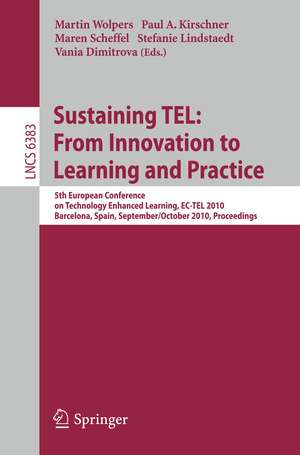
Sustaining TEL: From Innovation to Learning and Practice: 5th European Conference on Technology Enhanced Learning, EC-TEL 2010, Barcelona, Spain, September 28 - October 1, 2010, Proceedings: Lecture Notes in Computer Science, cartea 6383
Editat de Martin Wolpers, Paul A. Kirschner, Maren Scheffel, Stefanie Lindstaedt, Vania Dimitrovaen Limba Engleză Paperback – 27 sep 2010
Actualizarea majoră adusă de acest volum rezidă în schimbarea de paradigmă de la experimentul izolat la sustenabilitate. Dacă edițiile anterioare se concentrau pe prototipuri de laborator, Sustaining TEL: From Innovation to Learning and Practice marchează momentul în care comunitatea științifică face pasul decisiv spre implementarea pe scară largă în școli și industrie. Suntem de părere că această ediție a 5-a a conferinței EC-TEL reflectă maturizarea domeniului prin accentul pus pe evaluarea impactului social și economic al tehnologiilor educaționale.
Structura volumului este riguroasă, debutând cu lucrări invitate despre provocările interacțiunii om-calculator (HCI) în crearea ecosistemelor pervasive, urmate de o secțiune densă de lucrări complete. Apreciem în mod deosebit progresia logică a conținutului, care acoperă de la strategii de management pentru profesori, până la sisteme multi-agent pentru învățarea informală și utilizarea interfețelor tangibile în clasă. Dacă Learning in the Synergy of Multiple Disciplines de Ulrike Cress v-a oferit cadrul teoretic al interdependenței disciplinare, această carte oferă instrumentele practice necesare pentru a asigura continuitatea experiențelor de învățare în diverse contexte.
În contextul operei editorilor, acest volum completează direcția începută în Responsive Open Learning Environments, unde accentul cădea pe autonomia elevului. Aici, perspectiva se lărgește spre infrastructuri și certificări TEL, integrând soluții tehnice precum mashup-urile și software-ul social. Publicată în prestigioasa serie Lecture Notes in Computer Science, lucrarea rămâne un punct de referință tehnic pentru modul în care designul educațional adaptiv poate fi orchestrat prin standarde precum IMS Learning Design.
Din seria Lecture Notes in Computer Science
- 20%
 Preț: 558.53 lei
 - 20%
 Preț: 571.88 lei
 - 20%
 Preț: 675.83 lei
 - 20%
 Preț: 1020.28 lei
 - 20%
 Preț: 851.78 lei
 - 20%
 Preț: 560.93 lei
 - 20%
 Preț: 633.70 lei
 - 20%
 Preț: 731.82 lei
 - 20%
 Preț: 1359.66 lei
 - 20%
 Preț: 620.33 lei
 - 20%
 Preț: 733.68 lei
 - 18%
 Preț: 945.44 lei
 - 15%
 Preț: 558.12 lei
 - 20%
 Preț: 793.92 lei
 - 20%
 Preț: 560.93 lei
 - 20%
 Preț: 748.63 lei
 - 20%
 Preț: 562.49 lei
 - 20%
 Preț: 1246.46 lei
 - 20%
 Preț: 449.81 lei
 - 20%
 Preț: 606.22 lei
 - 20%
 Preț: 620.33 lei
 - 20%
 Preț: 562.49 lei
 - 20%
 Preț: 560.93 lei
 - 20%
 Preț: 313.10 lei
 - 20%
 Preț: 828.44 lei
 - 20%
 Preț: 560.93 lei
 - 20%
 Preț: 314.86 lei
 - 20%
 Preț: 1033.45 lei
 - 20%
 Preț: 563.29 lei
 - 20%
 Preț: 733.68 lei
 - 20%
 Preț: 1137.10 lei
 - 20%
 Preț: 735.28 lei
 - 20%
 Preț: 1079.23 lei
 - 20%
 Preț: 584.42 lei
 - 20%
 Preț: 854.16 lei
 - 15%
 Preț: 672.87 lei
 - 20%
 Preț: 1032.47 lei
 - 20%
 Preț: 617.17 lei
 - 20%
 Preț: 1022.15 lei
 - 20%
 Preț: 984.64 lei
 - 20%
 Preț: 556.96 lei
 - 20%
 Preț: 402.28 lei
 - 20%
 Preț: 316.28 lei
 - 20%
 Preț: 663.69 lei
 - 20%
 Preț: 320.24 lei
 - 20%
 Preț: 343.12 lei
 - 20%
 Preț: 313.87 lei
Preț: 637.96 lei
Preț vechi: 797.45 lei
-20%
Carte disponibilă
Livrare economică 18 noiembrie-02 decembrie
Specificații
ISBN-10: 3642160190
Pagini: 660
Ilustrații: XI, 649 p. 152 illus.
Greutate: 0.92 kg
Ediția:2010
Editura: Springer Berlin, Heidelberg
Colecția Springer
Seriile Lecture Notes in Computer Science, Programming and Software Engineering
Locul publicării:Berlin, Heidelberg, Germany
V-ar putea interesa
-
 Preț: 265.66 lei
 -
 -8%Preț: 565.30 lei614.45 lei
 -
 Learning to Teach in the Primary SchoolTeresa CreminPreț: 399.27 lei
 -
 -8%Preț: 435.99 lei473.89 lei
 -
 Nuthall's Hidden Lives of Learners in ActionBennie Kara-14%Preț: 93.50 lei108.60 lei
 -
 Preț: 321.32 lei
 -
 The Bloomsbury Handbook of Language Learning and TechnologyProfessor Regine Hampel-48%Preț: 713.77 lei1367.43 lei
 -
 Reflective Teaching in Higher EducationPaul Ashwin-13%Preț: 275.14 lei317.75 lei
 -
 How Do We Learn?Hector Ruiz MartinPreț: 136.27 lei
 -
 Meet Every Learner's NeedsRobert BarnettPreț: 189.73 lei
 -
 Get Better Faster 2.0Paul Bambrick-SantoyoPreț: 249.01 lei
 -
 -16%Preț: 296.63 lei351.68 lei
 -
 Engaging Learners EverywhereNathan MentzerPreț: 233.92 lei
 -
 E-Learning: Evolution, Strategies & TechnologiesDamon Flores-27%Preț: 1160.44 lei1582.46 lei
 -
 -9%Preț: 1524.23 lei1674.98 lei
 -
 Suspended FuturesRichard O WelshPreț: 249.94 lei
 -
 Preț: 384.13 lei
 -
 -15%Preț: 629.48 lei740.57 lei
 -
 Preț: 383.23 lei
 -
 Technology-Enabled Innovations in EducationSamira Hosseini-20%Preț: 642.10 lei802.63 lei
Public țintă
ResearchDe ce să citești această carte
Recomandăm acest volum cercetătorilor și dezvoltatorilor de platforme educaționale care doresc să treacă de la proiecte pilot la soluții scalabile. Cititorul câștigă o înțelegere tehnică profundă a interoperabilității și a designului de sisteme complexe. Este o resursă esențială pentru a înțelege cum pot fi integrate software-ul social și personalizarea extremă într-un ecosistem de învățare durabil și certificat.