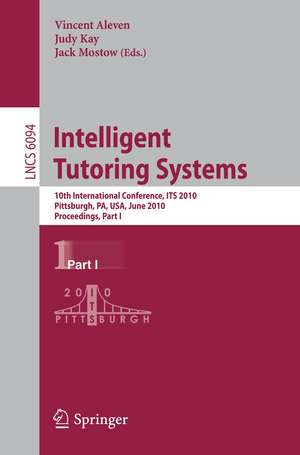
Intelligent Tutoring Systems: 10th International Conference, ITS 2010, Pittsburgh, PA, USA, June 14-18, 2010, Proceedings, Part I: Lecture Notes in Computer Science, cartea 6094
Editat de Vincent Aleven, Judy Kay, Jack Mostowen Limba Engleză Paperback – iun 2010
Găsim în acest volum, ce ia forma unui manual de cercetare și conferință, o sinteză riguroasă a progreselor înregistrate în domeniul tehnologiilor educaționale adaptive. Ca parte a seriei Lecture Notes in Computer Science, lucrarea documentează ediția aniversară a 10-a a conferinței ITS, punând accent pe conceptul de „punți către învățare”. Apreciem în mod deosebit caracterul interdisciplinar al selecției, care îmbină perspective din informatică, psihologie cognitivă și inteligență artificială pentru a aborda nevoile utilizatorilor individuali sau de grup.
Structura primei părți a volumului este organizată strategic, începând cu prelegeri invitate despre impactul tehnologiei în școli și continuând cu analize tehnice profunde. Descoperim secțiuni esențiale despre „Educational Data Mining”, unde sunt prezentate modele de predicție a corectitudinii în rezolvarea problemelor, și despre „Natural Language Interaction”, care explorează generarea automată de întrebări și recunoașterea vocală în cazul copiilor. Această organizare reflectă o progresie de la fundamentul teoretic și etic către aplicații computaționale concrete.
Comparabil cu Artificial Intelligence in Education de Cristina Conati în ceea ce privește rigoarea academică și procesul strict de selecție, acest volum se distinge prin focalizarea pe sistemele de tutorat care mediază activ procesul de învățare, spre deosebire de abordările mai largi ale AI în educație. De asemenea, lucrarea completează temele explorate de editori în International Handbook of Metacognition and Learning Technologies, mutând accentul de la procesele metacognitive ale studentului către arhitectura tehnică a sistemelor care le susțin.
Din seria Lecture Notes in Computer Science
- 20%
 Preț: 558.53 lei
 - 20%
 Preț: 571.88 lei
 - 20%
 Preț: 675.83 lei
 - 20%
 Preț: 1020.28 lei
 - 20%
 Preț: 620.33 lei
 - 20%
 Preț: 560.93 lei
 - 20%
 Preț: 633.70 lei
 - 20%
 Preț: 731.82 lei
 - 20%
 Preț: 1359.66 lei
 - 20%
 Preț: 560.93 lei
 - 20%
 Preț: 733.68 lei
 - 20%
 Preț: 828.44 lei
 - 15%
 Preț: 558.12 lei
 - 20%
 Preț: 793.92 lei
 - 20%
 Preț: 560.93 lei
 - 20%
 Preț: 748.63 lei
 - 20%
 Preț: 562.49 lei
 - 20%
 Preț: 1246.46 lei
 - 20%
 Preț: 449.81 lei
 - 20%
 Preț: 556.96 lei
 - 20%
 Preț: 562.49 lei
 - 20%
 Preț: 851.78 lei
 - 20%
 Preț: 313.10 lei
 - 18%
 Preț: 945.44 lei
 - 20%
 Preț: 314.86 lei
 - 20%
 Preț: 560.93 lei
 - 20%
 Preț: 606.22 lei
 - 20%
 Preț: 1033.45 lei
 - 20%
 Preț: 563.29 lei
 - 20%
 Preț: 733.68 lei
 - 20%
 Preț: 1137.10 lei
 - 20%
 Preț: 735.28 lei
 - 20%
 Preț: 1079.23 lei
 - 20%
 Preț: 584.42 lei
 - 20%
 Preț: 854.16 lei
 - 15%
 Preț: 672.87 lei
 - 20%
 Preț: 1032.47 lei
 - 20%
 Preț: 617.17 lei
 - 20%
 Preț: 1022.15 lei
 - 20%
 Preț: 984.64 lei
 - 20%
 Preț: 620.33 lei
 - 20%
 Preț: 402.28 lei
 - 20%
 Preț: 316.28 lei
 - 20%
 Preț: 663.69 lei
 - 20%
 Preț: 320.24 lei
 - 20%
 Preț: 343.12 lei
 - 20%
 Preț: 313.87 lei
Preț: 384.13 lei
Carte disponibilă
Livrare economică 13-27 noiembrie
Specificații
ISBN-10: 3642133878
Pagini: 468
Ilustrații: XXX, 437 p. 97 illus.
Greutate: 0.68 kg
Ediția:2010
Editura: Springer Berlin, Heidelberg
Colecția Springer
Seriile Lecture Notes in Computer Science, Programming and Software Engineering
Locul publicării:Berlin, Heidelberg, Germany
V-ar putea interesa
-
 Design for How People LearnJulie DirksenPreț: 268.45 lei
 -
 Language and Literacy in Science EducationJerry Wellington-29%Preț: 184.42 lei259.95 lei
 -
 Meaning Making in Secondary Science ClassroomsEduardo Mortimer-27%Preț: 203.19 lei277.33 lei
 -
 Good Practice in Science Teaching: What Research Has to SayJonathan Osborne-25%Preț: 210.29 lei281.13 lei
 -
 preparing for blended e-learningAllison LittlejohnPreț: 393.02 lei
 -
 WikiworldJuha SuorantaPreț: 229.81 lei
 -
 Preț: 403.67 lei
 -
 Empowering Students With TechnologyAlan NovemberPreț: 245.18 lei
Public țintă
Professional/practitionerDe ce să citești această carte
Această resursă este esențială pentru cercetătorii și practicienii din domeniul tehnologiei educaționale. Cititorul câștigă acces la metodologii validate de „data mining” educațional și strategii de interacțiune prin limbaj natural, oferind o bază solidă pentru dezvoltarea sistemelor de învățare adaptivă. Este un punct de referință pentru înțelegerea modului în care inteligența artificială poate personaliza experiența de instruire.