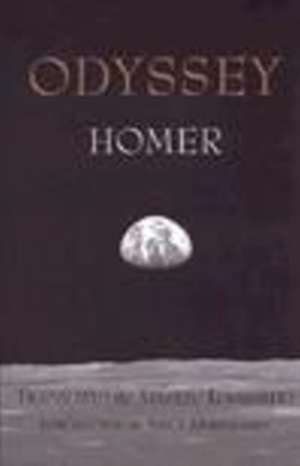
Odyssey
Autor Homer Traducere de Stanley Lombardo Introducere de Sheila Murnaghanen Limba Engleză Hardback – mar 2000
Bazându-ne pe expertiza de trei decenii a lui Joe Sachs în cadrul programului „Great Books”, recomandăm această ediție a The Odyssey ca fiind un punct de intrare ideal în literatura antică. Observăm că această versiune nu este doar o simplă traducere, ci o recalibrare a textului homeric pentru cititorul contemporan, oferind o claritate modernă care nu sacrifică rigoarea originalului grecesc. Față de alte ediții academice, volumul de față, publicat în colecția Collins Classics, adoptă un stil „transparent și natural”, facilitând o imersiune rapidă în periplul de zece ani al lui Odiseu spre Ithaca.
Structura cărții este gândită strategic pentru a servi atât curiozității generale, cât și nevoilor curriculare. Credem că selecția capitolelor — de la întâlnirea cu ciclopul Polifem și vrăjitoarea Circe, până la coborârea în lumea umbrelor — reușește să păstreze tensiunea narativă intactă, oferind în același timp contextul necesar prin note de subsol și hărți detaliate. Cititorii familiarizați cu The Iliad and the Odyssey Boxed Set în traducerea lui Robert Fagles vor aprecia aici abordarea lui Sachs, care pune accent pe „auzirea” epopeii așa cum ar fi fost receptată de auditoriul antic, oferind o perspectivă mai intimă asupra personajelor.
În contextul operei autorului, dacă Classic Starts®: The Iliad este o adaptare pentru tineri, iar Circe and the Cyclops izolează episoade specifice, acest volum oferă o sinteză echilibrată. Această ediție reușește să demonstreze de ce poemul rămâne o explorare fundamentală a condiției umane, fiind o resursă esențială pentru oricine dorește să confrunte imaginația și inima lui Homer fără barierele unui limbaj arhaic excesiv.
Preț: 332.46 lei
Preț vechi: 401.74 lei
-17%
Carte disponibilă
Livrare economică 06-20 noiembrie
Specificații
ISBN-10: 0872204855
Pagini: 478
Ilustrații: 1 b-w map
Dimensiuni: 137 x 216 x 139 mm
Greutate: 0.67 kg
Editura: Hackett Publishing Company,Inc
Colecția Hackett Publishing Company, Inc.
Locul publicării:United States
V-ar putea interesa
-
 Six Wives of Henry VIIIAlison Weir-27%Preț: 79.82 lei109.82 lei
 -
 Frederick the GreatNancy Mitford-37%Preț: 58.46 lei92.74 lei
 -
 The Sun KingNancy Mitford-32%Preț: 62.34 lei91.10 lei
 -
 The Portrait of a LadyHenry James-22%Preț: 64.66 lei82.53 lei
 -
 Candide and Other StoriesVoltairePreț: 47.27 lei
 -
 The IliadHomer-15%Preț: 51.13 lei60.08 lei
 -
 Medea and Other PlaysEuripidesPreț: 58.52 lei
 -
 The Love PoemsOvid-19%Preț: 69.94 lei86.16 lei
 -
 Selected PoetryJohn Keats-19%Preț: 52.70 lei64.76 lei
 -
 The IliadHomer-16%Preț: 61.78 lei73.85 lei
 -
 -39%Preț: 17.23 lei28.34 lei
 -
 The Black UnicornAudre Lorde-28%Preț: 51.24 lei70.85 lei
 -
 The Cancer JournalsAudre Lorde-36%Preț: 45.08 lei70.40 lei
 -
 Eyes of the Storm: A Graphic Novel (Bone #3)Jeff SmithPreț: 96.77 lei
 -
 The Story of HiawathaHenry Wadsworth LongfellowPreț: 56.95 lei
 -
 The Boys King ArthurSidney LanierPreț: 63.28 lei
 -
 The Merry Adventures of Robin HoodHoward Pyle-43%Preț: 74.90 lei131.41 lei
 -
 Preț: 28.01 lei
 -
 WavesVirginia WoolfPreț: 36.30 lei
 -
 UlyssesJames JoycePreț: 41.38 lei
 -
 Helen of TroyBettany Hughes-23%Preț: 147.53 lei191.52 lei
 -
 Midsummer Night''s DreamWilliam ShakespearePreț: 35.95 lei
 -
 Lord JimJoseph ConradPreț: 28.01 lei
 -
 Robinson CrusoeDaniel DefoePreț: 36.10 lei
 -
 Heart of DarknessJoseph ConradPreț: 30.68 lei
 -
 AeneidVirgilPreț: 36.01 lei
 -
 The Story of the IliadAlfred J. ChurchPreț: 69.86 lei
 -
 A Wonder Book and Tanglewood Tales, for Girls and BoysNathaniel HawthornePreț: 53.38 lei
De ce să citești această carte
Recomandăm această ediție pentru oricine dorește să descopere epopeea lui Homer într-un format accesibil, dar riguros. Cititorul câștigă o înțelegere profundă a călătoriei lui Odiseu datorită traducerii clare a lui Joe Sachs și a selecțiilor care elimină redundanțele, păstrând esența narativă. Este un instrument de studiu excelent datorită notelor explicative și hărților incluse, fiind ideal pentru studenți sau cititori pasionați de beletristica clasică.
Despre autor
Homer a fost un poet epic din Grecia Antică, considerat autorul fundamental al literaturii occidentale prin lucrările sale, Iliada și Odiseea. Deși identitatea sa rămâne subiect de dezbatere, tradiția îl descrie ca pe un bard orb din Ionia. Epopeile sale au modelat cultura și educația greacă, fiind pilonii pe care s-a construit civilizația europeană. Traducătorul acestui volum, Joe Sachs, aduce o perspectivă academică solidă, fiind cunoscut pentru traducerile sale fidele din Aristotel și Platon, realizate pe parcursul carierei sale de profesor la St. John's College.
Descriere
"[Lombardo] has brought his laconic wit and love of the ribald . . . to his version of the Odyssey. His carefully honed syntax gives the narrative energy and a whirlwind pace. The lines, rhythmic and clipped, have the tautness and force of Odysseus' bow."
—Chris Hedges, The New York Times Book Review
Recenzii
—The Common Review: The Magazine of the Great Books Foundation
"Lombardo weaves his cherished idioms into important patterns of repetition and transformation so familiar to the telling of the Odyssey. . . . Above all, such familiar phrases serve to remind us of the oral character of the original Odyssey, providing the reader with an uncanny immediacy and relevance."
—Christina Zwarg, The Bryn Mawr Classical Review
"Lombardo has the simple gift of summoning up a Homeric flavor wherever he turns. He may even blend contemporary colloquialisms with an antique epic grandeur, and the effect remains unimpaired. As Lombardo tells us, he recites and performs, he impersonates the poem as if he were the bard. We follow, we explore, plunging into 'medias res'. Homer arises before him as an encompassing reality. Lombardo moves at ease through this Homeric world, without artifice or rhetoric, attuning his verse to Homer's composition. Homer is here a vindication of poetry."
—Paolo Vivante, McGill University
"Lombardo has created a Homeric voice for his contemporaries: fresh, quick, and verbally engaging to the modern ear, as the original was to the ancient. His characters come alive as real people expressing real feelings with urgency and verve. I very much like the language and the pace of this version, and would welcome it for classroom use."
—Joseph Russo, Haverford College
"What could be finer / Than listening to a singer of tales / . . . with a voice like a god's?' So Odysseus on the bard Demodocus. And the singer, the oral poet, the 'aoidos', is what Lombardo embodies in his Homer. With a line and a language hammered out in public performance, he has made a verse that can move his audience to tears and even to laughter. At first glance, the simplicity startles—spare syntax, the highest proportion of short words in modern English poetry, colloquialism in the saddle, sudden and direct contact with the matter. But then the wonders of how he works become evident. So much was already to be seen/heard in Lombardo's version of the Iliad. But his Odyssey moves beyond, its verse widening its range to everything in between tears and laughter, able to present a storm, a battle, a chiding, a fable, a tale, and a whine with equal deftness. No version of the Odyssey is more immediate. No version shows better one of Homer's essentials: the oral poet at work. The persona is there, and it's real."
—Douglass Parker, University of Texas at Austin
"Ever since the publication of Stanley Lombardo's extraordinary translation of the Iliad, we have been waiting eagerly for his Odyssey, and it has been well worth the wait. Lombardo has done it again: he has rendered the Odyssey into English just as accurate, as perspicuous, and as gripping as that in his Iliad. Students will probably be unable to resist reading it in great long chunks. Lombardo's translation is enhanced by Sheila Murnaghan's characteristically lucid and accurate introduction, which will be a boon to teachers of undergraduates (or even high school students)."
—John Kirby, Purdue University
"It sheds new light, guiding us through a psychology of language we understand in order to show us the shadows of something quite alien to contemporary, secular experience. The language is honed, so that event, object and emotion are revealed by a tone of voice, or a compressed stanza that draws out an essential element without the accompanying poetic distortions of romance. This translation delivers the goods without dallying in over-amplified academic considerations. Instead, the words retain a kind of artful weight, with the emotional stress intact."
—First Intensity Magazine
Notă biografică
In The Iliad Homer sang of death and glory, of a few days in the struggle between the Greeks and the Trojans. Mortal men played out their fate under the gaze of the gods. The Odyssey is the original collection of tall traveller’s tales. Odysseus, on his way home from the Trojan War, encounters all kinds of marvels from one-eyed giants to witches and beautiful temptresses. His adventures are many and memorable before he gets back to Ithaca and his faithful wife Penelope. We can never be certain that both these stories belonged to Homer. In fact ‘Homer’ may not be a real name but a kind of nickname meaning perhaps ‘the hostage’ or ‘the blind one’. Whatever the truth of their origin, the two stories, developed around three thousand years ago, may well still be read in three thousand years’ time.
Robert Fagles (1933-2008) was Arthur W. Marks ’19 Professor of Comparative Literature, Emeritus, at Princeton University. He was the recipient of the 1997 PEN/Ralph Manheim Medal for Translation and a 1996 Award in Literature from the American Academy of Arts and Letters. His translations include Sophocles’s Three Theban Plays, Aeschylus’s Oresteia (nominated for a National Book Award), Homer’s Iliad (winner of the 1991 Harold Morton Landon Translation Award by The Academy of American Poets), Homer’s Odyssey, and Virgil's Aeneid.
Bernard Knox (1914-2010) was Director Emeritus of Harvard’s Center for Hellenic Studies in Washington, D.C. He taught at Yale University for many years. Among his numerous honors are awards from the National Institute of Arts and Letters and the National Endowment for the Humanities. His works include The Heroic Temper: Studies in Sophoclean Tragedy, Oedipus at Thebes: Sophocles’ Tragic Hero and His Time and Essays Ancient and Modern (awarded the 1989 PEN/Spielvogel-Diamonstein Award).
Textul de pe ultima copertă
After ten bloody years of fighting in the Trojan War, the intrepid Odysseus heads homeward, little imagining that it will take another ten years of desperate struggle to reclaim his kingdom and family. The wily hero circumvents the wrath of the sea god Poseidon and triumphs over an incredible array of obstacles, assisted by his patron goddess Athene and his own prodigious guile. From a literal descent into Hell to interrogate a dead prophet to a sojourn in the earthly paradise of the Lotus-eaters, the gripping narrative traverses the mythological world of ancient Greece to introduce an unforgettable cast of characters: one-eyed giants known as Cyclopses, the enchantress Circe, cannibals, sirens, the twin perils of Scylla and Charybdis, and a fantastic assortment of other creatures.
Remarkably modern in its skillful use of flashbacks and parallel line of action, Homer's monumental work is now available in this inexpensive, high-quality edition sure to be prized by students, teachers, and all who love the great myths and legends of the ancient world.
A selection of the Common Core State Standards Initiative.
Cuprins
- The Gods
- Odysseus
- A Note on Poetic Form and on the Translation
- Map
- Book One: Athena Visits Ithaca
- Book Two: Telemachus Prepares for His Voyage
- Book Three: Telemachus Visits Nestor in Pylos
- Book Four: The Suitors Plan to Kill Telemachus
- Book Five: Odysseus Leaves Calypso’s Island
- Book Six: Odysseus and Nausicaa
- Book Seven: Odysseus at the Court of Alcinous in Phaeacia
- Book Eight: Odysseus Is Entertained in Phaeacia
- Book Nine: Ismarus, the Lotus Eaters, and the Cyclops
- Book Ten: Aeolus, the Laestrygonians, and Circe
- Book Eleven: Odysseus Meets the Shades of the Dead
- Book Twelve: The Sirens, Scylla and Charybdis, the Cattle of the Sun
- Book Thirteen: Odysseus Leaves Phaeacia and Reaches Ithaca
- Book Fourteen: Odysseus Meets Eumaeus
- Book Fifteen: Telemachus Returns to Ithaca
- Book Sixteen: Odysseus Reveals Himself to Telemachus
- Book Seventeen: Odysseus Goes to the Palace as a Beggar
- Book Eighteen: Odysseus and Irus the Beggar
- Book Nineteen: Eurycleia Recognizes Odysseus
- Book Twenty: Odysseus Prepares for His Revenge
- Book Twenty-One: The Contest with Odysseus’s Bow
- Book Twenty-Two: The Killing of the Suitors
- Book Twenty-Three: Odysseus and Penelope
- Book Twenty-Four: Zeus and Athena End the Fighting
- Literary Contexts
- from Xenophanes, Fragments (c. fifth century bce)
- from Pindar, Nemean 7 (c. fifth century bce)
- from Plato, The Republic (c. 380 bce)
- from Aristotle, Poetics (c. 335 bce)
- from Longinus?, On the Sublime (c. 1st century ce)
- from Demetrius?, On Style (c. 1st century ce)
- The Odyssey in Ancient Art
- Early Written and Printed Versions
Glossary
Acknowledgment