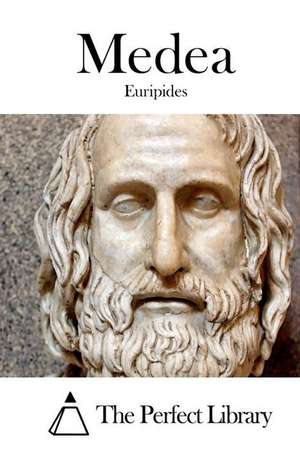
Medea
Autor Euripides Editat de The Perfect Libraryen Limba Engleză Paperback – vârsta de la 22 ani
Preț: 87.68 lei
Puncte Express: 132
Carte disponibilă
Livrare economică 11-25 noiembrie
Livrare prin curier în România Termenul estimat este afișat lângă disponibilitate.
Transport gratuit de la 400.00 lei Plată online sau ramburs, în funcție de opțiunile comenzii.
Retur gratuit în 14 zile Comandă securizată și suport în română.
Specificații
ISBN-13: 9781511922418
ISBN-10: 1511922419
Pagini: 38
Dimensiuni: 152 x 229 x 2 mm
Greutate: 0.06 kg
Editura: CREATESPACE
ISBN-10: 1511922419
Pagini: 38
Dimensiuni: 152 x 229 x 2 mm
Greutate: 0.06 kg
Editura: CREATESPACE
V-ar putea interesa
-
 Censorship of the American Theatre in the Twentieth CenturyJohn H. HouchinPreț: 343.03 lei
 -
 I Am My Own WifeWright DougPreț: 100.55 lei
 -
 About KaneGraham SaundersPreț: 78.50 lei
 -
 PopcornBen EltonPreț: 99.44 lei
 -
 Piano / ForteTerry JohnsonPreț: 86.81 lei
 -
 Cultural HybridityPeter BurkePreț: 147.21 lei
 -
 Theatricality as MediumSamuel WeberPreț: 367.08 lei
 -
 The Lieutenant of InishmorePatrick Lonergan-19%Preț: 78.30 lei96.54 lei
 -
 -19%Preț: 160.02 lei198.35 lei
 -
 Earthquakes in LondonMike Bartlett-18%Preț: 85.89 lei104.54 lei
 -
 -20%Preț: 159.06 lei197.81 lei
 -
 -20%Preț: 158.59 lei198.70 lei
 -
 Theories of PerformanceElizabeth Bell-27%Preț: 946.14 lei1296.08 lei
 -
 Life of the DramaEric BentleyPreț: 140.25 lei
 -
 Thom Pain (based on nothing)Will Eno-24%Preț: 79.75 lei104.47 lei
 -
 Dennis Kelly: Plays OneDennis KellyPreț: 170.96 lei
 -
 JerusalemJez ButterworthPreț: 78.13 lei
 -
 PenelopeEnda WalshPreț: 60.52 lei
 -
 -12%Preț: 80.31 lei91.74 lei
 -
 Preț: 195.74 lei
Descriere
Descriere de la o altă ediție sau format:
A Student Edition of Euripides' play, which accessibly unpacks Greek tragedy in its social context, issues of translation and adaptation, and performance approaches over the centuries.
Euripides' play Medea was first produced in 431BC and continues to be produced globally to this day. Its power and timeless appeal for audiences rests in its portrait of a woman driven to murder the new wife of the man who abandoned her and to murder her own children. In more recent times, Medea's actions have been taken as a symbol of female power in an otherwise male-dominated society.
Will Shüler's commentary in this Student Edition looks at the violence of the play - both onstage and off; the original performance conditions; staging challenges, both then and now (including Medea's exit on a dragon); the notion of myth and how Greek tragedians were telling old stories to get new meanings; and how the play has evolved through translation.
It considers a range of productions up to the present day, including the 2014 National Theatre production directed by Carrie Cracknell and starring Helen McCrory; Sophie Okonedo as Medea at the Soho Theatre, London, in 2023; and the 2000 Australian version, Black Medea, which interpreted Medea as an indigenous woman brought to a city by her ambitious husband.
A Student Edition of Euripides' play, which accessibly unpacks Greek tragedy in its social context, issues of translation and adaptation, and performance approaches over the centuries.
Euripides' play Medea was first produced in 431BC and continues to be produced globally to this day. Its power and timeless appeal for audiences rests in its portrait of a woman driven to murder the new wife of the man who abandoned her and to murder her own children. In more recent times, Medea's actions have been taken as a symbol of female power in an otherwise male-dominated society.
Will Shüler's commentary in this Student Edition looks at the violence of the play - both onstage and off; the original performance conditions; staging challenges, both then and now (including Medea's exit on a dragon); the notion of myth and how Greek tragedians were telling old stories to get new meanings; and how the play has evolved through translation.
It considers a range of productions up to the present day, including the 2014 National Theatre production directed by Carrie Cracknell and starring Helen McCrory; Sophie Okonedo as Medea at the Soho Theatre, London, in 2023; and the 2000 Australian version, Black Medea, which interpreted Medea as an indigenous woman brought to a city by her ambitious husband.
Textul de pe ultima copertă
One of the most powerful and enduring of Greek tragedies, Medea centers on the myth of Jason, leader of the Argonauts, who has won the dragon-guarded treasure of the Golden Fleece with the help of the sorceress Medea. Having married Medea and fathered her two children, Jason abandons her for a more favorable match, never suspecting the terrible revenge she will take. Euripides' masterly portrayal of the motives fiercely driving Medea's pursuit of vengeance for her husband's insult and betrayal has held theater audiences spellbound for more than twenty centuries. Rex Warner's authoritative translation brings this great classic of world literature vividly to life.
Notă biografică
Euripides is thought to have lived between 485 and 406 BC. He is considered to be one of the three great dramatists of Ancient Greece, alongside Aeschylus and Sophocles. He is particularly admired by modern audiences and readers for his characterization and astute and balanced depiction of human behaviour. Medea is his most famous work.
Robin Robertson is from the north-east coast of Scotland. He is the author of three collections of poetry: A Painted Field (1997), winner of the 1997 Forward Poetry Prize (Best First Collection), the Aldeburgh Poetry Festival Prize and the Saltire Society Scottish First Book of the Year Award; Slow Air (2002); and Swithering (2006). He is also the editor of Mortification: Writers' Stories of their Public Shame (2003). In 2004, he was named by the Poetry Book Society as one of the 'Next Generation' poets, and received the E. M. Forster Award from the American Academy of Arts and Letters. Robin Robertson's third poetry collection, Swithering (2006), was shortlisted for the 2005 T. S. Eliot Prize and won the 2006 Forward Poetry Prize (Best Poetry Collection of the Year). In 2013 Robin Robertson was awarded the Petrarca-Preis. He lives and works in London.
Robin Robertson is from the north-east coast of Scotland. He is the author of three collections of poetry: A Painted Field (1997), winner of the 1997 Forward Poetry Prize (Best First Collection), the Aldeburgh Poetry Festival Prize and the Saltire Society Scottish First Book of the Year Award; Slow Air (2002); and Swithering (2006). He is also the editor of Mortification: Writers' Stories of their Public Shame (2003). In 2004, he was named by the Poetry Book Society as one of the 'Next Generation' poets, and received the E. M. Forster Award from the American Academy of Arts and Letters. Robin Robertson's third poetry collection, Swithering (2006), was shortlisted for the 2005 T. S. Eliot Prize and won the 2006 Forward Poetry Prize (Best Poetry Collection of the Year). In 2013 Robin Robertson was awarded the Petrarca-Preis. He lives and works in London.
Cuprins
Chronology
Contexts (ritual; myth as storytelling; multiple plays performed at one time; audience and performer experience including collective spectacle; didactic)
Themes (gender; motherhood; feminism, including contemporary perspectives; political power; family)
Play in Performance (Aristotle's Poetics; dramatic structure; space of a Greek tragic theatre; acoustics; violence onstage and offstage; theatre design)
Text, Transmission, and Translation (How did this text survive until now? What are approaches to translation? What does this translation emphasise? What are the potentials for "translating" the play from page to stage?)
Play in performance (how various playwrights and theatre-makers have adapted the material including the 2014 NT production directed by Carrie Cracknell; the 2023 production at the Soho Theatre, London; the 2000 production in Australia, Black Medea; and Cherrie Moraga's 1995 adaptation The Hungry Woman, which was a queer re-telling of the play.)
PLAY TEXT
Notes
Contexts (ritual; myth as storytelling; multiple plays performed at one time; audience and performer experience including collective spectacle; didactic)
Themes (gender; motherhood; feminism, including contemporary perspectives; political power; family)
Play in Performance (Aristotle's Poetics; dramatic structure; space of a Greek tragic theatre; acoustics; violence onstage and offstage; theatre design)
Text, Transmission, and Translation (How did this text survive until now? What are approaches to translation? What does this translation emphasise? What are the potentials for "translating" the play from page to stage?)
Play in performance (how various playwrights and theatre-makers have adapted the material including the 2014 NT production directed by Carrie Cracknell; the 2023 production at the Soho Theatre, London; the 2000 production in Australia, Black Medea; and Cherrie Moraga's 1995 adaptation The Hungry Woman, which was a queer re-telling of the play.)
PLAY TEXT
Notes
Recenzii
"The excellent Introduction by Robin Mitchell-Boyask displays an admirable command of up-to-date scholarship and judiciously leaves controversial matters open to one's own interpretation. Arnson Svarlien's verse translation has both elegance and power -- it reads well, not just to the eye, but (happily for the director and actors) also to the ear." -- Ian Storey, Department of Classics, Trent University
Diane Arnson Svarlien's body of work means a quantum leap forward in the vibrancy and immediacy of classical verse drama. I first learned of her work when I was searching, madly, for a translation of Medea for a production I had been hired to direct. I sought out every published version. I tried to track down any unpublished ones rumored to exist. All the others were wanting; her translation was revelatory. Merely read her translation of the play, then read another. You will sense the difference. This is particularly true if you are a practitioner of theatre.--Patrick Wang, Director of Diane Arnson Svarlien's Medea in its world premiere at the Stella Adler Studio, and of the feature film In the Family, nominated for a "Best First Feature" Independent Spirit Award. Retrieved from monkeyatatypewriter.com.
This is the Medea we have been waiting for. It offers clarity without banality, eloquence without pretension, meter without doggerel, accuracy without clumsiness. No English Medea can ever be Euripides', but this is as close as anyone has come so far, and a good deal closer than I thought anyone would ever come. Arnson Svarlien has shown herself exceedingly skillful in making Euripides sound Euripidean.--David M. Schaps, Bryn Mawr Classical Review
Fluid, lively, and accurate!Amy Vail, Department of Classics, Baylor University
Diane Arnson Svarlien's body of work means a quantum leap forward in the vibrancy and immediacy of classical verse drama. I first learned of her work when I was searching, madly, for a translation of Medea for a production I had been hired to direct. I sought out every published version. I tried to track down any unpublished ones rumored to exist. All the others were wanting; her translation was revelatory. Merely read her translation of the play, then read another. You will sense the difference. This is particularly true if you are a practitioner of theatre.--Patrick Wang, Director of Diane Arnson Svarlien's Medea in its world premiere at the Stella Adler Studio, and of the feature film In the Family, nominated for a "Best First Feature" Independent Spirit Award. Retrieved from monkeyatatypewriter.com.
This is the Medea we have been waiting for. It offers clarity without banality, eloquence without pretension, meter without doggerel, accuracy without clumsiness. No English Medea can ever be Euripides', but this is as close as anyone has come so far, and a good deal closer than I thought anyone would ever come. Arnson Svarlien has shown herself exceedingly skillful in making Euripides sound Euripidean.--David M. Schaps, Bryn Mawr Classical Review
Fluid, lively, and accurate!Amy Vail, Department of Classics, Baylor University