
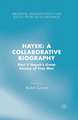
Hayek: A Collaborative Biography: Archival Insights into the Evolution of Economics
Editat de Robert Leesonen Limba Engleză Hardback – 25 sep 2018
Hayek claimed that he always made it his rule ‘not to be concerned with current politics, but to try to operate on public opinion.’ However, evidence suggests that he was a party political operative with ‘free’ market scholarship being the vehicle through which he sought – and achieved – party political influence. The ‘main purpose’ of his Mont Pelerin Society had ‘been wholly achieved’. Mises promoted ‘Fascists’ including Ludendorff and Hitler, and Hayekians promoted the Operation Condor military dictatorships and continue to maintain a ‘united front’ with ‘neo-Nazis.’ Hayek, who supported Pinochet’s torture-based regime and played a promotional role in ‘Dirty War’ Argentina, is presented as a saintly figure.




Preț: 991.15 lei
Preț vechi: 1208.72 lei
-18%
Puncte Express: 1487
Carte tipărită la comandă
Livrare economică 03-17 decembrie
Livrare prin curier în România Termenul estimat este afișat lângă disponibilitate.
Transport gratuit pentru acest produs Plată online sau ramburs, în funcție de opțiunile comenzii.
Retur gratuit în 14 zile Comandă securizată și suport în română.
Specificații
ISBN-13: 9783319913575
ISBN-10: 3319913573
Pagini: 516
Ilustrații: XV, 497 p.
Dimensiuni: 153 x 216 x 33 mm
Greutate: 0.73 kg
Ediția:1st ed. 2018
Editura: Springer
Colecția Archival Insights into the Evolution of Economics
Seria Archival Insights into the Evolution of Economics
Locul publicării:Cham, Switzerland
ISBN-10: 3319913573
Pagini: 516
Ilustrații: XV, 497 p.
Dimensiuni: 153 x 216 x 33 mm
Greutate: 0.73 kg
Ediția:1st ed. 2018
Editura: Springer
Colecția Archival Insights into the Evolution of Economics
Seria Archival Insights into the Evolution of Economics
Locul publicării:Cham, Switzerland
V-ar putea interesa
-
 Contemporary EconomicsRobert J. Carbaugh-19%Preț: 539.90 lei666.54 lei
 -
 The Economy of CitiesJane JacobsPreț: 92.41 lei
 -
 Gender and Social CapitalBrenda O'Neill-15%Preț: 446.80 lei525.64 lei
 -
 Preț: 106.40 lei
 -
 An Economic Theorist's Book of TalesGeorge AkerlofPreț: 436.98 lei
 -
 Game Theory for Applied EconomistsRobert S Gibbons-19%Preț: 459.12 lei566.81 lei
 -
 Spatial Statistics and ModelingCarlo Gaetan-18%Preț: 1114.35 lei1358.96 lei
 -
 Preț: 118.74 lei
 -
 Saving The SunGillian TettPreț: 116.89 lei
 -
 The Return of Depression EconomicsPaul Krugman-32%Preț: 62.97 lei92.20 lei
 -
 The Reformation in EconomicsPhilip PilkingtonPreț: 371.71 lei
 -
 Macroeconomic Patterns and StoriesEdward E. Leamer-18%Preț: 760.45 lei927.38 lei
 -
 Handbook of New Institutional EconomicsClaude Ménard-18%Preț: 728.59 lei888.52 lei
 -
 Economic DynamicsGiancarlo Gandolfo-18%Preț: 977.31 lei1191.84 lei
 -
 -15%Preț: 574.50 lei675.88 lei
 -
 Essays on Research MethodologyDinesh S. Hegde-15%Preț: 667.19 lei784.93 lei
Cuprins
PART I: ORIGINS.- 1. Introduction: ‘How we developed a consistent doctrine and some international circles of communication.’- Robert Leeson.- 2. The German Historical School of Economics and the Foundations and Development of the Austrian School of Economics.- Birsen Filip.- 3. Before Hitler: The Expansionary Program of the Brauns Commission.- Antonio Magliulo.- 4. Hayek, Gold, Deflation and Nihilism.- David Glasner.- 5. On the Rock: Hayek’s 1944 Proposals for the Gibraltar Economy.- Chris Grocott.- PART II: REVIVAL.- 6. The Austrian Revival.- Hiroyuki Okon.- 7. ‘Neutral Academic Data’ and the International Right- David Teacher.- 8. Private Club and Secret Service Armageddon.- David Teacher.- 9. The Pinochet Regime and the Trans-Nationalization of Italian Neo-Fascism.- Anna Bull and Galadriel Ravelli.- 10. Hayek on Limited Democracy, Dictatorships and the ‘Free’ Market: An Interview in Argentina, 1977.- Birsen Filip.- 11. Friedrich Hayek and his Visits to Chile: some Austrian Misrepresentations.- Birsen Filip.
Notă biografică
Robert Leeson has been Visiting Professor of Economics at Stanford University, USA since 2005, National Fellow and Visiting Scholar at the Hoover Institution since 1995 and Adjunct Professor at Notre Dame Australia University since 2008. He has published numerous articles in journals including The Economic Journal and Economics and History of Political Economy. In addition to writing and editing twenty books, he is the co-editor (with Charles Palm) of The Collected Writings of Milton Friedman. He has held further visiting positions at Cambridge University, the University of California, Berkeley, the University of California, Santa Cruz, Santa Clara University and the University of Western Ontario.
Textul de pe ultima copertă
Hayek claimed that he always made it his rule ‘not to be concerned with current politics, but to try to operate on public opinion.’ However, evidence suggests that he was a party political operative with ‘free’ market scholarship being the vehicle through which he sought – and achieved – party political influence. The ‘main purpose’ of his Mont Pelerin Society had ‘been wholly achieved’. Mises promoted ‘Fascists’ including Ludendorff and Hitler, and Hayekians promoted the Operation Condor military dictatorships and continue to maintain a ‘united front’ with ‘neo-Nazis.’ Hayek, who supported Pinochet’s torture-based regime and played a promotional role in ‘Dirty War’ Argentina, is presented as a saintly figure.
Caracteristici
Places 'free' market promotion in the context of the post-1965 neo-Fascist 'Strategy of Tension' Considers the role of the Mont Pelerin Society and its members Examines Hayek's role in the promotion of deflation that facilitated Hitler's rise to power