
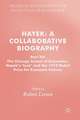
Hayek: A Collaborative Biography: Archival Insights into the Evolution of Economics
Autor Robert Leesonen Limba Engleză Hardback – 10 noi 2017





Preț: 991.69 lei
Preț vechi: 1209.38 lei
-18%
Puncte Express: 1488
Carte tipărită la comandă
Livrare economică 03-17 decembrie
Livrare prin curier în România Termenul estimat este afișat lângă disponibilitate.
Transport gratuit pentru acest produs Plată online sau ramburs, în funcție de opțiunile comenzii.
Retur gratuit în 14 zile Comandă securizată și suport în română.
Specificații
ISBN-13: 9783319520537
ISBN-10: 3319520539
Pagini: 528
Ilustrații: VII, 520 p.
Dimensiuni: 153 x 216 x 33 mm
Greutate: 0.75 kg
Ediția:1st ed. 2017
Editura: Springer International Publishing
Colecția Archival Insights into the Evolution of Economics
Seria Archival Insights into the Evolution of Economics
Locul publicării:Cham, Switzerland
ISBN-10: 3319520539
Pagini: 528
Ilustrații: VII, 520 p.
Dimensiuni: 153 x 216 x 33 mm
Greutate: 0.75 kg
Ediția:1st ed. 2017
Editura: Springer International Publishing
Colecția Archival Insights into the Evolution of Economics
Seria Archival Insights into the Evolution of Economics
Locul publicării:Cham, Switzerland
V-ar putea interesa
-
 Contemporary EconomicsRobert J. Carbaugh-19%Preț: 539.90 lei666.54 lei
 -
 The Economy of CitiesJane JacobsPreț: 92.41 lei
 -
 Gender and Social CapitalBrenda O'Neill-15%Preț: 446.80 lei525.64 lei
 -
 Preț: 106.40 lei
 -
 An Economic Theorist's Book of TalesGeorge AkerlofPreț: 436.98 lei
 -
 Game Theory for Applied EconomistsRobert S Gibbons-19%Preț: 459.12 lei566.81 lei
 -
 Spatial Statistics and ModelingCarlo Gaetan-18%Preț: 1114.35 lei1358.96 lei
 -
 Preț: 118.74 lei
 -
 Saving The SunGillian TettPreț: 116.89 lei
 -
 The Return of Depression EconomicsPaul Krugman-32%Preț: 62.97 lei92.20 lei
 -
 The Reformation in EconomicsPhilip PilkingtonPreț: 371.71 lei
 -
 Macroeconomic Patterns and StoriesEdward E. Leamer-18%Preț: 760.45 lei927.38 lei
 -
 Handbook of New Institutional EconomicsClaude Ménard-18%Preț: 728.59 lei888.52 lei
 -
 Economic DynamicsGiancarlo Gandolfo-18%Preț: 977.31 lei1191.84 lei
 -
 -15%Preț: 574.50 lei675.88 lei
 -
 Essays on Research MethodologyDinesh S. Hegde-15%Preț: 667.19 lei784.93 lei
Cuprins
1. Introduction.- 2. 2. Hayek’s ‘more effective form’.- 3. Post-Habsburg Führercults: Hayek, Hitler, Mises, Mayer and Spann.- 4. Hayek’s ‘framework of traditional and moral rules’.- 5. Universities and pseudo-academic Institutes: corruption, deflation, and opportunity.- 6. Honor.- 7. Austrian Business Cycle Theory and Hayek Triangles.- 8. 1-3: Austria, 1899-1931.- 9. America, Freudians, and the quest for producer sovereignty.- 10. Austrians and the Holocaust.- 11. London, Cambridge and Gibraltar, 1931-1949. 12. Chicago, 1950-1962.- 13. Europe, 1962-1992.- 14. The Nobel Prize Community, 1901.
Notă biografică
Robert Leeson has been a prolific contributor to the Schools of Economic Thought literature for a quarter of a century. He is ranked joint 17th with Paul Samuelson, based on the number of published journal articles included in the ECONLIT database of the American Economic Association. His articles have appeared in the Economic Journal, Economica, Cambridge Journal of Economics, Journal of Post Keynesian Economics, History of Political Economy and elsewhere. He is also a prolific op-ed columnist and economic commentator for a variety of newspapers, including the San Francisco Chronicle and the Australian Financial Review. In a 2005 column in the San Francisco Chronicle he predicted the global financial crisis.
Textul de pe ultima copertă
This book is the seventh volume in this series which explores the life of Nobel Price-winning economist F.A. Hayek (1899-1992). The volume uses archival material, juxtaposed with Hayek’s published work to challenge the existing perceptions of his life and thought. It examines the methods by which Hayek interacted with – and schemed against – the knowledge communities that he encountered during his very long life. Chapters explore the ‘rules of engagement’ that Hayek employed when interacting with fifth leading knowledge communities, including the Nobel Prize selection committee who were led to believe his claim about having predicted the Great Depression. It also explores his interactions with William Beveridge, the founder of the modern British Welfare State, A. C. Pigou, the founder of the market school, J. M. Keynes, Sir Arthur Lewis, and Anna Lerner.
Caracteristici
A fresh look at the life and works of Hayek Extensive use of archival material An in-depth look on how economic theory is conceived