
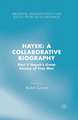
Hayek: A Collaborative Biography: Archival Insights into the Evolution of Economics
Autor Robert Leesonen Limba Engleză Paperback – 14 dec 2018
This volume examines the consequences of the ‘free’ market colonisation of economics – climate change, financial crises and the corruption of academic discourse




Preț: 730.74 lei
Preț vechi: 803.01 lei
-9%
Puncte Express: 1096
Carte tipărită la comandă
Livrare economică 30 noiembrie-05 decembrie
Livrare prin curier în România Termenul estimat este afișat lângă disponibilitate.
Transport gratuit pentru acest produs Plată online sau ramburs, în funcție de opțiunile comenzii.
Retur gratuit în 14 zile Comandă securizată și suport în română.
Specificații
ISBN-13: 9783030084530
ISBN-10: 3030084531
Pagini: 556
Ilustrații: VI, 548 p.
Dimensiuni: 148 x 210 x 30 mm
Greutate: 0.71 kg
Ediția:Softcover reprint of the original 1st ed. 2018
Editura: Springer International Publishing
Colecția Archival Insights into the Evolution of Economics
Seria Archival Insights into the Evolution of Economics
Locul publicării:Cham, Switzerland
ISBN-10: 3030084531
Pagini: 556
Ilustrații: VI, 548 p.
Dimensiuni: 148 x 210 x 30 mm
Greutate: 0.71 kg
Ediția:Softcover reprint of the original 1st ed. 2018
Editura: Springer International Publishing
Colecția Archival Insights into the Evolution of Economics
Seria Archival Insights into the Evolution of Economics
Locul publicării:Cham, Switzerland
V-ar putea interesa
-
 Contemporary EconomicsRobert J. Carbaugh-19%Preț: 539.90 lei666.54 lei
 -
 The Economy of CitiesJane JacobsPreț: 92.41 lei
 -
 Gender and Social CapitalBrenda O'Neill-15%Preț: 446.80 lei525.64 lei
 -
 Preț: 106.40 lei
 -
 An Economic Theorist's Book of TalesGeorge AkerlofPreț: 436.98 lei
 -
 Game Theory for Applied EconomistsRobert S Gibbons-19%Preț: 459.12 lei566.81 lei
 -
 Spatial Statistics and ModelingCarlo Gaetan-18%Preț: 1114.35 lei1358.96 lei
 -
 Preț: 118.74 lei
 -
 Saving The SunGillian TettPreț: 116.89 lei
 -
 The Return of Depression EconomicsPaul Krugman-32%Preț: 62.97 lei92.20 lei
 -
 The Reformation in EconomicsPhilip PilkingtonPreț: 359.55 lei
 -
 Macroeconomic Patterns and StoriesEdward E. Leamer-18%Preț: 760.45 lei927.38 lei
 -
 Handbook of New Institutional EconomicsClaude Ménard-18%Preț: 728.59 lei888.52 lei
 -
 Economic DynamicsGiancarlo Gandolfo-18%Preț: 977.31 lei1191.84 lei
 -
 -15%Preț: 574.50 lei675.88 lei
 -
 Essays on Research MethodologyDinesh S. Hegde-15%Preț: 667.19 lei784.93 lei
Cuprins
1.Orwellian Rectifiers and the 'Free' Market Welfare State.- 2.The Economic Consequences of Blind Faith.- 3.The Politicization of Academia.- 4.'Financial Considerations' and the 'Free' Academic Market.- 5.'Consistent Doctrine', 'The Morals of the Market', and the 'Filthy Load of Pinks'.- 6.The Fall of Left Utopia and the Rise of 'Free' Market Euphoria.- 7.'Intellectual Orgies' and 'the "Non-Concept" of Education.- 8.Mises' 'Evil Seed' of Christianity.- 9.'German Villains and Austrian Victims'.- 10.Who Lies Behind the 'Free' Market?
Notă biografică
Robert Leeson has been Visiting Professor of Economics at Stanford University, USA since 2005, National Fellow and Visiting Scholar at the Hoover Institution since 1995 and Adjunct Professor at Notre Dame Australia University since 2008. He has published numerous articles in journals including The Economic Journal and Economics and History of Political Economy. In addition to writing and editing twenty books, he is the co-editor (with Charles Palm) of The Collected Writings of Milton Friedman. He has held further visiting positions at Cambridge University, the University of California, Berkeley, the University of California, Santa Cruz, Santa Clara University and the University of Western Ontario.
Textul de pe ultima copertă
Funded by the tobacco and fossil fuel industries, the Mises- and Hayek-inspired ‘free’ market has adopted ‘The Slogan of Liberty’ - but should their faith-based assertions be accorded the same epistemological status as a science? If Austrian economics is a branch of divinely revealed ‘knowledge’ - as the epigone Godfather, Hans Sennholz, insists - what validity do its policy recommendations have? Should those who falsely claim to have PhDs be tax-funded as ‘Post-Doctoral Fellows’ and ‘Professors’?
This volume examines the consequences of the ‘free’ market colonisation of economics – climate change, financial crises and the corruption of academic discourse
This volume examines the consequences of the ‘free’ market colonisation of economics – climate change, financial crises and the corruption of academic discourse
Caracteristici
Makes extensive use of archival material to support arguments and debates Presents a comprehensive discussion of Hayek's influence and influences Illustrates the impact and effect that Austrian far-right movements of the time had on Hayek's intellectual development