
Hayek: A Collaborative Biography: Archival Insights into the Evolution of Economics
Autor Robert Leesonen Limba Engleză Hardback – 4 dec 2017
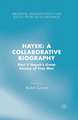
Leeson concludes this volume with a collection of chapters written by eminent scholars of Hayek. These chapters cover subjects as diverse as Hayek’s influence on scholars of Darwinian evolution, his views on psychology, and cultural evolution.




Preț: 1160.23 lei
Preț vechi: 1414.92 lei
-18%
Puncte Express: 1740
Carte tipărită la comandă
Livrare economică 03-17 decembrie
Livrare prin curier în România Termenul estimat este afișat lângă disponibilitate.
Transport gratuit pentru acest produs Plată online sau ramburs, în funcție de opțiunile comenzii.
Retur gratuit în 14 zile Comandă securizată și suport în română.
Specificații
ISBN-13: 9783319617138
ISBN-10: 3319617133
Pagini: 508
Ilustrații: VII, 498 p.
Dimensiuni: 153 x 216 x 32 mm
Greutate: 0.72 kg
Ediția:1st edition 2017
Editura: Springer International Publishing
Colecția Archival Insights into the Evolution of Economics
Seria Archival Insights into the Evolution of Economics
Locul publicării:Cham, Switzerland
ISBN-10: 3319617133
Pagini: 508
Ilustrații: VII, 498 p.
Dimensiuni: 153 x 216 x 32 mm
Greutate: 0.72 kg
Ediția:1st edition 2017
Editura: Springer International Publishing
Colecția Archival Insights into the Evolution of Economics
Seria Archival Insights into the Evolution of Economics
Locul publicării:Cham, Switzerland
V-ar putea interesa
-
 Contemporary EconomicsRobert J. Carbaugh-19%Preț: 539.90 lei666.54 lei
 -
 The Economy of CitiesJane JacobsPreț: 92.41 lei
 -
 Gender and Social CapitalBrenda O'Neill-15%Preț: 446.80 lei525.64 lei
 -
 Preț: 106.40 lei
 -
 An Economic Theorist's Book of TalesGeorge AkerlofPreț: 436.98 lei
 -
 Game Theory for Applied EconomistsRobert S Gibbons-19%Preț: 459.12 lei566.81 lei
 -
 Spatial Statistics and ModelingCarlo Gaetan-18%Preț: 1114.35 lei1358.96 lei
 -
 Preț: 118.74 lei
 -
 Saving The SunGillian TettPreț: 116.89 lei
 -
 The Return of Depression EconomicsPaul Krugman-32%Preț: 62.97 lei92.20 lei
 -
 The Reformation in EconomicsPhilip PilkingtonPreț: 359.55 lei
 -
 Macroeconomic Patterns and StoriesEdward E. Leamer-18%Preț: 760.45 lei927.38 lei
 -
 Handbook of New Institutional EconomicsClaude Ménard-18%Preț: 728.59 lei888.52 lei
 -
 Economic DynamicsGiancarlo Gandolfo-18%Preț: 977.31 lei1191.84 lei
 -
 -15%Preț: 574.50 lei675.88 lei
 -
 Essays on Research MethodologyDinesh S. Hegde-15%Preț: 667.19 lei784.93 lei
Cuprins
1. Fighting to prevent the ‘world from being made safe for democracy.- 2. Eugenics and the Austrian Third and Fourth Generation.- 3. Das Hayek Problem and Solution. 4. The Austrian Shadow and ‘The Slogan of Liberty.’. 5. Hayek’s ‘More Effective Form’ Eugenics?.- 6. Background to the Eugenics Movement and Influences on Friedrich Hayek.- 7. Eugenics and American Economics in the Interwar Years: The Case of Thomas Nixon Carver.- 8.Economists and Eugenics: Progressive Era Racism and its (Jewish) Discontents.- 9. The Evolution of Hayek’s Ethics.- 10. 'Dictatorial Democracy,’ the Four Habsburg Estates, and ‘The Ethical Foundations of a Free Society.’.- 11. Beyond Darwinism—Examining the Hayek-Imanishi dialogues.- 12. Hayek, Evolution and Imanishi.- 13. Crossing Paths: On Hayek’s Darwinian Evolutionism.
Notă biografică
Robert Leeson has published numerous articles in journals including the Economic Journal and Economics and History of Political Economy. In addition to writing and editing nineteen books, he is the co-editor (with Charles Palm) of The Collected Writings of Milton Friedman. He has been Visiting Professor of Economics at Stanford University, USA since 2005, National Fellow and Visiting Scholar at the Hoover Institution since 1995 and Adjunct Professor at Notre Dame Australia University since 2008. He has held other visiting positions at Cambridge University, the University of California, Berkeley, the University of California, Santa Cruz, Santa Clara University and the University of Western Ontario.
Textul de pe ultima copertă
This tenth part of Robert Leeson's collaborative biography of Friedrich August von Hayek explores Hayek’s thought on the free market and democracy. Using an unparalleled array of archival materials, Leeson reconstructs Hayek’s thinking as the notorious economist and his acolytes set about reshaping the post-war economic order. Darker areas of Hayek’s thought are also explored, including the influence of eugenics on his thought and his support for radical right-wing dictatorships in South America.
Leeson concludes this volume with a collection of chapters written by eminent scholars of Hayek. These chapters cover subjects as diverse as Hayek’s influence on scholars of Darwinian evolution, his views on psychology, and cultural evolution.
Leeson concludes this volume with a collection of chapters written by eminent scholars of Hayek. These chapters cover subjects as diverse as Hayek’s influence on scholars of Darwinian evolution, his views on psychology, and cultural evolution.
Caracteristici
Extensive use of archival material Contributions from several well-known Hayek scholars Comprehensive discussion of Hayek's influence and influences