
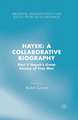
Hayek: A Collaborative Biography: Archival Insights into the Evolution of Economics
Editat de Robert Leesonen Limba Engleză Hardback – 16 noi 2018
On 9 August 1974, Richard Nixon resigned to avoid impeachment; on 29 April 1975, the United States scuttled from their Embassy in Saigon - optics that were interpreted as defeats for the ‘International Right’. Yet in 1975, Margaret Thatcher became leader of the Conservative Party; and in 1976 Ronald Reagan almost unseated a sitting Republican Party President. Pivotal to the ‘turn to the Right’ was Friedrich ‘von’ Hayek’s 1974 Nobel Prize for Economic Science - awarded for having used Austrian Business Cycle Theory to predict the Great Depression: ‘For him it is not a matter of a simple defence of a liberal system of society as may sometimes appear from the popularized versions of his thinking.’
The evidence suggests that Hayek’s fraudulent assertion was uncovered at the University of Chicago in the early 1930s – but not reported. The most likely explanation is self-censorship - for reasons of ideological correctness, fund raising and residual deference to the Second Estate. Four indirect tests suggest that ‘free’ market economists have - in other instances and presumably for fund-raising motives - suppressed embarrassing ‘knowledge’: which suggests that they were perfectly capable of suppressing ‘knowledge’ about Hayek’s non-prediction of the Great Depression.
With respect to the Nobel Prize and thus his ability to reach a wider audience, Hayek was fortune in having two loyal ‘intermediaries’: Lionel Robbins and Fritz Machlup who were – and probably felt themselves to be – ‘socially’ inferior to ‘von’ Hayek.




Preț: 762.17 lei
Preț vechi: 929.47 lei
-18%
Puncte Express: 1143
Carte tipărită la comandă
Livrare economică 03-17 decembrie
Livrare prin curier în România Termenul estimat este afișat lângă disponibilitate.
Transport gratuit pentru acest produs Plată online sau ramburs, în funcție de opțiunile comenzii.
Retur gratuit în 14 zile Comandă securizată și suport în română.
Specificații
ISBN-13: 9783319952185
ISBN-10: 3319952188
Pagini: 448
Ilustrații: XV, 432 p.
Dimensiuni: 153 x 216 x 29 mm
Greutate: 0.65 kg
Ediția:1st edition 2018
Editura: Springer
Colecția Archival Insights into the Evolution of Economics
Seria Archival Insights into the Evolution of Economics
Locul publicării:Cham, Switzerland
ISBN-10: 3319952188
Pagini: 448
Ilustrații: XV, 432 p.
Dimensiuni: 153 x 216 x 29 mm
Greutate: 0.65 kg
Ediția:1st edition 2018
Editura: Springer
Colecția Archival Insights into the Evolution of Economics
Seria Archival Insights into the Evolution of Economics
Locul publicării:Cham, Switzerland
V-ar putea interesa
-
 Contemporary EconomicsRobert J. Carbaugh-19%Preț: 539.90 lei666.54 lei
 -
 The Economy of CitiesJane JacobsPreț: 92.41 lei
 -
 Gender and Social CapitalBrenda O'Neill-15%Preț: 446.80 lei525.64 lei
 -
 Preț: 106.40 lei
 -
 An Economic Theorist's Book of TalesGeorge AkerlofPreț: 436.98 lei
 -
 Game Theory for Applied EconomistsRobert S Gibbons-19%Preț: 459.12 lei566.81 lei
 -
 Spatial Statistics and ModelingCarlo Gaetan-18%Preț: 1114.35 lei1358.96 lei
 -
 Preț: 118.74 lei
 -
 Saving The SunGillian TettPreț: 116.89 lei
 -
 The Return of Depression EconomicsPaul Krugman-32%Preț: 62.97 lei92.20 lei
 -
 The Reformation in EconomicsPhilip PilkingtonPreț: 359.55 lei
 -
 Macroeconomic Patterns and StoriesEdward E. Leamer-18%Preț: 760.45 lei927.38 lei
 -
 Handbook of New Institutional EconomicsClaude Ménard-18%Preț: 728.59 lei888.52 lei
 -
 Economic DynamicsGiancarlo Gandolfo-18%Preț: 977.31 lei1191.84 lei
 -
 -15%Preț: 574.50 lei675.88 lei
 -
 Essays on Research MethodologyDinesh S. Hegde-15%Preț: 667.19 lei784.93 lei
Cuprins
Part I: Hayek's Luck.- 1. ‘I have been lucky in this game.’ -Robert Leeson.- 2. The Tobacco, Obesity and Fossil Fuel Lobby - ‘As Happy as Hell.’ -Robert Leeson.- 3. 1-15: Residual reverence towards the Second Estate. -Robert Leeson.- 4. 16-20: Loyal ‘intermediaries.’ -Robert Leeson.- 5. 21-24: ‘I desire to preserve correct relations in public.’ Robert Leeson.- 6. 25: Suppression, the dogs that didn’t bark, and the emerging Chicago School of Economics. -Robert Leeson.- 7. 31 Conclusions about Hayek’s Nineteen Thirty One ‘Prediction.’ -Robert Leeson.- Part II: Myrdal and Machlup.- 8. The Saving/Investment Explanation of Business Cycles in Hayek and Myrdal: Similarities and Differences. -Adrián de León Arias.- 9. Machlup and Hayek: Filation of Ideas and Ambition. Carol M. Connell.- Part III: The Chicago School of Economics.- 10. Friedman and Hayek’s Converging Ideas on Freedom and the State. Birsen Filip.- 11. Chicago Economics in the Making, 1926-1940: A Further Look at United States Interwar Pluralism. Luca Fiorito and Sebastiano Nerozzi.
Notă biografică
Robert Leeson has been Visiting Professor of Economics at Stanford University, USA since 2005, National Fellow and Visiting Scholar at the Hoover Institution since 1995 and Adjunct Professor at Notre Dame Australia University since 2008. He has published numerous articles in journals including The Economic Journal and Economics and History of Political Economy. In addition to writing and editing twenty books, he is the co-editor (with Charles Palm) of The Collected Writings of Milton Friedman. He has held further visiting positions at Cambridge University, the University of California, Berkeley, the University of California, Santa Cruz, Santa Clara University and the University of Western Ontario.
Textul de pe ultima copertă
On 9 August 1974, Richard Nixon resigned to avoid impeachment; on 29 April 1975, the United States scuttled from their Embassy in Saigon - optics that were interpreted as defeats for the ‘International Right’. Yet in 1975, Margaret Thatcher became leader of the Conservative Party; and in 1976 Ronald Reagan almost unseated a sitting Republican Party President. Pivotal to the ‘turn to the Right’ was Friedrich ‘von’ Hayek’s 1974 Nobel Prize for Economic Science - awarded for having used Austrian Business Cycle Theory to predict the Great Depression: ‘For him it is not a matter of a simple defence of a liberal system of society as may sometimes appear from the popularized versions of his thinking.’
The evidence suggests that Hayek’s fraudulent assertion was uncovered at the University of Chicago in the early 1930s – but not reported. The most likely explanation is self-censorship - for reasons of ideological correctness, fund raising and residual deference to the Second Estate. Four indirect tests suggest that ‘free’ market economists have - in other instances and presumably for fund-raising motives - suppressed embarrassing ‘knowledge’: which suggests that they were perfectly capable of suppressing ‘knowledge’ about Hayek’s non-prediction of the Great Depression.
With respect to the Nobel Prize and thus his ability to reach a wider audience, Hayek was fortune in having two loyal ‘intermediaries’: Lionel Robbins and Fritz Machlup who were – and probably felt themselves to be – ‘socially’ inferior to ‘von’ Hayek.
Caracteristici
Makes extensive use of archival material to support arguments and debates Presents a comprehensive discussion of Hayek's influence and influences Explores the School of Chicago Economics