
Hayek: A Collaborative Biography: Archival Insights into the Evolution of Economics
Autor Robert Leesonen Limba Engleză Paperback – 22 dec 2018
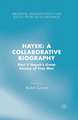
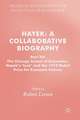
Two concepts of civilization revolve around power – should it be separated or concentrated? Liberalism in the non-Austrian classical tradition remains fearful of power concentrated in the hands of government, labour unions or corporations; Red Terrorists sought to monopolize power to liquidate enemies and competitors as a prelude to utopia (the ‘withering away of the State’); and behind the ‘slogan of liberty,’ White Terror promoters (Mises and Hayek) sought to concentrate power in the hands of a ‘dictatorial democracy’ where henchmen would liquidate enemies, and – ‘guided’ by ‘utopia’ (the ‘spontaneous’ order) – follow orders from their social superiors. This volume, Part XII, examines the ‘free’ market Use of Knowledge in Society; examines the foundations of ‘free’ market educational credentials; and asks whether those funded by the tobacco industry and the carbon lobby should be accorded ‘independent policy expert’ status.




Preț: 711.93 lei
Preț vechi: 837.56 lei
-15%
Puncte Express: 1068
Carte tipărită la comandă
Livrare economică 03-17 decembrie
Livrare prin curier în România Termenul estimat este afișat lângă disponibilitate.
Transport gratuit pentru acest produs Plată online sau ramburs, în funcție de opțiunile comenzii.
Retur gratuit în 14 zile Comandă securizată și suport în română.
Specificații
ISBN-13: 9783030090098
ISBN-10: 3030090094
Pagini: 428
Ilustrații: XII, 414 p.
Dimensiuni: 148 x 210 x 24 mm
Greutate: 0.55 kg
Ediția:Softcover reprint of the original 1st ed. 2018
Editura: Springer International Publishing
Colecția Archival Insights into the Evolution of Economics
Seria Archival Insights into the Evolution of Economics
Locul publicării:Cham, Switzerland
ISBN-10: 3030090094
Pagini: 428
Ilustrații: XII, 414 p.
Dimensiuni: 148 x 210 x 24 mm
Greutate: 0.55 kg
Ediția:Softcover reprint of the original 1st ed. 2018
Editura: Springer International Publishing
Colecția Archival Insights into the Evolution of Economics
Seria Archival Insights into the Evolution of Economics
Locul publicării:Cham, Switzerland
V-ar putea interesa
-
 Contemporary EconomicsRobert J. Carbaugh-19%Preț: 539.90 lei666.54 lei
 -
 The Economy of CitiesJane JacobsPreț: 92.41 lei
 -
 Gender and Social CapitalBrenda O'Neill-15%Preț: 446.80 lei525.64 lei
 -
 Preț: 106.40 lei
 -
 An Economic Theorist's Book of TalesGeorge AkerlofPreț: 436.98 lei
 -
 Game Theory for Applied EconomistsRobert S Gibbons-19%Preț: 459.12 lei566.81 lei
 -
 Spatial Statistics and ModelingCarlo Gaetan-18%Preț: 1114.35 lei1358.96 lei
 -
 Preț: 118.74 lei
 -
 Saving The SunGillian TettPreț: 116.89 lei
 -
 The Return of Depression EconomicsPaul Krugman-32%Preț: 62.97 lei92.20 lei
 -
 The Reformation in EconomicsPhilip PilkingtonPreț: 359.55 lei
 -
 Macroeconomic Patterns and StoriesEdward E. Leamer-18%Preț: 760.45 lei927.38 lei
 -
 Handbook of New Institutional EconomicsClaude Ménard-18%Preț: 728.59 lei888.52 lei
 -
 Economic DynamicsGiancarlo Gandolfo-18%Preț: 977.31 lei1191.84 lei
 -
 -15%Preț: 574.50 lei675.88 lei
 -
 Essays on Research MethodologyDinesh S. Hegde-15%Preț: 667.19 lei784.93 lei
Cuprins
1.‘Austrian Thought and Fascism’: ‘The victory of Fascism in a number of countries is only an episode in the long series of struggles over the problem of property.- 2. Persuade the intellectuals in the hopes that ultimately they could be converted and transmit my ideas to the public at large.- 3. Hayek and Aristocratic Influence.- 4. Pigouvian Market Failure.- 5. Britain, White Supremacism, and the International Right.- 6. The ‘Free’ Market ‘Emergency’ Demand for ‘Fascism.'.- 7.‘[Italian] Fascism.- 8. Austrian ‘Instincts,’ Serfdom, and Spanish and Portuguese ‘Fascism.
Notă biografică
Robert Leeson has been Visiting Professor of Economics at Stanford University, USA since 2005, National Fellow and Visiting Scholar at the Hoover Institution since 1995 and Adjunct Professor at Notre Dame Australia University since 2008. He has published numerous articles in journals including The Economic Journal and Economics and History of Political Economy. In addition to writing and editing twenty books, he is the co-editor (with Charles Palm) of The Collected Writings of Milton Friedman. He has held further visiting positions at Cambridge University, the University of California, Berkeley, the University of California, Santa Cruz, Santa Clara University and the University of Western Ontario.
Textul de pe ultima copertă
F.A. von Hayek (1899-1992) was a Nobel Prize winning economist, famous for promoting an Austrian version of classical liberalism. The multi-volume Hayek: A Collaborative Biography examines the evolution of his life and influence.
Two concepts of civilization revolve around power – should it be separated or concentrated? Liberalism in the non-Austrian classical tradition remains fearful of power concentrated in the hands of government, labour unions or corporations; Red Terrorists sought to monopolize power to liquidate enemies and competitors as a prelude to utopia (the ‘withering away of the State’); and behind the ‘slogan of liberty,’ White Terror promoters (Mises and Hayek) sought to concentrate power in the hands of a ‘dictatorial democracy’ where henchmen would liquidate enemies, and – ‘guided’ by ‘utopia’ (the ‘spontaneous’ order) – follow orders from their social superiors. This volume, Part XII, examines the ‘free’ market Use of Knowledge in Society; examines thefoundations of ‘free’ market educational credentials; and asks whether those funded by the tobacco industry and the carbon lobby should be accorded ‘independent policy expert’ status.
Two concepts of civilization revolve around power – should it be separated or concentrated? Liberalism in the non-Austrian classical tradition remains fearful of power concentrated in the hands of government, labour unions or corporations; Red Terrorists sought to monopolize power to liquidate enemies and competitors as a prelude to utopia (the ‘withering away of the State’); and behind the ‘slogan of liberty,’ White Terror promoters (Mises and Hayek) sought to concentrate power in the hands of a ‘dictatorial democracy’ where henchmen would liquidate enemies, and – ‘guided’ by ‘utopia’ (the ‘spontaneous’ order) – follow orders from their social superiors. This volume, Part XII, examines the ‘free’ market Use of Knowledge in Society; examines thefoundations of ‘free’ market educational credentials; and asks whether those funded by the tobacco industry and the carbon lobby should be accorded ‘independent policy expert’ status.
Caracteristici
Extensive use of archival material Considers how the free market relates to the tobacco industry and climate change Explores the relationship between power and liberalism