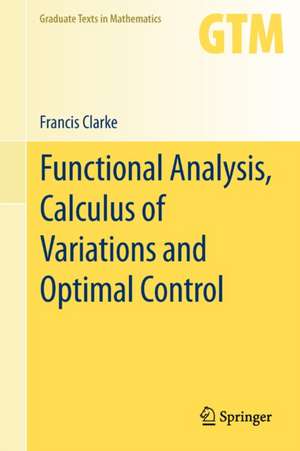
Functional Analysis, Calculus of Variations and Optimal Control: Graduate Texts in Mathematics, cartea 264
Autor Francis Clarkeen Limba Engleză Hardback – 6 feb 2013
Remarcăm structura riguros eșalonată a lucrării Functional Analysis, Calculus of Variations and Optimal Control, organizată în patru părți fundamentale ce facilitează o progresie logică de la abstract la aplicat. Metodologia autorului Francis Clarke se bazează pe unitatea dintre analiza funcțională clasică și instrumentele moderne ale analizei ne-netede, necesare pentru abordarea problemelor de control optim. Primele secțiuni fundamentează spațiile normate, seturile convexe și topologiile slabe, pregătind terenul pentru a doua jumătate a cărții, dedicată calculului variațiilor și metodelor Hamilton-Jacobi. Apreciem integrarea unor rezultate avansate care apar pentru prima dată într-un manual academic, precum unificările recente asupra regularității și principiul maximului al lui Pontryagin. Această abordare face ca volumul să fie nu doar un suport de curs, ci și o lucrare de referință pentru cercetători. Comparativ cu Functional Analysis, Sobolev Spaces, and Calculus of Variations de Pablo Pedregal, care se concentrează pe fundamentele analitice moderne și spațiile Sobolev, lucrarea lui Clarke este mai extinsă, integrând analiza ne-netedă și teoria sistemelor într-un cadru unitar. În contextul operei autorului, acest titlu rafinează și extinde conceptele explorate în lucrarea sa anterioară, Nonsmooth Analysis and Control Theory. Dacă volumul precedent era axat pe esența analizei ne-netede, ediția de față din seria Graduate Texts in Mathematics oferă un curs complet, îmbogățit cu peste 300 de exerciții și aplicații practice în economie și inginerie. Tonul este precis, specific literaturii matematice de nivel absolvent, menținând un echilibru între demonstrațiile riguroase și intuiția geometrică.
Din seria Graduate Texts in Mathematics
- 13%
 Preț: 407.97 lei
 -
 Preț: 401.21 lei
 -
 Preț: 508.82 lei
 - 15%
 Preț: 414.37 lei
 - 15%
 Preț: 552.46 lei
 - 15%
 Preț: 407.56 lei
 - 15%
 Preț: 530.03 lei
 - 15%
 Preț: 448.00 lei
 - 15%
 Preț: 412.20 lei
 - 15%
 Preț: 413.35 lei
 - 15%
 Preț: 450.20 lei
 - 15%
 Preț: 449.14 lei
 - 15%
 Preț: 530.66 lei
 - 15%
 Preț: 418.70 lei
 - 15%
 Preț: 486.50 lei
 - 15%
 Preț: 526.92 lei
 - 13%
 Preț: 406.59 lei
 -
 Preț: 446.38 lei
 - 15%
 Preț: 579.99 lei
 -
 Preț: 381.34 lei
 - 15%
 Preț: 455.36 lei
 - 15%
 Preț: 560.82 lei
 - 17%
 Preț: 445.95 lei
 - 15%
 Preț: 590.39 lei
 -
 Preț: 500.30 lei
 -
 Preț: 451.05 lei
 -
 Preț: 386.90 lei
 - 15%
 Preț: 614.52 lei
 - 15%
 Preț: 477.57 lei
 -
 Preț: 460.05 lei
 - 15%
 Preț: 498.36 lei
 -
 Preț: 504.56 lei
 - 18%
 Preț: 808.24 lei
 -
 Preț: 472.04 lei
 - 15%
 Preț: 621.81 lei
 -
 Preț: 398.40 lei
 - 15%
 Preț: 656.51 lei
Preț: 569.40 lei
Preț vechi: 669.87 lei
-15%
Carte tipărită la comandă
Livrare economică 30 noiembrie-14 decembrie
Specificații
ISBN-10: 1447148193
Pagini: 608
Ilustrații: XIV, 591 p. 24 illus., 8 illus. in color.
Dimensiuni: 160 x 241 x 37 mm
Greutate: 1.02 kg
Ediția:2013
Editura: Springer
Colecția Graduate Texts in Mathematics
Seria Graduate Texts in Mathematics
Locul publicării:London, United Kingdom
V-ar putea interesa
-
 Further Mathematics for Economic AnalysisKnut Sydsaeter-11%Preț: 679.12 lei763.06 lei
 -
 A Course in Calculus and Real AnalysisSudhir R. Ghorpade-19%Preț: 509.25 lei628.70 lei
 -
 Introductory Functional Analysis with Applications (WSE)Erwin Kreyszig-18%Preț: 988.71 lei1205.75 lei
 -
 Elements of the Theory of Functions and Functional AnalysisA. N. Kolmogorov-20%Preț: 120.10 lei149.46 lei
 -
 Preț: 90.15 lei
 -
 Optimal Control TheoryDonald E. KirkPreț: 210.78 lei
 -
 Introductory Real AnalysisA. N. Kolmogorov-25%Preț: 141.37 lei188.28 lei
 -
 Elementary Classical AnalysisJerrold Marsden-9%Preț: 574.10 lei630.88 lei
 -
 -27%Preț: 1220.45 lei1661.45 lei
 -
 Linear Functional AnalysisBryan RynnePreț: 306.67 lei
 -
 Nonlinear Analysis - Theory and MethodsNikolaos S. Papageorgiou-18%Preț: 947.92 lei1156.00 lei
 -
 Computational Mathematics and Variational AnalysisNicholas J. Daras-18%Preț: 960.80 lei1171.72 lei
 -
 Convex Analysis and BeyondBoris S. Mordukhovich-17%Preț: 529.30 lei637.72 lei
 -
 Fundamentals of Convex Analysis and OptimizationRafael Correa-15%Preț: 415.48 lei488.81 lei
 -
 Partial Differential Equations IIIMichael E. TaylorPreț: 560.75 lei
 -
 Fundamentals of Functional AnalysisDouglas Farenick-15%Preț: 511.22 lei601.43 lei
 -
 Calculus and Analysis in Euclidean SpaceJerry ShurmanPreț: 403.29 lei
 -
 Functional AnalysisSergei Ovchinnikov-15%Preț: 402.83 lei473.91 lei
Public țintă
GraduateDe ce să citești această carte
Această lucrare este esențială pentru studenții de master și doctorat în matematică sau inginerie care doresc o bază solidă în optimizare. Cititorul câștigă o perspectivă unificată asupra analizei funcționale și controlului optim, beneficiind de expertiza unui lider în domeniu. Este o resursă rară care include dezvoltări recente despre principiul Pontryagin, fiind ideală pentru cercetarea aplicată în economie sau sisteme dinamice.
Descriere scurtă
This book provides a thorough introduction to functional analysis and includes many novel elements as well as the standard topics. A short course on nonsmooth analysis and geometry completes the first half of the book whilst the second half concerns the calculus of variations and optimal control. The author provides a comprehensive course on these subjects, from their inception through to the present. A notable feature is the inclusion of recent, unifying developments on regularity, multiplier rules, and the Pontryagin maximum principle, which appear here for the first time in a textbook. Othermajor themes include existence and Hamilton-Jacobi methods.
The many substantial examples, and the more than three hundred exercises, treat such topics as viscosity solutions, nonsmooth Lagrangians, the logarithmic Sobolev inequality, periodic trajectories, and systems theory. They also touch lightly upon several fields of application: mechanics, economics, resources, finance, control engineering.
Functional Analysis, Calculus of Variations and Optimal Control is intended to support several different courses at the first-year or second-year graduate level, on functional analysis, on the calculus of variations and optimal control, or on some combination. For this reason, it has been organized with customization in mind. The text also has considerable value as a reference. Besides its advanced results in the calculus of variations and optimal control, its polished presentation of certain other topics (for example convex analysis, measurable selections, metric regularity, and nonsmooth analysis) will be appreciated by researchers in these and related fields.
Cuprins
Recenzii
“The book is composed of four parts … . A nice feature of this graduate-level textbook is that the book is sprinkled with a number of exercises including additional ones for each part of the book, notes, solutions, and hints and hence ideally suitable for adaptation for a first/second level graduate course in control theory. … the book, written by a well-known expert in control theory, is an excellent lasting addition to the field of calculus of variations and optimal control.” (D. Subbaram Naidu, Amazon.com, May, 2013)
“Each of the four parts the book, or selections of chapters, can be used for courses on different topics. … Written by an expert in the field, with outstanding contributions to nonsmooth analysis, calculus of variations and optimal control, the present book, written in a live but rigorous style, will help the interested people to a smooth approach and a better understanding of this difficult subject in mathematics, both pure and applied, which is optimal control.” (S. Cobzaş, Studia Universitatis Babes-Bolyai, Mathematica, Vol. 58 (2), 2013)
"This new book stands out because it combines, within a single publication, treatment of major themes of optimal control theory with coverage of areas of functional analysis, convex analysis, the calculus of variations and nonsmooth analysis oriented towards aspects of these subjects having special relevance to control. But to describe it as a self-contained text book for a graduate level course in optimal control theory is to sell it short. This is because the parts preceding the optimal control chapters, on functional analysis, optimization and nonsmooth analysis, and the calculus of variations all to a large extent stand alone, and so it provides suitable material for several courses, besides one on optimal control."
"The final section covers, for the first time in book form, the most recent important advances in the theory of necessary conditions."
"The quality of exposition is extremely high. Great emphasis has been placed on accessibility, with much motivating discussion and a very large number of exercises and worked examples."
Reviewed by Richard B. Vinter (Mathematical Reviews)
In summary, this book is a monumental work collecting an impressive amount of technical material ranging from historical results of calculus of variations to modern advances in nonsmooth analysis and optimization. As such, the book as a whole cannot be considered as a textbook: its scope is too broad, and some developments (especially in Part IV) seem to be too technical. However, on pages ix-x the author suggests various roadmaps for course adoption, at various levels, based on his own teaching experience. Moreover, the author's lively writing style very often provides additional insight and intuition behind the key technical concepts. This is why, in this reviewer's opinion, this book is a central, and unprecedented reference in the field of optimization and optimal control.
Didier Henrion (LASS, Toulouse)