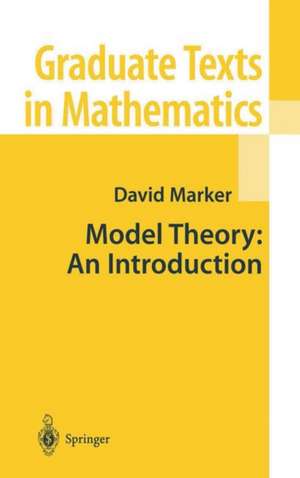
Model Theory : An Introduction: Graduate Texts in Mathematics, cartea 217
Autor David Markeren Limba Engleză Hardback – 21 aug 2002
Exercițiile propuse în Model Theory : An Introduction nu sunt simple verificări ale teoriei, ci extinderi care ating concepte matematice de o complexitate remarcabilă, facilitând tranziția de la logică la algebra clasică. Recomandăm acest volum ca pe o resursă fundamentală pentru studenții de la nivel masteral sau doctoral, datorită modului în care David Marker reușește să demonstreze utilitatea teoriei modelelor în analiza structurilor matematice concrete. Notăm cu interes progresia logică a cuprinsului, care pornește de la structuri și teorii de bază, trece prin tehnici esențiale și exemple algebrice, culminând cu secțiuni avansate despre grupuri omega-stabile și geometria seturilor puternic minimale. Această lucrare reprezintă o evoluție naturală în opera autorului; dacă în An Invitation to Mathematical Logic acesta oferea o bază accesibilă pentru logică, iar în Model Theory of Fields se concentra pe un domeniu de nișă, volumul de față sintetizează aceste direcții într-un manual comprehensiv. Model Theory : An Introduction constituie o alternativă solidă la A Shorter Model Theory de Wilfrid Hodges pentru cursurile de logică matematică, având avantajul unei orientări mult mai pronunțate spre aplicațiile algebrice practice și o integrare mai profundă a rezultatelor recente din teoria stabilității geometrice, temă explorată și de Anand Pillay în lucrările sale.
Din seria Graduate Texts in Mathematics
- 13%
 Preț: 407.97 lei
 -
 Preț: 526.10 lei
 - 15%
 Preț: 414.37 lei
 - 15%
 Preț: 403.03 lei
 - 15%
 Preț: 413.96 lei
 - 15%
 Preț: 530.03 lei
 - 15%
 Preț: 449.14 lei
 - 15%
 Preț: 532.83 lei
 - 15%
 Preț: 530.66 lei
 - 15%
 Preț: 501.17 lei
 - 15%
 Preț: 543.00 lei
 - 13%
 Preț: 406.00 lei
 -
 Preț: 446.38 lei
 - 15%
 Preț: 579.99 lei
 -
 Preț: 381.34 lei
 - 15%
 Preț: 455.36 lei
 - 15%
 Preț: 560.82 lei
 - 17%
 Preț: 453.24 lei
 - 15%
 Preț: 590.39 lei
 -
 Preț: 500.30 lei
 -
 Preț: 451.05 lei
 -
 Preț: 386.90 lei
 - 15%
 Preț: 614.52 lei
 - 15%
 Preț: 477.57 lei
 -
 Preț: 460.05 lei
 - 15%
 Preț: 498.36 lei
 -
 Preț: 504.56 lei
 - 18%
 Preț: 808.24 lei
 -
 Preț: 472.04 lei
 - 15%
 Preț: 621.81 lei
 -
 Preț: 398.40 lei
 - 15%
 Preț: 656.51 lei
 - 15%
 Preț: 602.39 lei
 - 15%
 Preț: 531.78 lei
 -
 Preț: 405.89 lei
Preț: 481.44 lei
Carte tipărită la comandă
Livrare economică 04-18 decembrie
Specificații
ISBN-10: 0387987606
Pagini: 356
Ilustrații: VIII, 345 p.
Dimensiuni: 160 x 241 x 25 mm
Greutate: 0.63 kg
Ediția:2002
Editura: Springer
Colecția Graduate Texts in Mathematics
Seria Graduate Texts in Mathematics
Locul publicării:New York, NY, United States
V-ar putea interesa
-
 McGraw-Hill Dictionary of MathematicsMcGraw-HillPreț: 135.64 lei
 -
 Introduction to Boolean AlgebrasSteven GivantPreț: 462.91 lei
 -
 Mathematical LogicJ. D. Monk-15%Preț: 621.69 lei731.40 lei
 -
 Perspectives of Elementary MathematicsG P Hochschild-15%Preț: 656.64 lei772.52 lei
 -
 Classical Descriptive Set TheoryAlexander Kechris-15%Preț: 406.08 lei477.74 lei
 -
 7th International Conference on Automated DeductionR. E. Shostak-15%Preț: 630.17 lei741.37 lei
 -
 Self-Reference and Modal LogicCraig Smoryński-15%Preț: 670.11 lei788.37 lei
 -
 A Course on Borel SetsS. M. Srivastava-15%Preț: 604.88 lei711.62 lei
 -
 A Course in Model TheoryBruno Poizat-15%Preț: 612.43 lei720.50 lei
 -
 The Universal Book of MathematicsDavid DarlingPreț: 259.01 lei
 -
 The Theory of Information and CodingRobert McEliece-14%Preț: 1189.40 lei1383.03 lei
 -
 Dependence LogicJouko Väänänen-11%Preț: 451.04 lei506.78 lei
 -
 The Mathematics of LogicRichard W. KayePreț: 425.61 lei
 -
 Forcing IdealizedJindrich Zapletal-14%Preț: 873.57 lei1015.78 lei
 -
 Lectures on Infinitary Model TheoryDavid Marker-14%Preț: 820.46 lei954.02 lei
 -
 Brouwer Meets HusserlMark van Atten-18%Preț: 982.35 lei1197.99 lei
 -
 A Concise Introduction to Mathematical LogicWolfgang Rautenberg-15%Preț: 506.81 lei596.25 lei
 -
 Preț: 159.09 lei
 -
 The Classical Decision ProblemEgon Börger-18%Preț: 1073.88 lei1309.61 lei
 -
 Petri-NetzeLutz PriesePreț: 257.98 lei
Public țintă
GraduateDe ce să citești această carte
Recomandăm această carte cercetătorilor și studenților avansați care doresc să înțeleagă cum logica matematică poate fi utilizată ca instrument de lucru în algebră. Cititorul câștigă o perspectivă riguroasă asupra teoriilor stabile și a geometriei seturilor minimale, beneficiind de un aparat pedagogic testat în cadrul prestigioasei serii Graduate Texts in Mathematics de la Springer.
Cuprins
Introduction * Structures and Theories * Basic Techniques * Algebraic Examples * Realizing and Omitting Types * Indiscernibles * w-stable theoryes * w-stable groups * Geometry of strongly minmal sets * Appendix A: Set Theory * Appendix B: Real Algebra * References * Index
Recenzii
MATHEMATICAL REVIEWS
"This is an extremely fine graduate level textbook on model theory. There is a careful selection of topics…There is a strong focus on the meaning of model-theoretic concepts in mathematically interesting examples. The exercises touch on a wealth of beautiful topics."
"This is an extremely fine graduate level textbook on model theory. There is a careful selection of topics, with a route leading to a substantial treatment of Hrushovski’s proof of the Mordell-Lang conjecture for function fields. … The exercises touch on a wealth of beautiful topics. … There is additional basic background in two appendices (on set theory and on real algebra)." (Dugald Macpherson, Mathematical Reviews, 2003 e)
"Model theory is the branch of mathematical logic that examines what it means for a first-order sentence … to be true in a particular structure … . This is a text for graduate students, mainly aimed at those specializing in logic, but also of interest for mathematicians outside logic who want to know what model theory can offer them in their own disciplines. … it is one which makes a good case for model theory as much more than a tool for specialist logicians." (Gerry Leversha, The Mathematical Gazette, Vol. 88 (513), 2004)
"The author’s intended audience for this high level introduction to model theory is graduate students contemplating research in model theory, graduate students in logic, and mathematicians who are not logicians but who are in areas where model theory has interesting applications. … The text is noteworthy for its wealth of examples and its desire to bring the student to the point where the frontiers of research are visible. … this book should be on the shelf of anybody with an interest in model theory." (J. M. Plotkin, Zentralblatt Math, Vol. 1003 (03), 2003)
Textul de pe ultima copertă
This book is a modern introduction to model theory which stresses applications to algebra throughout the text. The first half of the book includes classical material on model construction techniques, type spaces, prime models, saturated models, countable models, and indiscernibles and their applications. The author also includes an introduction to stability theory beginning with Morley's Categoricity Theorem and concentrating on omega-stable theories. One significant aspect of this text is the inclusion of chapters on important topics not covered in other introductory texts, such as omega-stable groups and the geometry of strongly minimal sets. The author then goes on to illustrate how these ingredients are used in Hrushovski's applications to diophantine geometry.
David Marker is Professor of Mathematics at the University of Illinois at Chicago. His main area of research involves mathematical logic and model theory, and their applications to algebra and geometry. This book was developed from a series of lectures given by the author at the Mathematical Sciences Research Institute in 1998.
Descriere
Assumes only a familiarity with algebra at the beginning graduate level; Stresses applications to algebra; Illustrates several of the ways Model Theory can be a useful tool in analyzing classical mathematical structures