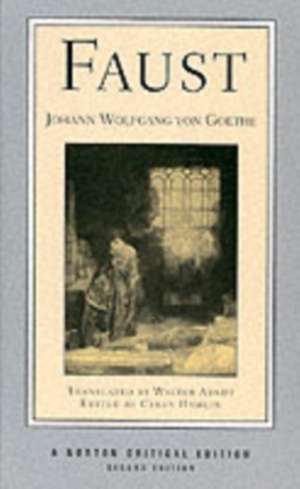
Faust
Autor Johann Wolfgang von Goethe Editat de Cyrus Hamlin Traducere de Walter Arndten Limba Engleză Paperback – 5 noi 1998
Găsim în această ediție publicată de WORDSWORTH EDITIONS LTD o abordare tehnică riguroasă menită să restaureze integritatea vizuală a textului clasic. Spre deosebire de reproducerile fotostatice obișnuite, această versiune a fost reformatată integral prin tehnici moderne de tehnoredactare, corectând erorile de punctuație și punctele oarbe specifice tehnologiei OCR, fără a altera însă construcția originală a operei. Apreciem în mod deosebit efortul de a păstra autenticitatea istorică a textului lui Johann Wolfgang von Goethe, oferind în același timp o lizibilitate adaptată cerințelor contemporane. Această ediție, ce face parte din seria Classics of World Literature, completează perspectiva oferită de Goethe: Faust Part One de Nicholas Boyle, adăugând o dimensiune vizuală și structurală unitară pe care edițiile fragmentate sau pur critice o omit uneori în favoarea analizei academice. Dacă lucrarea lui Boyle se concentrează pe coerența poetică a primei părți, ediția de față propune o experiență de lectură fluidă a întregului ansamblu dramatic. În contextul operei autorului, Faust reprezintă punctul culminant al carierei sale, integrând temele introspecției și ale ambiției umane pe care le regăsim și în Sketchy, Doubtful, Incomplete Jottings. Structura narativă este una complexă, pendulând între registrul tragic și cel comic, unde personajul Mephistopheles devine un catalizator pentru explorarea limitelor cunoașterii umane. Ritmul lecturii este susținut de bogăția imaginilor și a versificației, transformând acest poem dramatic într-o experiență intelectuală densă, dar accesibilă prin claritatea noii prezentări grafice.
Preț: 194.84 lei
Carte disponibilă
Livrare economică 10-24 noiembrie
Specificații
ISBN-10: 0393972828
Pagini: 752
Ilustrații: bibliog
Dimensiuni: 144 x 237 x 23 mm
Greutate: 0.58 kg
Ediția:Critică
Editura: W. W. Norton & Company
V-ar putea interesa
-
 The Screwtape LettersC. S. LewisPreț: 78.87 lei
 -
 Hero Within - Rev. & Expanded Ed.Carol S PearsonPreț: 106.25 lei
 -
 -18%Preț: 101.10 lei123.29 lei
 -
 Brave New World RevisitedAldous Huxley-20%Preț: 57.13 lei71.13 lei
 -
 Selected WritingsMeister Eckhart-30%Preț: 65.03 lei93.40 lei
 -
 Notes from Underground and the DoubleFyodor DostoyevskyPreț: 79.69 lei
 -
 Warranted Christian BeliefAlvin Plantinga-17%Preț: 338.87 lei410.32 lei
 -
 -20%Preț: 354.42 lei444.71 lei
 -
 The Ritual Process: Structure and Anti-StructureVictor TurnerPreț: 407.09 lei
 -
 -14%Preț: 419.56 lei487.86 lei
 -
 -14%Preț: 418.63 lei486.77 lei
 -
 -24%Preț: 77.37 lei101.70 lei
 -
 The Opium of the IntellectualsRaymond Aron-8%Preț: 483.76 lei525.83 lei
 -
 Knowledge and Christian BeliefAlvin PlantingaPreț: 103.13 lei
 -
 Between Theater and AnthropologyRichard SchechnerPreț: 295.35 lei
 -
 Stilling the MindB. Alan Wallace-19%Preț: 88.17 lei108.38 lei
 -
 I Ching Bk of Changes & the Unchanging TruthHua-Ching NiPreț: 240.46 lei
 -
 The Way of MenJack DonovanPreț: 89.22 lei
 -
 Becoming a BarbarianJack DonovanPreț: 75.35 lei
 -
 A More Complete BeastJack DonovanPreț: 63.69 lei
 -
 The Complete Works of Michel de MontaigneMichel De MontaignePreț: 329.30 lei
 -
 Dreaming Yourself AwakeB. Alan WallacePreț: 108.86 lei
 -
 Wilhelm Meister's ApprenticeshipJohann Wolfgang von GoethePreț: 200.18 lei
 -
 Dreams of AwakeningCharlie Morley-18%Preț: 88.92 lei108.57 lei
 -
 Divine Comedy InfernoDante AlighieriPreț: 56.62 lei
 -
 The Lady from the SeaHenrik IbsenPreț: 30.58 lei
 -
 History of Classical Music for BeginnersR. Ryan EndrisPreț: 108.09 lei
 -
 Sparge tipareleSETH GODINPreț: 19.00 lei
 -
 Gândire rapidă, gândire lentăDaniel KahnemanPreț: 99.00 lei
De ce să citești această carte
Recomandăm această ediție oricărui cititor care dorește să descopere pilonul central al literaturii germane într-un format fizic de înaltă calitate. Câștigați acces la o traducere de referință a lui John R. Williams, prezentată într-o machetă grafică ce elimină erorile tipografice ale edițiilor vechi. Este motivul ideal pentru a explora mitul pactului cu diavolul și căutarea sensului existențial, într-o formă ce onorează importanța culturală a textului.
Despre autor
Johann Wolfgang von Goethe (1749–1832) a fost o figură enciclopedică a culturii europene, activând ca poet, dramaturg, romancier și om de știință. Membru marcant al mișcării Sturm und Drang, el a redefinit literatura germană prin lucrări precum „Suferințele tânărului Werther” și „Anii de ucenicie ai lui Wilhelm Meister”. Pe parcursul șederii sale la Weimar, unde a deținut funcții administrative importante, Goethe și-a dedicat șase decenii perfecționării dramei Faust, lucrare ce sintetizează vasta sa experiență asupra condiției umane, artei și științelor naturale.
Descriere scurtă
Descriere
Notă biografică
David Constantine is a poet, novelist, biographer, playwright and translator. He has taught German at the Universities of Durham, Oxford and Rutgers, New Jersey and is currently Visiting Professor in the School of English at the University of Liverpool. He lives in Oxford and (with his wife the translator Helen Constantine) is joint editor of Modern Poetry in Translation. His book of poetry Something for the Ghosts was short listed for the 2002 Whitbread Prize and his translation of Hans Magnus Enzensberger's Lighter than Air, won the Corneliu Popescu Prize for European Poetry Translation in 2003.
A S Byatt, novelist, short story writer, and critic, is the author of many books including Possession, winner of the 1990 Booker Prize; Babel Tower; The Biographer's Tale; and The Whistling Woman. She was appointed DBE in 1999.
Recenzii
"Goethe’s Faust is an enigmatic and perhaps barely translatable masterpiece. Its grotesque and exuberant part 2 must be the most outrageous poem in the western canon. Martin Greenberg’s revised version conveys the outrage yet also shows again and again why the poem does stand with the major works of the western tradition."—Harold Bloom
"Greenberg has accomplished a magnificent literary feat. He has taken a great German work, until now all but inaccessible to English readers, and made it into a sparkling English poem, full of verve and wit. Greenberg's translation lives; it is done in a modern idiom but with respect for the original text; I found it a joy to read."—Irving Howe