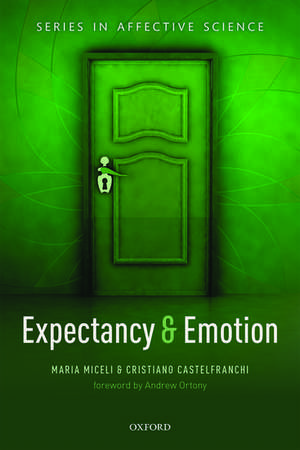
Expectancy and emotion: Series in Affective Science
Autor Maria Miceli, Cristiano Castelfranchien Limba Engleză Hardback – 27 noi 2014
Din seria Series in Affective Science
- 28%
 Preț: 521.37 lei
 - 28%
 Preț: 539.48 lei
 - 31%
 Preț: 700.70 lei
 - 31%
 Preț: 600.71 lei
 - 28%
 Preț: 506.59 lei
 - 31%
 Preț: 685.09 lei
 - 28%
 Preț: 399.99 lei
 - 28%
 Preț: 461.65 lei
 - 30%
 Preț: 629.76 lei
 - 31%
 Preț: 575.34 lei
 - 31%
 Preț: 549.22 lei
 - 31%
 Preț: 962.76 lei
 - 31%
 Preț: 549.22 lei
 - 31%
 Preț: 526.66 lei
 - 31%
 Preț: 592.54 lei
 - 31%
 Preț: 549.62 lei
 - 27%
 Preț: 504.33 lei
 - 31%
 Preț: 600.60 lei
 - 26%
 Preț: 892.05 lei
 - 21%
 Preț: 346.96 lei
 - 31%
 Preț: 544.32 lei
 - 32%
 Preț: 627.89 lei
 - 31%
 Preț: 576.05 lei
 - 28%
 Preț: 536.09 lei
 - 29%
 Preț: 480.81 lei
 - 32%
 Preț: 829.74 lei
 - 33%
 Preț: 921.63 lei
 - 33%
 Preț: 683.67 lei
 - 31%
 Preț: 813.66 lei
 - 31%
 Preț: 792.55 lei
 - 29%
 Preț: 719.48 lei
 - 26%
 Preț: 486.60 lei
 - 32%
 Preț: 722.73 lei
Preț: 560.63 lei
Preț vechi: 809.63 lei
-31%
Puncte Express: 841
Carte tipărită la comandă
Livrare economică 27 noiembrie-08 decembrie
Livrare prin curier în România Termenul estimat este afișat lângă disponibilitate.
Transport gratuit pentru acest produs Plată online sau ramburs, în funcție de opțiunile comenzii.
Retur gratuit în 14 zile Comandă securizată și suport în română.
Specificații
ISBN-13: 9780199685868
ISBN-10: 019968586X
Pagini: 278
Dimensiuni: 177 x 248 x 21 mm
Greutate: 0.66 kg
Editura: Oxford University Press
Colecția OUP Oxford
Seria Series in Affective Science
Locul publicării:Oxford, United Kingdom
ISBN-10: 019968586X
Pagini: 278
Dimensiuni: 177 x 248 x 21 mm
Greutate: 0.66 kg
Editura: Oxford University Press
Colecția OUP Oxford
Seria Series in Affective Science
Locul publicării:Oxford, United Kingdom
V-ar putea interesa
-
 Preț: 97.24 lei
 -
 Emotions, Technology, and LearningSharon Y. Tettegah-24%Preț: 340.60 lei450.53 lei
 -
 WillpowerJohn Tierney-19%Preț: 64.51 lei79.22 lei
 -
 Human Body Perception from the Inside OutGünther Knoblich-19%Preț: 311.74 lei385.31 lei
 -
 -33%Preț: 868.46 lei1290.82 lei
 -
 -32%Preț: 974.48 lei1439.70 lei
 -
 On Romantic Love: Simple Truths about a Complex EmotionBerit Brogaard-17%Preț: 191.72 lei232.32 lei
 -
 Thinking Twice: Two minds in one brainJonathan St B. T. Evans-30%Preț: 480.15 lei684.51 lei
 -
 -33%Preț: 553.21 lei822.52 lei
 -
 The Oxford Handbook of PsycholinguisticsGareth Gaskell-19%Preț: 385.65 lei477.95 lei
 -
 Musical Creativities in PracticePamela Burnard-33%Preț: 597.55 lei895.91 lei
 -
 Cognitive Psychology For DummiesMichael PakePreț: 154.97 lei
 -
 -15%Preț: 473.86 lei557.49 lei
 -
 Preț: 471.55 lei
 -
 Agent AutonomyHenry Hexmoor-20%Preț: 671.69 lei839.62 lei
 -
 -34%Preț: 47.25 lei71.79 lei
 -
 ChokeSian Beilock-26%Preț: 69.08 lei93.54 lei
 -
 Intelligent Agents VII. Agent Theories Architectures and LanguagesCristiano Castelfranchi-20%Preț: 326.26 lei407.83 lei
 -
 Artificial Social SystemsCristiano Castelfranchi-20%Preț: 325.44 lei406.80 lei
 -
 From Reaction to CognitionCristiano CastelfranchiPreț: 374.09 lei
 -
 The Challenge of AnticipationGiovanni Pezzulo-20%Preț: 335.46 lei419.34 lei
 -
 Trust and Deception in Virtual SocietiesCristiano Castelfranchi-20%Preț: 318.55 lei398.19 lei
Recenzii
In all my years of thinking about the various types of emotions and how best to characterize their differences, as well as my thinking about the nature of surprise, I have never been able to be as insightful, as profound, and as rigorous as these two authors are in this book. What they have done is not only unique, it is brilliant. As I read it, I stopped worrying about whether I agreed with them that this or that mental state is or isn't an emotion. Instead, I realized that sometimes it doesn't matter-that what matters is that there is a family of interesting and psychologically important, related states that we need to understand, regardless of how we categorize them. To make a die-hard purist like me ignore my prejudices is quite an achievement, and yet I feel all the better for it-indeed, almost liberated! Quite simply, this is wonderful, compelling book for which I heartily congratulate my friends, the authors. I loved reading it; I wish I had written it.
Notă biografică
Maria Miceli, a social psychologist with a background in philosophy, is a senior researcher at the Institute of Cognitive Sciences and Technologies of the Italian National Research Council (ISTC-CNR) in Rome, where she is a member of the Goal-Oriented Agents Lab. Her research activity focuses on the cognitive aspects of social mechanisms and processes and their interplay with motivational and emotional components, and on modelling architectures of intelligent autonomous agents endowed with social capabilities. Topics of interest include: kinds and processes of evaluation; values; self-esteem and defense strategies; loneliness; dependence, help-giving and help-seeking; loss of motivation; helplessness and crying; guilt and guilt-inducement strategies; anticipation and related emotions; social comparison and related emotions; persuasion strategies, with special reference to emotional strategies; comfort as a special form of social support; forgiveness.Cristiano Castelfranchi is professor of economical psychology at the LUISS University in Rome (2007-present), and full professor of social psychology at the Uninettuno international telematic university (2008-present). He has been full professor of general psychology at the University of Siena (2001-2011), and director of the ISTC-CNR in Rome (2002-2011), where he is presently coordinator of the Goal-Oriented Agents Lab. A cognitive scientist with a background in linguistics and psychology, he is also active in the multi-agent systems and social simulation communities. He introduced the study of goal-directed action and normative behavior in distributed artificial intelligence, and at the same time championed the use of the autonomous agents paradigm and social simulation in cognitive psychology and social science.