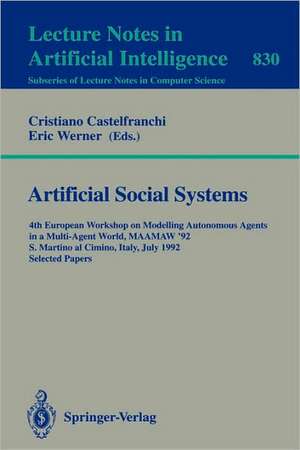
Artificial Social Systems
Editat de Cristiano Castelfranchi, Eric Werneren Limba Engleză Paperback – 13 iul 1994
The book opens with an introductory survey by the volume editors not only on the collection of papers but also on the history and present situation of Distributed Artificial Intelligence (DAI) and its interdisciplinary relations to social sciences, artificial life, and economics. The 19 technical papers are organized into sections on artificial life and reactive systems, economics and game theory, coordination and multi-agent planning, and DAI tools and applications.
Preț: 325.44 lei
Preț vechi: 406.80 lei
-20%
Puncte Express: 488
Carte tipărită la comandă
Livrare economică 26 noiembrie-10 decembrie
Livrare prin curier în România Termenul estimat este afișat lângă disponibilitate.
Transport gratuit de la 400.00 lei Plată online sau ramburs, în funcție de opțiunile comenzii.
Retur gratuit în 14 zile Comandă securizată și suport în română.
Specificații
ISBN-13: 9783540582663
ISBN-10: 3540582665
Pagini: 364
Ilustrații: XVIII, 337 p.
Dimensiuni: 155 x 235 x 20 mm
Greutate: 0.55 kg
Ediția:1994
Editura: Springer
Locul publicării:Berlin, Heidelberg, Germany
ISBN-10: 3540582665
Pagini: 364
Ilustrații: XVIII, 337 p.
Dimensiuni: 155 x 235 x 20 mm
Greutate: 0.55 kg
Ediția:1994
Editura: Springer
Locul publicării:Berlin, Heidelberg, Germany
V-ar putea interesa
-
 The Designer's Guide to VHDLPeter J. Ashenden-34%Preț: 375.93 lei572.56 lei
 -
 Deep SimplicityJohn GribbinPreț: 92.84 lei
 -
 Expectancy and emotionMaria Miceli-31%Preț: 560.63 lei809.63 lei
 -
 The Computer and the BrainJohn Von NeumannPreț: 113.01 lei
 -
 Introduction to Systems TheoryNiklas LuhmannPreț: 169.40 lei
 -
 Perturbation Analysis of Optimization ProblemsJ.Frederic Bonnans-18%Preț: 1341.26 lei1635.67 lei
 -
 Stochastic Networked Control SystemsSerdar Yüksel-18%Preț: 995.63 lei1214.17 lei
 -
 Stochastic Networked Control SystemsSerdar Yüksel-18%Preț: 909.87 lei1109.60 lei
 -
 -18%Preț: 918.59 lei1120.23 lei
 -
 Modeling and Control of Discrete-Event Dynamic SystemsBranislav Hrúz-15%Preț: 471.15 lei554.30 lei
 -
 Introducing ChaosIwona AbramsPreț: 63.55 lei
 -
 Model-Based Control of Networked SystemsEloy Garcia-15%Preț: 675.30 lei794.47 lei
 -
 Introduction to Time-Delay Systems: Analysis and ControlEmilia Fridman-46%Preț: 513.77 lei945.44 lei
Public țintă
ResearchCuprins
Multi-agent simulation as a tool for modeling societies: Application to social differentiation in ant colonies.- Experiments in multi-agent system dynamics.- Social aggregations in evolving neural networks.- An architecture for action, emotion, and social behavior.- Game theory vs. multiple agents: The iterated prisoner's dilemma.- Trust in distributed artificial intelligence.- Negotiation with incomplete information about worth: Strict versus tolerant mechanisms.- Equilibratory approach to distributed resource allocation: Toward coordinated balancing.- Strategic interaction in oligopolistic markets — experimenting with real and artificial agents.- Multi agent coordinated decision-making using epistemic utility theory.- The search for coordination: Knowledge-guided abstraction and search in a hierarchical behavior space.- Multi-agent planning as search for a consensus that maximizes social welfare.- Planned team activity.- Some requirements for mobile distributed telecomputing architecture.- Multi-agent research in the knobotics group.- A conflict resolution-based decentralized multi-agent problem solving model.- Decision coordination in production management.- MAKILA: A tool for the development of cooperative societies.- User role in problem solving with distributed artificial intelligent systems.