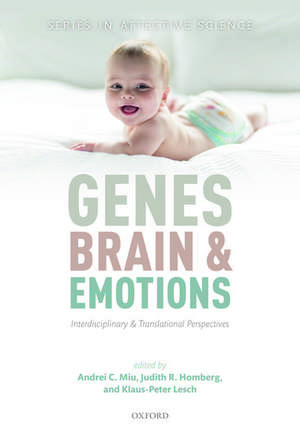
Genes, brain, and emotions: Interdisciplinary and Translational Perspectives: Series in Affective Science
Editat de Andrei C. Miu, Judith R. Homberg, Klaus-Peter Leschen Limba Engleză Hardback – 10 apr 2019
Din seria Series in Affective Science
- 28%
 Preț: 521.37 lei
 - 28%
 Preț: 539.48 lei
 - 31%
 Preț: 700.70 lei
 - 31%
 Preț: 600.71 lei
 - 28%
 Preț: 506.59 lei
 - 31%
 Preț: 685.09 lei
 - 28%
 Preț: 399.99 lei
 - 28%
 Preț: 461.65 lei
 - 30%
 Preț: 629.76 lei
 - 31%
 Preț: 575.34 lei
 - 31%
 Preț: 549.22 lei
 - 31%
 Preț: 962.76 lei
 - 31%
 Preț: 549.22 lei
 - 31%
 Preț: 526.66 lei
 - 31%
 Preț: 592.54 lei
 - 31%
 Preț: 549.62 lei
 - 27%
 Preț: 504.33 lei
 - 31%
 Preț: 600.60 lei
 - 26%
 Preț: 892.05 lei
 - 21%
 Preț: 346.96 lei
 - 31%
 Preț: 544.32 lei
 - 32%
 Preț: 627.89 lei
 - 31%
 Preț: 576.05 lei
 - 28%
 Preț: 536.09 lei
 - 29%
 Preț: 480.81 lei
 - 32%
 Preț: 829.74 lei
 - 33%
 Preț: 921.63 lei
 - 33%
 Preț: 683.67 lei
 - 31%
 Preț: 813.66 lei
 - 31%
 Preț: 792.55 lei
 - 31%
 Preț: 560.63 lei
 - 26%
 Preț: 486.60 lei
 - 32%
 Preț: 722.73 lei
Preț: 719.48 lei
Preț vechi: 1012.11 lei
-29%
Puncte Express: 1079
Carte disponibilă
Livrare economică 06-17 noiembrie
Livrare prin curier în România Termenul estimat este afișat lângă disponibilitate.
Transport gratuit pentru acest produs Plată online sau ramburs, în funcție de opțiunile comenzii.
Retur gratuit în 14 zile Comandă securizată și suport în română.
Specificații
ISBN-13: 9780198793014
ISBN-10: 0198793014
Pagini: 464
Dimensiuni: 179 x 253 x 31 mm
Greutate: 1.03 kg
Editura: OUP OXFORD
Colecția OUP Oxford
Seria Series in Affective Science
Locul publicării:Oxford, United Kingdom
ISBN-10: 0198793014
Pagini: 464
Dimensiuni: 179 x 253 x 31 mm
Greutate: 1.03 kg
Editura: OUP OXFORD
Colecția OUP Oxford
Seria Series in Affective Science
Locul publicării:Oxford, United Kingdom
V-ar putea interesa

Notă biografică
Andrei C. Miu is Professor of Cognitive Neuroscience and Behavioral Genetics at the Department of Psychology, Babeș-Bolyai University, and the Founding Director of the Cognitive Neuroscience Laboratory, one of the leading research groups in the field of cognitive and affective science in Romania. His research investigates the psychological and biological mechanisms of emotion and emotion regulation, with the aim of uncovering individual differences that contribute to risk for psychopathology.Dr. Judith Homberg obtained her PhD in 2004 at the Free University Medical Center in Amsterdam on preclinical research aiming to understand individual differences in vulnerability to drug addiction. Then she pursued a postdoc position at the Hubrecht Institute in Utrecht and generated and characterized knockout rats. One of the knockout rats involved the serotonin transporter knockout rat, which displays heightened emotional behaviour. After obtaining a personal subsidy from the Dutch government she started her own research group at the Donders Institute in Nijmegen in 2008. From this position she further built up her current research group focussing on the individual differences in behaviour and risk for stress-related disorders, with serotonin as main modulator.Dr. Lesch has undergone training in Psychiatry and Psychotherapy. His work has been focussing on the interdependent relationship between molecular, cellular and systems neurobiology and mechanisms of pharmacologic and psychotherapeutic treatments related to neurodevelopmental and life-spanning psychiatric disorders using interdisciplinary and translational research strategies. In its scope, the Lesch lab's work is regarded as an interface with contributions to bridging the sizeable gap between basic molecular, neurobiologic and clinically applicable research. The work uncompromisingly integrates pertinent research strategies to elucidate mechanisms of pathologically altered synaptic plasticity (synaptopathy), intraneuronal signaling (neuronal dysregulation) and interneuronal communication (system dysfunction) as well as their impact on the pathophysiology of neuropsychiatric disease.
Cuprins
- List of Contributors
- 1: Andrei C. Miu, Judith R. Homberg, and Klaus-Peter Lesch: Introduction to Genes, Brain and Emotions. Interdisciplinary and Translational Perspectives
- Part One: Methods and Approaches
- 2: Megan Flom, and Kimberly J. Saudino: Twin Studies of Emotion
- 3: Suzanne Vrshek-Schallhorn, Bradley M. Avery, and Vaibhav Sapuram: Gene-environment interactions in humans across multiple units of analyses: A focus on psychopathology and imaging
- 4: Jenny van Dongen, and Dorret I. Boomsma: Epigenetics and twin studies: A review and applications in human aggressive behavior
- 5: Thomas W. Mühleisen, and Sven Cichon: Genome-wide association studies
- 6: Daniela Felice, Anand Gururajan, Olivia O'Leary, and John F. Cryan: Gene by environment interactions in animal models of depression and anxiety
- 7: Celine L. St. Pierre, Kayvon Sharif, Emily Funsten, Abraham A. Palmer, and Clarissa C Parker: Methods and Theoretical Approaches: Genetic Animal Models of Emotional Disorders and Convergence with Human Data
- 8: Alexandre Surget, and Catherine Belzung: Optogenetic and chemogenetic technologies for advanced functional investigations of the neural correlates of emotions
- Part Two: Cognitive Mechanisms
- 9: Tina B. Lonsdorf: Fear learning and extinction
- 10: Inge Volman, Hanneke Den Ouden, and Karin Roelofs: Emotional action control: the role of serotonin in health and disease
- 11: Andrei C. Miu, and Mirela I. Bîlc: Genetics of emotion regulation: A systematic review
- 12: Mana R. Ehlers, and Rebecca M. Todd: Emotional Memory
- 13: Joshua C. Gray, Sandra Sanchez-Roige, Abraham A. Palmer, Harriet de Wit, and James MacKillop: Genetics of decision making
- Part Three: Biological Mechanisms
- 14: Turhan Canli: Missing heritability in studies of trait anxiety and amygdala function: Is the solution in plain sight?
- 15: Erik M. Mueller: Electrocortical endophenotypes of anxiety
- 16: Ulrich Rabl, and Lukas Pezawas: Imaging genetics in depression
- 17: Idan Shalev, and Waylon J. Hastings: Psychosocial Stress and Telomere Regulation
- 18: Annette Conzelmann, Paul Pauli, Alexander Prehn-Kristensen, and Tobias Renner: Genetic effects on peripheral psychophysiological measures of emotion processing
- Part Four: Disorders and Therapy
- 19: Thomas J. Bouchard, Jr., Wendy Johnson, and Irving I. Gottesman: The Genetics of Personality/Psychopathology: A Brief Review of Constructs, Results, Approaches and Implications
- 20: Rebecca Alexander, and Justine Megan Gatt: Resilience
- 21: Joan Kaufman, Janitza L. Montalvo-Ortiz, and Richard Lee: Understanding Risk and Resilience in Maltreated Children: Emerging Findings From Translational, Genetic, Neuroimaging, and Treatment Studies
- 22: Lisa Heltzel, and Judith R. Homberg: Animal models of posttraumatic stress disorder: Towards understanding of individual differences
- 23: Dan Rujescu, and Ina Giegling: Genetics of impulsivity, anger and aggression as risk factors for suicidal behavior
- 24: Tatjana van Strien: Causes of distress-induced emotional eating
- 25: Nuno R. Zilhão, Dorret I. Boomsma, Dirk J.A. Smit, and Danielle C. Cath: Genetics of obsessive-compulsive disorder and Tourette's syndrome
- 26: Jonathan R.I. Coleman, Kathryn J. Lester, and Thalia C. Eley: Therapygenetics: Predicting psychological treatment response from genetic markers
- 27: Airiss R. Chan, Ilona Gorbovskaya, and Daniel J. Müller: The Role of Pharmacogenetics in the Treatment of Depression