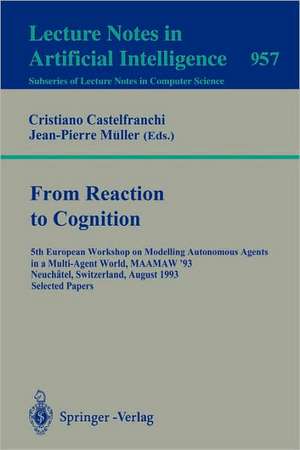
From Reaction to Cognition
Editat de Cristiano Castelfranchi, Jean-Pierre Mülleren Limba Engleză Paperback – 2 aug 1995
The volume opens with a detailed introduction by the volume editors bringing the papers in line and offering a readers' guide. The 15 full research papers reflect the state-of-the-art in this dynamic field of research; they are organized in sections on emergence of global properties, emergence of sociality, multi-agent planning, multi-agent communication, and multi-agent architectures.
Preț: 374.09 lei
Puncte Express: 561
Carte tipărită la comandă
Livrare economică 21 noiembrie-05 decembrie
Livrare prin curier în România Termenul estimat este afișat lângă disponibilitate.
Transport gratuit de la 400.00 lei Plată online sau ramburs, în funcție de opțiunile comenzii.
Retur gratuit în 14 zile Comandă securizată și suport în română.
Specificații
ISBN-13: 9783540601555
ISBN-10: 3540601554
Pagini: 264
Ilustrații: VI, 258 p.
Dimensiuni: 155 x 235 x 15 mm
Greutate: 0.41 kg
Ediția:1995
Editura: Springer
Locul publicării:Berlin, Heidelberg, Germany
ISBN-10: 3540601554
Pagini: 264
Ilustrații: VI, 258 p.
Dimensiuni: 155 x 235 x 15 mm
Greutate: 0.41 kg
Ediția:1995
Editura: Springer
Locul publicării:Berlin, Heidelberg, Germany
V-ar putea interesa
-
 Multi-Agent Reinforcement LearningFilippos Christianos-20%Preț: 487.36 lei609.19 lei
 -
 Formal Methods for Multi-Agent Feedback Control SystemsDimos V. Dimarogonas-20%Preț: 609.25 lei761.56 lei
 -
 Verschure, P: Nature and Dynamics of CollaborationPaul Verschure, F.M.J.-14%Preț: 469.65 lei546.11 lei
 -
 Agentic AI For DummiesPam Baker-20%Preț: 145.95 lei182.44 lei
 -
 -11%Preț: 178.39 lei199.41 lei
 -
 AI Agents in ActionMicheal Lanham-20%Preț: 338.76 lei423.45 lei
 -
 -20%Preț: 342.06 lei427.57 lei
 -
 -5%Preț: 350.89 lei369.36 lei
 -
 -20%Preț: 330.54 lei413.16 lei
 -
 -20%Preț: 324.19 lei405.23 lei
 -
 -20%Preț: 317.68 lei397.10 lei
 -
 -20%Preț: 325.79 lei407.24 lei
 -
 -20%Preț: 644.77 lei805.96 lei
 -
 -20%Preț: 397.51 lei496.89 lei
 -
 -20%Preț: 623.89 lei779.85 lei
 -
 -20%Preț: 1655.95 lei2069.94 lei
 -
 -20%Preț: 1407.11 lei1758.89 lei
Public țintă
ResearchCuprins
From reaction to cognition 5th European Workshop on modelling an agent in a multi-agent world MAAMAW '93.- When ants play chess (Or can strategies emerge from tactical behaviours?).- How to define agent properties — or: What is a fair agent?.- Emergent planning: A computational architecture for situated behaviour.- Coalition formation among autonomous agents: Strategies and complexity (preliminary report).- Coalition formation among autonomous agents.- Organizational fluidity and sustainable cooperation.- Emergent constraint satisfaction through multi-agent coordinated interaction.- Sophisticated and distributed: The transportation domain.- A framework for the interleaving of execution and planning for dynamic tasks by multiple agents.- Generic, configurable, cooperation protocols for multi-agent systems.- Around the architectural agent approach to model conversations.- Norms as mental objects. From normative beliefs to normative goals.- The hedonic agent: A constructivist approach of abductive capacities.- The conceptual framework of MAI2L.- Designing good pursuit problems as testbeds for distributed AI: A novel application of genetic algorithms.