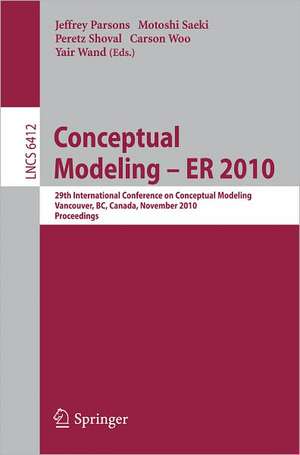
Conceptual Modeling – ER 2010: 29th International Conference on Conceptual Modeling, Vancouver, BC, Canada, November 1-4, 2010, Proceedings: Lecture Notes in Computer Science, cartea 6412
Editat de Jeffrey Parsons, Motoshi Saeki, Peretz Shoval, Carson Woo, Yair Wanden Limba Engleză Paperback – 19 oct 2010
Diferențiindu-se de documentația tehnică standard sau de manualele de programare axate pe sintaxă, Conceptual Modeling – ER 2010 oferă o perspectivă teoretică și practică asupra fundamentelor sistemelor informatice. Găsim în acest volum o analiză profundă a modului în care abstractizarea facilitează comunicarea dintre stakeholderi și dezvoltatori, acționând ca un liant esențial în ciclul de viață al software-ului. Spre deosebire de un ghid de implementare, aceste lucrări explorează ontologiile de decizie și raționamentul în modelarea cerințelor.
Structura volumului reflectă o progresie logică, de la modelarea proceselor de afaceri și agregarea activităților, până la provocările complexe ale evoluției datelor și adaptării schemelor. Secțiunile dedicate ingineriei cerințelor (Requirements Engineering) sunt deosebit de relevante, prezentând studii de caz concrete, cum este cel despre conformitatea reglementărilor în domeniul sănătății. Cititorul care a aplicat deja conceptele din Conceptual Modeling de Gillian Dobbie va găsi aici o bază istorică și metodologică solidă care completează cercetările mai recente din domeniu.
Editorii, printre care se numără și Jeffrey Parsons, mențin standardul academic ridicat observat și în alte lucrări coordonate de aceștia, precum Advances in Conceptual Modeling. Dacă în lucrările ulterioare accentul se mută spre design science, acest volum din seria Lecture Notes in Computer Science rămâne ancorat în problemele fundamentale de interoperabilitate și co-evoluție a modelelor conceptuale cu bazele de date fizice. Este o resursă tehnică ce documentează nu doar soluțiile, ci și raționamentul de proiectare din spatele sistemelor complexe.
Din seria Lecture Notes in Computer Science
- 20%
 Preț: 558.53 lei
 - 20%
 Preț: 571.88 lei
 - 20%
 Preț: 675.83 lei
 - 20%
 Preț: 1020.28 lei
 - 20%
 Preț: 851.78 lei
 - 20%
 Preț: 560.93 lei
 - 20%
 Preț: 633.70 lei
 - 20%
 Preț: 731.82 lei
 - 20%
 Preț: 1359.66 lei
 - 20%
 Preț: 620.33 lei
 - 20%
 Preț: 733.68 lei
 - 18%
 Preț: 945.44 lei
 - 15%
 Preț: 558.12 lei
 - 20%
 Preț: 793.92 lei
 - 20%
 Preț: 560.93 lei
 - 20%
 Preț: 748.63 lei
 - 20%
 Preț: 562.49 lei
 - 20%
 Preț: 1246.46 lei
 - 20%
 Preț: 449.81 lei
 - 20%
 Preț: 606.22 lei
 - 20%
 Preț: 620.33 lei
 - 20%
 Preț: 562.49 lei
 - 20%
 Preț: 560.93 lei
 - 20%
 Preț: 313.10 lei
 - 20%
 Preț: 828.44 lei
 - 20%
 Preț: 560.93 lei
 - 20%
 Preț: 314.86 lei
 - 20%
 Preț: 1033.45 lei
 - 20%
 Preț: 563.29 lei
 - 20%
 Preț: 733.68 lei
 - 20%
 Preț: 1137.10 lei
 - 20%
 Preț: 735.28 lei
 - 20%
 Preț: 1079.23 lei
 - 20%
 Preț: 584.42 lei
 - 20%
 Preț: 854.16 lei
 - 15%
 Preț: 672.87 lei
 - 20%
 Preț: 1032.47 lei
 - 20%
 Preț: 617.17 lei
 - 20%
 Preț: 1022.15 lei
 - 20%
 Preț: 984.64 lei
 - 20%
 Preț: 556.96 lei
 - 20%
 Preț: 402.28 lei
 - 20%
 Preț: 316.28 lei
 - 20%
 Preț: 663.69 lei
 - 20%
 Preț: 320.24 lei
 - 20%
 Preț: 343.12 lei
 - 20%
 Preț: 313.87 lei
Preț: 330.98 lei
Preț vechi: 413.73 lei
-20%
Carte disponibilă
Livrare economică 17 noiembrie-01 decembrie
Specificații
ISBN-10: 3642163726
Pagini: 504
Ilustrații: XIV, 490 p. 163 illus.
Greutate: 0.74 kg
Ediția:2010
Editura: Springer Berlin, Heidelberg
Colecția Springer
Seriile Lecture Notes in Computer Science, Information Systems and Applications, incl. Internet/Web, and HCI
Locul publicării:Berlin, Heidelberg, Germany
V-ar putea interesa
-
 Applying UML and PatternsCraig Larman-15%Preț: 605.79 lei712.70 lei
 -
 Domain-Driven DesignEric J. Evans-20%Preț: 423.02 lei528.78 lei
 -
 Patterns of Enterprise Application ArchitectureMartin Fowler-20%Preț: 396.95 lei496.18 lei
 -
 Information Systems DevelopmentGeorge Angelos Papadopoulos-20%Preț: 2032.93 lei2541.17 lei
 -
 Database SystemsRamez Elmasri-20%Preț: 552.09 lei690.12 lei
 -
 Modern Systems Analysis and Design, Global EditionJoseph Valacich-8%Preț: 606.91 lei659.70 lei
 -
 Conceptual Knowledge StructuresInma P. Cabrera-20%Preț: 434.33 lei542.91 lei
 -
 Preț: 379.45 lei
 -
 -20%Preț: 328.16 lei410.20 lei
 -
 Preț: 371.00 lei
 -
 -20%Preț: 321.81 lei402.26 lei
 -
 Preț: 372.67 lei
 -
 -20%Preț: 642.89 lei803.61 lei
 -
 Preț: 373.03 lei
 -
 -20%Preț: 642.40 lei803.00 lei
 -
 -20%Preț: 327.36 lei409.20 lei
 -
 -20%Preț: 333.68 lei417.09 lei
 -
 Business Process ManagementAndreas GadatschPreț: 324.24 lei
 -
 Building Model-based Enterprise ArchitectureMudar Bahri-20%Preț: 241.80 lei302.25 lei
Public țintă
ResearchDe ce să citești această carte
Recomandăm această lucrare cercetătorilor și arhitecților de sisteme care doresc să înțeleagă mecanismele de abstractizare dincolo de cod. Cititorul câștigă o viziune clară asupra modului în care modelarea conceptuală poate preveni eșecul proiectelor IT prin alinierea cerințelor de business cu specificațiile tehnice. Este un instrument esențial pentru stăpânirea evoluției datelor și a interoperabilității în sisteme deschise.