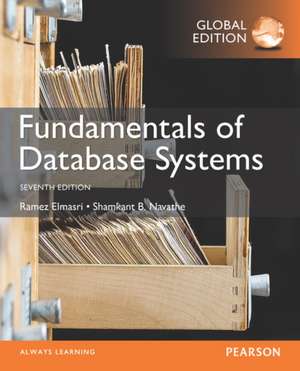
Database Systems
Autor Ramez Elmasri, Shamkant B. Navatheen Limba Engleză Paperback – 19 aug 2016
Recomandăm abordarea acestui volum pornind de la exercițiile de mapare a diagramelor Entity Relationship (ER) către scheme relaționale, un proces critic explicat pas cu pas în capitolul 9. Această ediție a șaptea a lucrării Database Systems oferă o fundamentare tehnică riguroasă, fiind construită pentru a servi atât ca suport de curs universitar, cât și ca manual de referință pentru inginerii de software. Structura este una progresivă, organizată în cinci părți mari: începe cu arhitectura sistemelor, trece prin modelarea conceptuală (ER și EER) și ajunge la limbajul SQL și tehnici avansate de programare. Remarcăm atenția deosebită acordată capitolului de programare web cu PHP, care transformă teoria bazelor de date într-un instrument practic pentru aplicații reale. Pe linia practică a volumului ISE Database System Concepts de Abraham Silberschatz, dar cu un focus mai pronunțat pe modelarea extinsă (EER) și pe standardele XML, lucrarea lui Ramez Elmasri și Shamkant B. Navathe se distinge prin profunzimea detaliilor despre implementarea fizică a sistemelor de gestiune a bazelor de date. Cuprinsul reflectă o evoluție logică, de la algebra relațională la baze de date obiect-relaționale, oferind cititorului un parcurs complet asupra modului în care datele sunt stocate, interogate și securizate în mediile moderne de producție.
Preț: 552.09 lei
Preț vechi: 690.12 lei
-20%
Carte disponibilă
Livrare economică 29 octombrie-12 noiembrie
Livrare express 14-20 octombrie pentru 86.15 lei
Specificații
ISBN-10: 1292097612
Pagini: 1272
Dimensiuni: 233 x 186 x 65 mm
Greutate: 1.95 kg
Ediția:7th edition
Editura: Prentice Hall
Colecția Pearson Higher Education
V-ar putea interesa
-
 -39%Preț: 402.67 lei660.61 lei
 -
 Deep LearningIan Goodfellow-20%Preț: 619.58 lei774.48 lei
 -
 Probabilistic Machine LearningKevin P. Murphy-21%Preț: 847.49 lei1078.71 lei
 -
 Image Processing and Acquisition using PythonRavishankar Chityala-18%Preț: 1034.06 lei1261.06 lei
 -
 -20%Preț: 412.85 lei516.06 lei
 -
 Numerical Geometry of Non-Rigid ShapesAlexander M. Bronstein-20%Preț: 515.64 lei644.54 lei
 -
 Multiple View Geom Comp Vision 2edRichard Hartley-14%Preț: 766.84 lei891.67 lei
 -
 -20%Preț: 1258.86 lei1573.58 lei
 -
 The Cyber Risk HandbookDomenic Antonucci-8%Preț: 499.31 lei542.73 lei
 -
 Digital Image Processing, Global EditionRafael Gonzalez-11%Preț: 654.09 lei734.93 lei
 -
 Geometric Methods and ApplicationsJean Gallier-15%Preț: 726.41 lei854.59 lei
 -
 Guide to Computational Geometry ProcessingJ. Andreas Bærentzen-15%Preț: 513.45 lei604.06 lei
 -
 Programming Robots with ROSMorgan Quigley-20%Preț: 260.82 lei326.02 lei
 -
 Bridging Relational and NoSQL DatabasesDrazena Gaspar-20%Preț: 1091.20 lei1364.00 lei
 -
 Docker in ActionBret Fisher-20%Preț: 302.80 lei378.50 lei
 -
 -20%Preț: 285.05 lei356.31 lei
 -
 Robot Operating System CookbookPackt Publishing-20%Preț: 274.91 lei343.64 lei
 -
 Mastering ROS for Robotics Programming - Second EditionLentin Joseph-19%Preț: 477.95 lei590.06 lei
 -
 Hands-On Computer Vision with TensorFlow 2Benjamin Planche-20%Preț: 214.62 lei268.28 lei
 -
 -20%Preț: 297.64 lei372.04 lei
 -
 Python Image Processing CookbookSandipan Dey-20%Preț: 269.83 lei337.28 lei
 -
 Computer Graphics and Geometric ModellingMax K. Agoston-20%Preț: 397.02 lei496.28 lei
 -
 Mathematical Image ProcessingKristian Bredies-15%Preț: 545.09 lei641.28 lei
 -
 Principles of Distributed Database SystemsM. Tamer Özsu-20%Preț: 616.86 lei771.07 lei
 -
 Robot Operating System (ROS)Anis Koubâa-18%Preț: 1123.70 lei1370.36 lei
 -
 Foundations of Computer VisionJames F. Peters-20%Preț: 687.07 lei858.83 lei
 -
 SQL & NoSQL DatabasesAndreas Meier-20%Preț: 321.18 lei401.48 lei
 -
 -20%Preț: 297.18 lei371.47 lei
 -
 -15%Preț: 442.35 lei520.41 lei
De ce să citești această carte
Pentru studenții la informatică și dezvoltatorii care doresc să înțeleagă nu doar cum să scrie interogări SQL, ci și cum sunt proiectate intern sistemele de baze de date. Câștigați o perspectivă clară asupra modelării complexe și a integrării bazelor de date în aplicații web, beneficiind de expertiza unor profesori de renume internațional în domeniu.
Despre autor
Ramez Elmasri este profesor de informatică și inginerie la Universitatea Texas din Arlington. Și-a obținut titlurile de master și doctorat la Universitatea Stanford, fiind o figură centrală în cercetarea sistemelor de baze de date. Alături de Shamkant B. Navathe, a transformat acest volum într-un standard academic global, actualizând constant materialul pentru a reflecta noile tehnologii, de la baze de date obiect-orientate la integrarea XML în ecosistemele informatice contemporane.
Descriere
For database systems courses in Computer Science This book introduces the fundamental concepts necessary for designing, using, and implementing database systems and database applications. Our presentation stresses the fundamentals of database modeling and design, the languages and models provided by the database management systems, and database system implementation techniques. The book is meant to be used as a textbook for a one- or two-semester course in database systems at the junior, senior, or graduate level, and as a reference book.
The goal is to provide an in-depth and up-to-date presentation of the most important aspects of database systems and applications, and related technologies. It is assumed that readers are familiar with elementary programming and data-structuring concepts and that they have had some exposure to the basics of computer organization.
Cuprins
- Part 1: Introduction to Databases
- Chapter 1: Databases and Database Users
- Chapter 2: Database Systems Concepts and Architecture
- Part 2: Conceptual Data Modeling and Database Design
- Chapter 3: Data Modeling Using the Entity Relationship (ER) Model
- Chapter 4: The Enhanced Entity Relationship (EER) Model
- Part 3: The Relational Data Model and SQL
- Chapter 5: The Relational Data Model and Relational Database Constraints
- Chapter 6: Basic SQL
- Chapter 7: More SQL: Complex Queries, Triggers, Views, and Schema Modification
- Chapter 8: The Relational Algebra and Relational Calculus
- Chapter 9: Relational Database Design by ER- and EER-to-Relational Mapping
- Part 4: Database Programming Techniques
- Chapter 10: Introduction to SQL Programming Techniques
- Chapter 11: Web Database Programming Using PHP
- Part 5: Object, Object-Relational, and XML: Concepts, Models, Languages, and Standards
- Chapter 12: Object and Object-Relational Databases
- Chapter 13: XLM: Extensible Markup Language
- Part 6: Database Design Theory and Normalization
- Chapter 14: Basics of Functional Dependencies and Normalization for Relational Databases
- Chapter 15: Relational Database Design Algorithms and Further Dependencies
- Part 7: File Structures, Hashing, Indexing, and Physical Database Design
- Chapter 16: Disc Storage, Basic File Structures, Hashing, and Modern Storage Architectures
- Chapter 17: Indexing Structures for Files and Physical Database Design
- Part 8: Query Processing and Optimization
- Chapter 18: Strategies for Query Processing
- Chapter 19: Query Optimization
- Part 9: Transaction Processing, Concurrency Control, and Recovering
- Chapter 20: Introduction to Transaction Processing Concepts and Theory
- Chapter 21: Concurrency Control Techniques
- Chapter 22: Database Recovery Techniques
- Part 10: Distributed Databases, NOSQL Systems, Cloud Computing, and Big Data
- Chapter 23: Distributed Database Concepts
- Chapter 24: NOSQL Databases and Big Data Storage Systems
- Chapter 25: Big Data Technologies Based on MapReduce and Hadoop
- Part 11: Advanced Database Models, Systems, and Applications
- Chapter 26: Enhanced Data Models: Introduction to Active, Temporal, Spatial, Multimedia, and Deductive Databases
- Chapter 27: Introduction to Information Retrieval and Web Search
- Chapter 28: Data Mining Concepts
- Chapter 29: Overview of Data Warehousing and OLAP
- Part 12: Additional Database Topics: Security
- Chapter 30: Database Security
- Appendix A: Alternative Diagrammatic Notations for ER Models
- Appendix B: Parameters of Disks
- Appendix C: Overview of the QBE Language
- Appendix D: Overview of the Hierarchical Data Model
- Appendix E: Overview of the Network Data Model