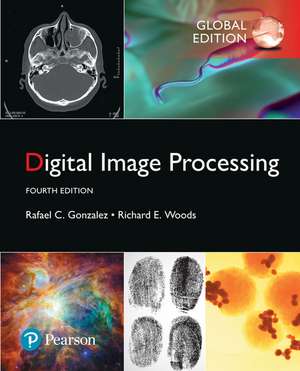
Gonzalez, R: Digital Image Processing, Global Edition
Autor Rafael C. Gonzalez, Richard E. Woodsen Limba Engleză Paperback – 2 noi 2017
Autorii Rafael C. Gonzalez și Richard E. Woods aduc o experiență academică și practică de peste patru decenii în dezvoltarea acestui manual de referință, considerat standardul industrial în domeniul viziunii artificiale. Ediția a 4-a a Digital Image Processing, Global Edition, publicată de Pearson, reprezintă o evoluție semnificativă, fiind modelată după sugestiile a sute de specialiști din mediul universitar global pentru a reflecta schimbările tehnologice majore din ultimii ani.
Subliniem rigoarea structurii narative și tehnice: volumul pornește de la fundamentele percepției vizuale și achiziției de imagini, avansând progresiv către transformări de intensitate, filtrare spațială și procesarea în domeniul frecvenței. Considerăm esențială noua organizare a materialului despre transformatele de imagine, care oferă acum o prezentare mult mai coerentă a conceptelor matematice complexe. Pe linia practică a lucrării Fundamentals of Digital Image Processing de Chris Solomon, dar cu un focus mult mai profund pe fundamentele teoretice și pe noile tehnologii de inteligență artificială, volumul de față integrează rețelele neuronale convoluționale și metodele de deep learning direct în fluxul de lucru al procesării de imagini.
Reținem că această ediție introduce, pentru prima dată, proiecte MATLAB la finalul fiecărui capitol, transformând teoria abstractă în aplicații concrete. De la algoritmi de segmentare precum „graph cuts” și „active contours”, până la tehnici avansate de potrivire a histogramelor, textul acoperă spectrul complet necesar unui inginer sau cercetător modern. Este o resursă vastă, de peste 1000 de pagini, care echilibrează perfect demonstrațiile matematice cu implementarea practică.
Preț: 670.70 lei
Preț vechi: 789.05 lei
-15%
Carte disponibilă
Livrare economică 09-23 decembrie
Livrare express 24-28 noiembrie pentru 75.24 lei
Specificații
ISBN-10: 1292223049
Pagini: 1024
Dimensiuni: 190 x 235 x 55 mm
Greutate: 1.63 kg
Ediția:4th edition
Editura: Pearson
V-ar putea interesa
-
 -11%Preț: 355.73 lei398.49 lei
-
 -39%Preț: 402.67 lei660.61 lei
-
 Lab Manual for Digital FundamentalsThomas Floyd-19%Preț: 579.78 lei715.77 lei
-
 Thinking, Fast and SlowDaniel Kahneman-26%Preț: 91.92 lei123.57 leiRecomandat
-
 -24%Preț: 104.61 lei138.27 lei
-
 -20%Preț: 418.89 lei523.61 lei
-
 Numerical Geometry of Non-Rigid ShapesAlexander M. Bronstein-20%Preț: 531.29 lei664.11 lei
-
 Army of NonePaul ScharrePreț: 131.35 lei
-
 Image ProcessingMaria M P Petrou-19%Preț: 546.25 lei674.39 lei
-
 Trade of QueensCharles StrossPreț: 105.34 lei
-
 Database SystemsRamez Elmasri-20%Preț: 594.63 lei743.29 lei
-
 -13%Preț: 631.41 lei725.76 lei
-
 Geometric Methods and ApplicationsJean Gallier-15%Preț: 755.45 lei888.77 lei
-
 Guide to Computational Geometry ProcessingJ. Andreas Bærentzen-15%Preț: 558.31 lei656.83 lei
-
 Programming Robots with ROSMorgan Quigley-20%Preț: 265.08 lei331.35 lei
-
 How Emotions Are Made: The Secret Life of the BrainLisa Feldman Barrett-32%Preț: 64.08 lei94.27 lei
-
 Docker in ActionBret Fisher-20%Preț: 305.41 lei381.76 lei
-
 -20%Preț: 285.05 lei356.31 lei
-
 Robot Operating System CookbookPackt Publishing-20%Preț: 274.91 lei343.64 lei
-
 Mastering ROS for Robotics Programming - Second EditionLentin Joseph-19%Preț: 477.95 lei590.06 lei
-
 Hands-On Computer Vision with TensorFlow 2Benjamin Planche-20%Preț: 214.62 lei268.28 lei
-
 -20%Preț: 297.64 lei372.04 lei
-
 Computer Graphics and Geometric ModellingMax K. Agoston-20%Preț: 402.91 lei503.64 lei
-
 Robot Operating System (ROS)Anis Koubâa-18%Preț: 1160.23 lei1414.92 lei
-
 Foundations of Computer VisionJames F. Peters-20%Preț: 687.07 lei858.83 lei
De ce să citești această carte
Recomandăm acest volum studenților la masterat și profesioniștilor în Computer Vision care au nevoie de o bază teoretică solidă dublată de aplicații practice. Cititorul câștigă acces la metode moderne de deep learning și SIFT, beneficiind totodată de proiecte MATLAB gata de implementat. Este resursa definitivă pentru a trece de la teoria semnalelor la procesarea complexă de imagini digitale într-un context academic sau industrial.
Despre autor
Rafael C. Gonzalez este profesor emerit la Universitatea din Tennessee, Knoxville, având o carieră academică și de cercetare începută în 1970. Deține titluri de masterat și doctorat în inginerie electrică de la Universitatea din Florida și este fondatorul Image & Pattern Analysis Group. Expertiza sa în sisteme liniare și recunoașterea formelor a consacrat Digital Image Processing, Global Edition ca fiind cel mai utilizat manual în domeniu la nivel mondial, autorul fiind recunoscut pentru capacitatea de a sintetiza domenii complexe precum viziunea artificială și robotica.
Descriere
For courses in Image Processing and Computer Vision. Introduce your students to image processing with the industry's most prized text For 40 years, Image Processing has been the foundational text for the study of digital image processing. The book is suited for students at the college senior and first-year graduate level with prior background in mathematical analysis, vectors, matrices, probability, statistics, linear systems, and computer programming.
As in all earlier editions, the focus of this edition of the book is on fundamentals. The 4th Edition, which celebrates the book's 40th anniversary, is based on an extensive survey of faculty, students, and independent readers in 150 institutions from 30 countries. Their feedback led to expanded or new coverage of topics such as deep learning and deep neural networks, including convolutional neural nets, the scale-invariant feature transform (SIFT), maximally-stable extremal regions (MSERs), graph cuts, k-means clustering and superpixels, active contours (snakes and level sets), and exact histogram matching.
Major improvements were made in reorganizing the material on image transforms into a more cohesive presentation, and in the discussion of spatial kernels and spatial filtering. Major revisions and additions were made to examples and homework exercises throughout the book. For the first time, we added MATLAB projects at the end of every chapter, and compiled support packages for students and faculty containing, solutions, image databases, and sample code.
Cuprins
- 1 Introduction
- 1.1 What is Digital Image Processing?
- 1.2 The Origins of Digital Image Processing
- 1.3 Examples of Fields that Use Digital Image Processing
- 1.4 Fundamental Steps in Digital Image Processing
- 1.5 Components of an Image Processing System
- 2 Digital Image Fundamentals
- 2.1 Elements of Visual Perception
- 2.2 Light and the Electromagnetic Spectrum
- 2.3 Image Sensing and Acquisition
- 2.4 Image Sampling and Quantization
- 2.5 Some Basic Relationships Between Pixels
- 2.6 Introduction to the Basic Mathematical Tools Used in Digital Image Processing
- 3 Intensity Transformations and Spatial Filtering
- 3.1 Background
- 3.2 Some Basic Intensity Transformation Functions
- 3.3 Histogram Processing
- 3.4 Fundamentals of Spatial Filtering
- 3.5 Smoothing (Lowpass) Spatial Filters
- 3.6 Sharpening (Highpass) Spatial Filters
- 3.7 Highpass, Bandreject, and Bandpass Filters from Lowpass Filters
- 3.8 Combining Spatial Enhancement Methods
- 3.9 Using Fuzzy Techniques for Intensity Transformations and Spatial Filtering
- 4 Filtering in the Frequency Domain
- 4.1 Background
- 4.2 Preliminary Concepts
- 4.3 Sampling and the Fourier Transform of Sampled Functions
- 4.4 The Discrete Fourier Transform of One Variable
- 4.5 Extensions to Functions of Two Variables
- 4.6 Some Properties of the 2-D DFT and IDFT
- 4.7 The Basics of Filtering in the Frequency Domain
- 4.8 Image Smoothing Using Lowpass Frequency Domain Filters
- 4.9 Image Sharpening Using Highpass Filters
- 4.10 Selective Filtering
- 4.11 The Fast Fourier Transform
- 5 Image Restoration and Reconstruction
- 5.1 A Model of the Image Degradation/Restoration Process
- 5.2 Noise Models
- 5.3 Restoration in the Presence of Noise Only-Spatial Filtering
- 5.4 Periodic Noise Reduction Using Frequency Domain Filtering
- 5.5 Linear, Position-Invariant Degradations
- 5.6 Estimating the Degradation Function
- 5.7 Inverse Filtering
- 5.8 Minimum Mean Square Error (Wiener) Filtering
- 5.9 Constrained Least Squares Filtering
- 5.10 Geometric Mean Filter
- 5.11 Image Reconstruction from Projections
- 6 Wavelet and Other Image Transforms
- 6.1 Preliminaries
- 6.2 Matrix-based Transforms
- 6.3 Correlation
- 6.4 Basis Functions in the Time-Frequency Plane
- 6.5 Basis Images
- 6.6 Fourier-Related Transforms
- 6.7 Walsh-Hadamard Transforms
- 6.8 Slant Transform
- 6.9 Haar Transform
- 6.10 Wavelet Transforms
- 7 Color Image Processing
- 7.1 Color Fundamentals
- 7.2 Color Models
- 7.3 Pseudocolor Image Processing
- 7.4 Basics of Full-Color Image Processing
- 7.5 Color Transformations
- 7.6 Color Image Smoothing and Sharpening
- 7.7 Using Color in Image Segmentation
- 7.8 Noise in Color Images
- 7.9 Color Image Compression
- 8 Image Compression and Watermarking
- 8.1 Fundamentals
- 8.2 Huffman Coding
- 8.3 Golomb Coding
- 8.4 Arithmetic Coding
- 8.5 LZW Coding
- 8.6 Run-length Coding