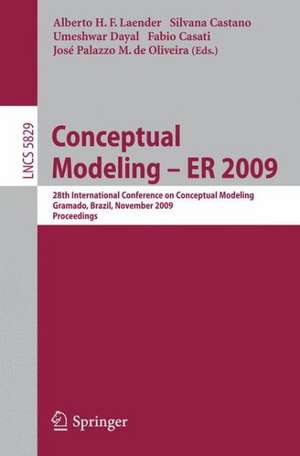
Conceptual Modeling - ER 2009: 28th International Conference on Conceptual Modeling, Gramado, Brazil, November 9-12, 2009, Proceedings: Lecture Notes in Computer Science, cartea 5829
Editat de Alberto H. F. Laender, Silvana Castano, Umeshwar Dayal, Fabio Casati, José Palazzo M. de Oliveriraen Limba Engleză Paperback – 26 oct 2009
Considerăm că Conceptual Modeling - ER 2009 este o resursă tehnică esențială pentru cercetătorii care doresc să înțeleagă evoluția metodelor de formalizare a cerințelor de sistem. Editorul principal, Alberto H. F. Laender, își aduce expertiza recunoscută în gestionarea datelor complexe — vizibilă și în lucrarea sa Automatic Disambiguation of Author Names in Bibliographic Repositories — pentru a structura o serie de lucrări ce tratează modelarea conceptuală nu doar ca exercițiu teoretic, ci ca instrument de inginerie software. Putem afirma că rigoarea editorială reflectă experiența sa anterioară din volume precum String Processing and Information Retrieval.
Abordarea prezentată aici diferă de cea din Advances in Conceptual Modeling - Challenging Perspectives prin gradul de aplicabilitate directă; în timp ce volumul menționat se concentrează pe perspectivele teoretice ale workshop-urilor adiacente, Conceptual Modeling - ER 2009 pune accent pe implementări precum auditarea calității datelor folosind tablete de modele și integrarea vulnerabilităților în cerințele de securitate. Ne-a atras atenția în mod deosebit progresia logică a volumului: acesta pornește de la o retrospectivă a celor 30 de ani de conferințe ER, trece prin algebre de manipulare a cadrelor pentru modelarea logică și ajunge la soluții practice pentru sisteme autonome. Structura este riguroasă, acoperind paliere de la ontologii și convenții lingvistice până la variabilitatea domeniului în ingineria cerințelor. Această organizare permite o navigare eficientă între fundamentele teoretice și tehnicile de transformare a modelelor în sisteme funcționale, demonstrând de ce modelarea rămâne coloana vertebrală a ingineriei datelor.
Din seria Lecture Notes in Computer Science
- 20%
 Preț: 558.53 lei
 - 20%
 Preț: 571.88 lei
 - 20%
 Preț: 675.83 lei
 - 20%
 Preț: 1020.28 lei
 - 20%
 Preț: 851.78 lei
 - 20%
 Preț: 560.93 lei
 - 20%
 Preț: 633.70 lei
 - 20%
 Preț: 731.82 lei
 - 20%
 Preț: 1359.66 lei
 - 20%
 Preț: 620.33 lei
 - 20%
 Preț: 733.68 lei
 - 18%
 Preț: 945.44 lei
 - 15%
 Preț: 558.12 lei
 - 20%
 Preț: 793.92 lei
 - 20%
 Preț: 560.93 lei
 - 20%
 Preț: 748.63 lei
 - 20%
 Preț: 562.49 lei
 - 20%
 Preț: 1246.46 lei
 - 20%
 Preț: 449.81 lei
 - 20%
 Preț: 606.22 lei
 - 20%
 Preț: 620.33 lei
 - 20%
 Preț: 562.49 lei
 - 20%
 Preț: 560.93 lei
 - 20%
 Preț: 313.10 lei
 - 20%
 Preț: 828.44 lei
 - 20%
 Preț: 560.93 lei
 - 20%
 Preț: 314.86 lei
 - 20%
 Preț: 1033.45 lei
 - 20%
 Preț: 563.29 lei
 - 20%
 Preț: 733.68 lei
 - 20%
 Preț: 1137.10 lei
 - 20%
 Preț: 735.28 lei
 - 20%
 Preț: 1079.23 lei
 - 20%
 Preț: 584.42 lei
 - 20%
 Preț: 854.16 lei
 - 15%
 Preț: 672.87 lei
 - 20%
 Preț: 1032.47 lei
 - 20%
 Preț: 617.17 lei
 - 20%
 Preț: 1022.15 lei
 - 20%
 Preț: 984.64 lei
 - 20%
 Preț: 556.96 lei
 - 20%
 Preț: 402.28 lei
 - 20%
 Preț: 316.28 lei
 - 20%
 Preț: 663.69 lei
 - 20%
 Preț: 320.24 lei
 - 20%
 Preț: 343.12 lei
 - 20%
 Preț: 313.87 lei
Preț: 633.70 lei
Preț vechi: 792.12 lei
-20%
Carte tipărită la comandă
Livrare economică 07-21 decembrie
Specificații
ISBN-10: 3642048390
Pagini: 534
Ilustrații: XVIII, 516 p.
Dimensiuni: 155 x 235 x 30 mm
Greutate: 0.79 kg
Ediția:2009
Editura: Springer Berlin, Heidelberg
Colecția Springer
Seriile Lecture Notes in Computer Science, Information Systems and Applications, incl. Internet/Web, and HCI
Locul publicării:Berlin, Heidelberg, Germany
V-ar putea interesa
-
 Applying UML and PatternsCraig Larman-15%Preț: 605.79 lei712.70 lei
 -
 Domain-Driven DesignEric J. Evans-20%Preț: 423.02 lei528.78 lei
 -
 Patterns of Enterprise Application ArchitectureMartin Fowler-20%Preț: 396.95 lei496.18 lei
 -
 Information Systems DevelopmentGeorge Angelos Papadopoulos-20%Preț: 2032.93 lei2541.17 lei
 -
 Database SystemsRamez Elmasri-20%Preț: 552.09 lei690.12 lei
 -
 Modern Systems Analysis and Design, Global EditionJoseph Valacich-8%Preț: 606.91 lei659.70 lei
 -
 Conceptual Knowledge StructuresInma P. Cabrera-20%Preț: 434.33 lei542.91 lei
 -
 -20%Preț: 620.33 lei775.42 lei
 -
 Preț: 379.45 lei
 -
 Preț: 371.00 lei
 -
 -20%Preț: 330.98 lei413.73 lei
 -
 -20%Preț: 321.81 lei402.26 lei
 -
 Preț: 372.67 lei
 -
 Preț: 373.03 lei
 -
 -20%Preț: 327.36 lei409.20 lei
 -
 -20%Preț: 642.40 lei803.00 lei
 -
 -20%Preț: 327.36 lei409.20 lei
 -
 -20%Preț: 333.68 lei417.09 lei
 -
 Building Model-based Enterprise ArchitectureMudar Bahri-20%Preț: 241.80 lei302.25 lei
Public țintă
ResearchDe ce să citești această carte
Recomandăm acest volum cercetătorilor și inginerilor software care au nevoie de o bază teoretică solidă pentru formalizarea sistemelor complexe. Cititorul câștigă acces la metode verificate de comunicare a designului către stakeholderi și tehnici avansate de validare a sistemelor. Este o resursă critică pentru cei care doresc să implementeze ontologii și modele conceptuale în medii de producție, asigurând interoperabilitatea și calitatea datelor.
Descriere scurtă
Cuprins
Textul de pe ultima copertă
The 31 revised full papers presented together with 18 demo papers were carefully reviewed and selected from 162 submissions. The papers are organized in topical sections on conceptual modeling, requirements engineering, query approaches, space and time modeling, schema matching and integration, application contexts, process and service modeling, and industrial session.