
Computational Linguistics and Intelligent Text Processing: Lecture Notes in Computer Science, cartea 13451
Editat de Alexander Gelbukhen Limba Engleză Paperback – 26 feb 2023
The papers are organized in the following topical sections: General, Information extraction, Information retrieval, Language modeling, Lexical resources, Machine translation, Morphology, sintax, parsing, Name entity recognition, Semantics and text similarity, Sentiment analysis, Speech processing, Text categorization, Text generation, and Text mining.
Din seria Lecture Notes in Computer Science
- 20%
 Preț: 558.53 lei
 - 20%
 Preț: 571.88 lei
 - 20%
 Preț: 675.83 lei
 - 20%
 Preț: 1020.28 lei
 - 20%
 Preț: 851.78 lei
 - 20%
 Preț: 560.93 lei
 - 20%
 Preț: 633.70 lei
 - 20%
 Preț: 731.82 lei
 - 20%
 Preț: 1359.66 lei
 - 20%
 Preț: 620.33 lei
 - 20%
 Preț: 733.68 lei
 - 18%
 Preț: 945.44 lei
 - 15%
 Preț: 558.12 lei
 - 20%
 Preț: 793.92 lei
 - 20%
 Preț: 560.93 lei
 - 20%
 Preț: 748.63 lei
 - 20%
 Preț: 562.49 lei
 - 20%
 Preț: 1246.46 lei
 - 20%
 Preț: 449.81 lei
 - 20%
 Preț: 606.22 lei
 - 20%
 Preț: 620.33 lei
 - 20%
 Preț: 562.49 lei
 - 20%
 Preț: 560.93 lei
 - 20%
 Preț: 313.10 lei
 - 20%
 Preț: 828.44 lei
 - 20%
 Preț: 560.93 lei
 - 20%
 Preț: 314.86 lei
 - 20%
 Preț: 1033.45 lei
 - 20%
 Preț: 563.29 lei
 - 20%
 Preț: 733.68 lei
 - 20%
 Preț: 1137.10 lei
 - 20%
 Preț: 735.28 lei
 - 20%
 Preț: 1079.23 lei
 - 20%
 Preț: 584.42 lei
 - 20%
 Preț: 854.16 lei
 - 15%
 Preț: 672.87 lei
 - 20%
 Preț: 1032.47 lei
 - 20%
 Preț: 617.17 lei
 - 20%
 Preț: 1022.15 lei
 - 20%
 Preț: 984.64 lei
 - 20%
 Preț: 556.96 lei
 - 20%
 Preț: 402.28 lei
 - 20%
 Preț: 316.28 lei
 - 20%
 Preț: 663.69 lei
 - 20%
 Preț: 320.24 lei
 - 20%
 Preț: 343.12 lei
 - 20%
 Preț: 313.87 lei
Preț: 670.03 lei
Preț vechi: 837.54 lei
-20%
Puncte Express: 1005
Carte tipărită la comandă
Livrare economică 07-21 decembrie
Livrare prin curier în România Termenul estimat este afișat lângă disponibilitate.
Transport gratuit pentru acest produs Plată online sau ramburs, în funcție de opțiunile comenzii.
Retur gratuit în 14 zile Comandă securizată și suport în română.
Specificații
ISBN-13: 9783031243363
ISBN-10: 3031243366
Pagini: 696
Ilustrații: XXI, 672 p. 180 illus., 108 illus. in color.
Dimensiuni: 155 x 235 x 38 mm
Greutate: 0.96 kg
Ediția:1st edition 2023
Editura: Springer
Colecția Lecture Notes in Computer Science
Seria Lecture Notes in Computer Science
Locul publicării:Cham, Switzerland
ISBN-10: 3031243366
Pagini: 696
Ilustrații: XXI, 672 p. 180 illus., 108 illus. in color.
Dimensiuni: 155 x 235 x 38 mm
Greutate: 0.96 kg
Ediția:1st edition 2023
Editura: Springer
Colecția Lecture Notes in Computer Science
Seria Lecture Notes in Computer Science
Locul publicării:Cham, Switzerland
V-ar putea interesa
-
 Psycholinguistics: A Very Short IntroductionFernanda Ferreira-18%Preț: 58.22 lei71.42 lei
 -
 The Oxford Handbook of Computational LinguisticsRuslan Mitkov-32%Preț: 1500.58 lei2198.88 lei
 -
 Introduction to Natural Language ProcessingJacob Eisenstein-28%Preț: 524.94 lei727.42 lei
 -
 -27%Preț: 721.31 lei988.10 lei
 -
 Mathematical Structure of Syntactic MergeMatilde Marcolli-14%Preț: 418.77 lei486.95 lei
 -
 Becoming A Translator For DummiesRegina GalassoPreț: 112.69 lei
 -
 Learning A New Language For DummiesMaria J. Cabrera-PuchePreț: 96.65 lei
 -
 Polish for DummiesDaria GabryanczykPreț: 116.63 lei
 -
 Spanish for DummiesCecie KraynakPreț: 138.32 lei
 -
 Agentic AI For DummiesPam Baker-20%Preț: 146.02 lei182.53 lei
 -
 AlgospeakAdam AleksicPreț: 122.02 leiRecomandat
 -
 Natural Language Processing in ActionHapke Hannes-20%Preț: 350.43 lei438.03 lei
 -
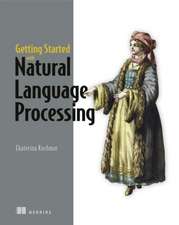 Getting Started with Natural Language ProcessingEkaterina Kochmar-20%Preț: 271.65 lei339.56 lei
 -
 Computational Intelligence in Data ScienceMieczyslaw Lech Owoc-20%Preț: 744.34 lei930.44 lei
 -
 -20%Preț: 636.86 lei796.08 lei
 -
 -20%Preț: 321.03 lei401.30 lei
 -
 -18%Preț: 152.96 lei186.24 lei
 -
 -18%Preț: 796.35 lei971.15 lei
 -
 -18%Preț: 3556.76 lei4337.51 lei
 -
 Mastering Text AnalyticsShailendra Kadre-20%Preț: 283.12 lei353.90 lei
Cuprins
Artificial intelligence.- Natural language processing.- Information extraction.- Lexical semantics.- Natural language generation.- Language resources.- Phonology .- Morphology.- Discourse.- Dialogue and pragmatics.
Caracteristici
Up-to-date results in computational linguistics and intelligent text processing Fast-track conference proceedings State-of-the-art research
Textul de pe ultima copertă
This two-volume set, consisting of LNCS 7181 and LNCS 7182, constitutes the thoroughly refereed proceedings of the 13th International Conference on Computer Linguistics and Intelligent Processing, held in New Delhi, India, in March 2012.
The total of 92 full papers were carefully reviewed and selected for inclusion in the proceedings. The contents have been ordered according to the following topical sections: NLP system architecture; lexical resources; morphology and syntax; word sense disambiguation and named entity recognition; semantics and discourse; sentiment analysis, opinion mining, and emotions; natural language generation; machine translation and multilingualism; text categorization and clustering; information extraction and text mining; information retrieval and question answering; document summarization; and applications.
The total of 92 full papers were carefully reviewed and selected for inclusion in the proceedings. The contents have been ordered according to the following topical sections: NLP system architecture; lexical resources; morphology and syntax; word sense disambiguation and named entity recognition; semantics and discourse; sentiment analysis, opinion mining, and emotions; natural language generation; machine translation and multilingualism; text categorization and clustering; information extraction and text mining; information retrieval and question answering; document summarization; and applications.