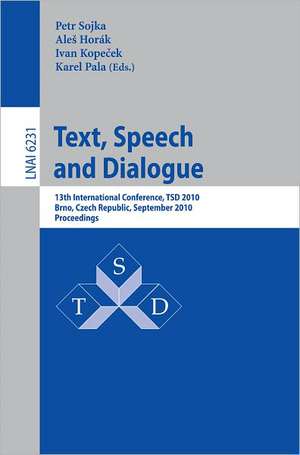
Text, Speech and Dialogue: 13th International Conference, TSD 2010, Brno, Czech Republic, September 6-10, 2010.Proceedings: Lecture Notes in Computer Science, cartea 6231
Editat de Petr Sojka, Aleš Horák, Ivan Kopeček, Karel Palaen Limba Engleză Paperback – 30 aug 2010
Metodologia prezentată în volumul Text, Speech and Dialogue, editat de Petr Sojka și colaboratorii săi, se concentrează pe intersecția tehnică dintre procesarea limbajului natural (NLP) și tehnologiile de recunoaștere a vorbirii. Observăm o rigoare academică ridicată, confirmată de rata de selecție de sub 50%, ceea ce garantează o densitate mare de informații despre arhitecturi de sistem și modele computaționale avansate. Structura este organizată logic, începând cu lucrări invitate care trasează direcțiile actuale în aplicații de tip real-world parsing și evoluția designului decodoarelor ASR.
Suntem de părere că valoarea acestui volum rezidă în abordarea granulară a componentelor de procesare. Secțiunea dedicată textului explorează structuri de evenimente în Wordnets, relații lexical-conceptuale și metode de identificare a duplicatelor semantice prin învățare automată. În ceea ce privește arhitectura sistemelor, lucrarea detaliază utilizarea motoarelor de căutare PML-TQ pentru lexicoane de valență și tehnici de rezoluție a anaforei. Credem că această progresie, de la unități lexicale izolate la sisteme complexe de Question Answering pentru Web-ul semantic, oferă o imagine clară asupra provocărilor de implementare în ingineria limbajului.
În cadrul seriei Lecture Notes in Computer Science, acest număr se distinge prin efortul de a unifica cercetarea teoretică cu necesitățile practice ale sistemelor de dialog. Sunt documentate atât abordări bazate pe reguli, cât și metode statistice, oferind specificații concrete pentru dezvoltatorii care lucrează la interfețe om-mașină și la optimizarea regăsirii informației prin procesare lingvistică profundă.
Din seria Lecture Notes in Computer Science
- 20%
 Preț: 558.53 lei
 - 20%
 Preț: 571.88 lei
 - 20%
 Preț: 675.83 lei
 - 20%
 Preț: 1020.28 lei
 - 20%
 Preț: 620.33 lei
 - 20%
 Preț: 560.93 lei
 - 20%
 Preț: 633.70 lei
 - 20%
 Preț: 731.82 lei
 - 20%
 Preț: 1359.66 lei
 - 20%
 Preț: 560.93 lei
 - 20%
 Preț: 733.68 lei
 - 20%
 Preț: 828.44 lei
 - 15%
 Preț: 558.12 lei
 - 20%
 Preț: 793.92 lei
 - 20%
 Preț: 560.93 lei
 - 20%
 Preț: 748.63 lei
 - 20%
 Preț: 562.49 lei
 - 20%
 Preț: 1246.46 lei
 - 20%
 Preț: 449.81 lei
 - 20%
 Preț: 556.96 lei
 - 20%
 Preț: 562.49 lei
 - 20%
 Preț: 851.78 lei
 - 20%
 Preț: 313.10 lei
 - 18%
 Preț: 945.44 lei
 - 20%
 Preț: 314.86 lei
 - 20%
 Preț: 560.93 lei
 - 20%
 Preț: 606.22 lei
 - 20%
 Preț: 1033.45 lei
 - 20%
 Preț: 563.29 lei
 - 20%
 Preț: 733.68 lei
 - 20%
 Preț: 1137.10 lei
 - 20%
 Preț: 735.28 lei
 - 20%
 Preț: 1079.23 lei
 - 20%
 Preț: 584.42 lei
 - 20%
 Preț: 854.16 lei
 - 15%
 Preț: 672.87 lei
 - 20%
 Preț: 1032.47 lei
 - 20%
 Preț: 617.17 lei
 - 20%
 Preț: 1022.15 lei
 - 20%
 Preț: 984.64 lei
 - 20%
 Preț: 620.33 lei
 - 20%
 Preț: 402.28 lei
 - 20%
 Preț: 316.28 lei
 - 20%
 Preț: 663.69 lei
 - 20%
 Preț: 320.24 lei
 - 20%
 Preț: 343.12 lei
 - 20%
 Preț: 313.87 lei
Preț: 636.86 lei
Preț vechi: 796.08 lei
-20%
Carte disponibilă
Livrare economică 14-28 noiembrie
Specificații
ISBN-10: 3642157599
Pagini: 608
Ilustrații: XIV, 593 p. 120 illus.
Dimensiuni: 12 x 93 x 33 mm
Greutate: 0.89 kg
Ediția:2010
Editura: Springer Berlin, Heidelberg
Colecția Springer
Seriile Lecture Notes in Computer Science, Lecture Notes in Artificial Intelligence
Locul publicării:Berlin, Heidelberg, Germany
V-ar putea interesa
-
 Preț: 69.77 lei
 -
 Introduction to Natural Language ProcessingJacob Eisenstein-29%Preț: 507.39 lei714.77 lei
 -
 -27%Preț: 721.31 lei988.10 lei
 -
 NLT Life Application Study Bible, Third Edition, Personal Size (Hardcover, Red Letter)New Living TranslationPreț: 270.06 lei
 -
 AlgospeakAdam AleksicPreț: 122.02 leiRecomandat
 -
 Natural Language Processing in ActionHapke Hannes-20%Preț: 350.43 lei438.03 lei
 -
 Real-World Natural Language ProcessingMasato Hagiwara-20%Preț: 331.07 lei413.83 lei
 -
 Getting Started with Natural Language ProcessingEkaterina Kochmar-20%Preț: 266.99 lei333.73 lei
 -
 Speaking in TonguesJ. M. CoetzeePreț: 105.11 lei
 -
 Preț: 72.51 lei
 -
 Preț: 89.52 lei
 -
 OracyNeil MercerPreț: 135.90 lei
 -
 Computational Linguistics and Intelligent Text ProcessingAlexander Gelbukh-20%Preț: 542.90 lei678.63 lei
 -
 Text, Speech, and DialogueElmar Nöth-20%Preț: 378.53 lei473.16 lei
 -
 -20%Preț: 313.87 lei392.34 lei
 -
 -20%Preț: 316.28 lei395.35 lei
 -
 Helpfinder Bible Nlt, Filament Enabled (Softcover, Red Letter)New Living TranslationPreț: 163.99 lei
 -
 Helpfinder Bible Nlt, Filament Enabled (Leatherlike, Harbor Blue, Red Letter)New Living TranslationPreț: 256.64 lei
 -
 Mastering Text AnalyticsShailendra Kadre-20%Preț: 283.12 lei353.90 lei
 -
 .NET 10 RevealedKajetan Duszy¿ski-20%Preț: 240.60 lei300.75 lei
Public țintă
ResearchDe ce să citești această carte
Pentru cercetătorii și inginerii din domeniul Inteligenței Artificiale, acest volum oferă o bază tehnică solidă pentru implementarea sistemelor NLP moderne. Cititorul câștigă acces la metodologii validate de evaluare a parserelor și la tehnici avansate de dezambiguizare semantică. Este o resursă esențială pentru a înțelege cum pot fi integrate procesarea textului și recunoașterea vorbirii în sisteme de dialog funcționale, bazate pe date experimentale și modele matematice riguroase.