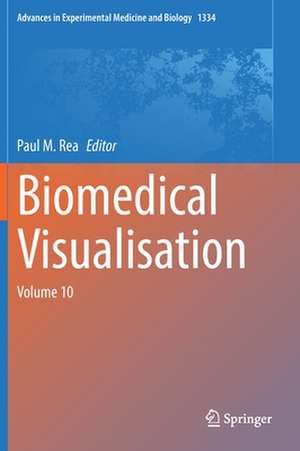
Biomedical Visualisation: Advances in Experimental Medicine and Biology, cartea 1334
Editat de Paul M. Reaen Limba Engleză Hardback – 3 sep 2021
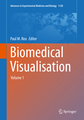
The reader will be able to explore the utilisation of technologies from a number of fields to enable an engaging and meaningful visual representation of the biomedical sciences.
The chapters presented in this volume cover such a diverse range of topics, with something for everyone. We present here chapters on technology enhanced learning in neuroanatomy; 3D printing and surgical planning; changes in higher education utilising technology, decolonising the curriculum and visual representations of the humanbody in education. We also showcase how not to use protective personal equipment inspired by the pandemic; anatomical and historical visualisation of obstetrics and gynaecology; 3D modelling of carpal bones and augmented reality for arachnid phobias for public engagement. In addition, we also present face modelling for surgical education in a multidisciplinary setting, military medical museum 3D digitising of historical pathology specimens and finally computational fluid dynamics.
Din seria Advances in Experimental Medicine and Biology
- 30%
 Preț: 752.07 lei
 - 5%
 Preț: 1334.86 lei
 - 5%
 Preț: 1212.42 lei
 - 5%
 Preț: 1335.15 lei
 - 5%
 Preț: 1207.57 lei
 - 5%
 Preț: 1142.42 lei
 - 18%
 Preț: 1163.92 lei
 - 5%
 Preț: 1057.02 lei
 - 5%
 Preț: 1487.84 lei
 - 5%
 Preț: 1200.13 lei
 - 18%
 Preț: 980.33 lei
 - 5%
 Preț: 942.82 lei
 - 18%
 Preț: 992.48 lei
 - 18%
 Preț: 1274.22 lei
 - 5%
 Preț: 1275.48 lei
 - 18%
 Preț: 1157.14 lei
 - 5%
 Preț: 1138.79 lei
 - 18%
 Preț: 1165.27 lei
 - 5%
 Preț: 1206.95 lei
 - 18%
 Preț: 1268.90 lei
 - 5%
 Preț: 1347.73 lei
 - 18%
 Preț: 1462.85 lei
 - 18%
 Preț: 1459.28 lei
 - 18%
 Preț: 1283.66 lei
 - 5%
 Preț: 1679.37 lei
 - 5%
 Preț: 1352.87 lei
 - 18%
 Preț: 1166.87 lei
 - 5%
 Preț: 1138.79 lei
 - 24%
 Preț: 966.03 lei
 - 15%
 Preț: 667.86 lei
 - 5%
 Preț: 1137.79 lei
 - 18%
 Preț: 981.18 lei
 - 18%
 Preț: 980.36 lei
 - 5%
 Preț: 1199.06 lei
 - 20%
 Preț: 1742.49 lei
 - 5%
 Preț: 750.62 lei
 - 18%
 Preț: 1451.34 lei
 - 5%
 Preț: 1133.64 lei
 - 18%
 Preț: 2616.27 lei
 - 5%
 Preț: 1075.08 lei
 - 18%
 Preț: 1443.07 lei
 - 5%
 Preț: 745.85 lei
 - 5%
 Preț: 1146.99 lei
 - 5%
 Preț: 696.54 lei
 - 18%
 Preț: 1037.10 lei
 - 5%
 Preț: 1363.25 lei
 - 5%
 Preț: 1084.55 lei
 - 5%
 Preț: 701.25 lei
Preț: 1142.35 lei
Preț vechi: 1202.46 lei
-5%
Puncte Express: 1714
Carte tipărită la comandă
Livrare economică 02-16 decembrie
Livrare prin curier în România Termenul estimat este afișat lângă disponibilitate.
Transport gratuit pentru acest produs Plată online sau ramburs, în funcție de opțiunile comenzii.
Retur gratuit în 14 zile Comandă securizată și suport în română.
Specificații
ISBN-13: 9783030769505
ISBN-10: 303076950X
Pagini: 240
Ilustrații: XVI, 223 p. 141 illus., 125 illus. in color.
Dimensiuni: 183 x 260 x 19 mm
Greutate: 0.59 kg
Ediția:1st ed. 2021
Editura: Springer
Colecția Advances in Experimental Medicine and Biology
Seria Advances in Experimental Medicine and Biology
Locul publicării:Cham, Switzerland
ISBN-10: 303076950X
Pagini: 240
Ilustrații: XVI, 223 p. 141 illus., 125 illus. in color.
Dimensiuni: 183 x 260 x 19 mm
Greutate: 0.59 kg
Ediția:1st ed. 2021
Editura: Springer
Colecția Advances in Experimental Medicine and Biology
Seria Advances in Experimental Medicine and Biology
Locul publicării:Cham, Switzerland
V-ar putea interesa
-
 Eyes by HandDan Roche-5%Preț: 142.27 lei149.76 lei
 -
 Computer-Assisted Planning in Craniofacial SurgeryAmir H. Dorafshar-29%Preț: 785.97 lei1106.27 lei
 -
 Obstetric Imaging: Fetal Diagnosis and CareJoshua A. Copel-28%Preț: 1751.36 lei2417.89 leiRecomandat
 -
 Atlas of Orthoses and Assistive DevicesDouglas P. Murphy-28%Preț: 1169.10 lei1618.81 leiRecomandat
 -
 Sabiston Textbook of Surgery: The Biological Basis of Modern Surgical PracticeDouglas Scott Tyler-29%Preț: 1169.15 lei1645.26 leiRecomandat
 -
 Weir & Abrahams' Imaging Atlas of Human AnatomyJonathan Spratt-28%Preț: 377.69 lei525.82 lei
 -
 -32%Preț: 251.67 lei367.54 lei
 -
 Preț: 384.83 leiRecomandat
 -
 Visual Anatomy & Physiology, Global EditionEdwin Bartholomew-5%Preț: 666.36 lei701.43 lei
 -
 Visualize ThisNathan Yau-20%Preț: 233.34 lei291.67 lei
 -
 Visual Methods for Digital Research - An IntroductionGabriele ColomboPreț: 139.67 lei
 -
 -30%Preț: 234.31 lei335.86 lei
 -
 MicrocosmosBrandon BrollPreț: 142.96 lei
 -
 Putting Plastic Surgery on PaperChristine SloboginPreț: 245.12 lei
 -
 Interactive Media for Cultural HeritageFotis Liarokapis-20%Preț: 1338.28 lei1672.86 lei
 -
 -5%Preț: 1152.47 lei1213.12 lei
 -
 The NeuronomiconGrayson W. Hooper-5%Preț: 453.16 lei477.01 lei
 -
 Virtual AnthropologyFred L. Bookstein-15%Preț: 637.07 lei749.49 lei
 -
 -5%Preț: 1332.39 lei1402.52 lei
 -
 Applications of Three-dimensional Imaging for Craniofacial RegionShailendra Singh Rana-5%Preț: 1082.94 lei1139.94 lei
Cuprins
Evaluating the Efficacy and Optimisation of the Peer-led Flipped Model Using TEL Resources Within Neuroanatomy.- Observation of Patients’ 3D Printed Anatomical Features and 3D Visualisation Technologies Improve Spatial Awareness for Surgical Planning and in-Theatre Performance.- Pandemics, Protests and Pronouns: The Changing Landscape of Biomedical Visualisation and Education.- What Not to Do with PPE: A Digital Application to Raise Awareness of Proper PPE Protocol.- The Embryonic re-Development of an Anatomy Museum.- Visualising the Link Between Carpal Bones and their Etymologies.- Augmented Reality Application of Schizocosa Ocreata: A tool for Reducing Fear of Arachnids Through Public Outreach.- The Surgical Art Face©: Developing a Bespoke Multimodal Face Model for Reconstructive Surgical Education.- Modernizing Medical Museums Through the 3D Digitization of Pathological Specimens.- An Introduction to Biomedical Computational Fluid Dynamics.
Notă biografică
Paul M. Rea is a Professor of Digital and Anatomical Education at the University of Glasgow. He is qualified with a medical degree (MBChB), a MSc (by research) in craniofacial anatomy/surgery, a PhD in neuroscience, the Diploma in Forensic Medical Science (DipFMS), and an MEd with Merit (Learning and Teaching in Higher Education). He is an elected Fellow of the Royal Society for the encouragement of Arts, Manufactures and Commerce (FRSA), elected Fellow of the Royal Society of Biology (FRSB), Senior Fellow of the Higher Education Academy, professional member of the Institute of Medical Illustrators (MIMI) and a registered medical illustrator with the Academy for Healthcare Science.
Paul has published widely and presented at many national and international meetings, including invited talks. He sits on the Executive Editorial Committee for the Journal of Visual Communication in Medicine, is Associate Editor for the European Journal of Anatomy and reviews for 25 different journals/publishers.
He is the Public Engagement and Outreach lead for anatomy coordinating collaborative projects with the Glasgow Science Centre, NHS and Royal College of Physicians and Surgeons of Glasgow. Paul is also a STEM ambassador and has visited numerous schools to undertake outreach work.
His research involves a long-standing strategic partnership with the School of Simulation and Visualisation The Glasgow School of Art. This has led to multi-million pound investment in creating world leading 3D digital datasets to be used in undergraduate and postgraduate teaching to enhance learning and assessment. This successful collaboration resulted in the creation of the worlds first taught MSc Medical Visualisation and Human Anatomy combining anatomy and digital technologies. The Institute of Medical Illustrators also accredits it. It has created college-wide, industry, multi-institutional and NHS research linked projects for students. Paul is the Programme Director for this degree.
Paul has published widely and presented at many national and international meetings, including invited talks. He sits on the Executive Editorial Committee for the Journal of Visual Communication in Medicine, is Associate Editor for the European Journal of Anatomy and reviews for 25 different journals/publishers.
He is the Public Engagement and Outreach lead for anatomy coordinating collaborative projects with the Glasgow Science Centre, NHS and Royal College of Physicians and Surgeons of Glasgow. Paul is also a STEM ambassador and has visited numerous schools to undertake outreach work.
His research involves a long-standing strategic partnership with the School of Simulation and Visualisation The Glasgow School of Art. This has led to multi-million pound investment in creating world leading 3D digital datasets to be used in undergraduate and postgraduate teaching to enhance learning and assessment. This successful collaboration resulted in the creation of the worlds first taught MSc Medical Visualisation and Human Anatomy combining anatomy and digital technologies. The Institute of Medical Illustrators also accredits it. It has created college-wide, industry, multi-institutional and NHS research linked projects for students. Paul is the Programme Director for this degree.
Textul de pe ultima copertă
This edited book explores the use of technology to enable us to visualise the life sciences in a more meaningful and engaging way. It will enable those interested in visualisation techniques to gain a better understanding of the applications that can be used in visualisation, imaging and analysis, education, engagement and training. The reader will also be able to learn about the use of visualisation techniques and technologies for the historical and forensic settings. The reader will be able to explore the utilisation of technologies from a number of fields to enable an engaging and meaningful visual representation of the biomedical sciences.
The chapters presented in this volume cover such a diverse range of topics, with something for everyone. We present here chapters on technology enhanced learning in neuroanatomy; 3D printing and surgical planning; changes in higher education utilising technology, decolonising the curriculum and visual representations of the human body ineducation. We also showcase how not to use protective personal equipment inspired by the pandemic; anatomical and historical visualisation of obstetrics and gynaecology; 3D modelling of carpal bones and augmented reality for arachnid phobias for public engagement. In addition, we also present face modelling for surgical education in a multidisciplinary setting, military medical museum 3D digitising of historical pathology specimens and finally computational fluid dynamics.
The chapters presented in this volume cover such a diverse range of topics, with something for everyone. We present here chapters on technology enhanced learning in neuroanatomy; 3D printing and surgical planning; changes in higher education utilising technology, decolonising the curriculum and visual representations of the human body ineducation. We also showcase how not to use protective personal equipment inspired by the pandemic; anatomical and historical visualisation of obstetrics and gynaecology; 3D modelling of carpal bones and augmented reality for arachnid phobias for public engagement. In addition, we also present face modelling for surgical education in a multidisciplinary setting, military medical museum 3D digitising of historical pathology specimens and finally computational fluid dynamics.
Caracteristici
Highlights unique ways to use computing technology to visualise data from a wide variety of fields from the biomedical and life sciences Presents methodologies which will enable the reader to easily reproduce related materials for their courses, specialty, or to engage a wider audience Contains visually engaging material from many specialties to appeal to a wide audience