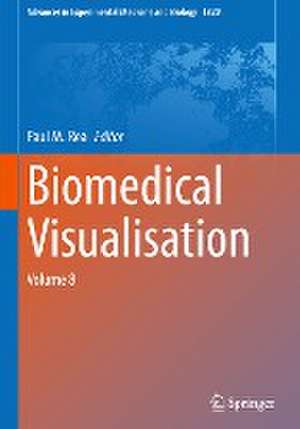
Biomedical Visualisation: Advances in Experimental Medicine and Biology, cartea 1320
Editat de Paul M. Reaen Limba Engleză Hardback – 20 noi 2020
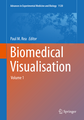
This edited book explores the use of technology to enable us to visualise the life sciences in a more meaningful and engaging way. It will enable those interested in visualisation techniques to gain a better understanding of the applications that can be used in visualisation, imaging and analysis, education, engagement and training.
The reader will be able to explore the utilisation of technologies from a number of fields to enable an engaging and meaningful visual representation of the biomedical sciences, with a focus in this volume related to anatomy, and clinically applied scenarios.
The first six chapters in this volume show the wide variety of tools and methodologies that digital technologies and visualisation techniques can be utilised and adopted in the educational setting. This ranges from body painting, clinical neuroanatomy, histology and veterinary anatomy through to real time visualisations and the uses of digital and social media for anatomical education. The last four chapters represent the diversity that technology has to be able to use differing realities and 3D capture in medical visualisation, and how remote visualisation techniques have developed. Finally, it concludes with an analysis of image overlays and augmented reality and what the wider literature says about this rapidly evolving field.
Din seria Advances in Experimental Medicine and Biology
- 30%
 Preț: 752.07 lei
 - 5%
 Preț: 1334.86 lei
 - 5%
 Preț: 1212.42 lei
 - 5%
 Preț: 1335.15 lei
 - 5%
 Preț: 1207.57 lei
 - 5%
 Preț: 1142.42 lei
 - 18%
 Preț: 1163.92 lei
 - 5%
 Preț: 1057.02 lei
 - 5%
 Preț: 1487.84 lei
 - 5%
 Preț: 1200.13 lei
 - 18%
 Preț: 980.33 lei
 - 5%
 Preț: 942.82 lei
 - 18%
 Preț: 992.48 lei
 - 18%
 Preț: 1274.22 lei
 - 5%
 Preț: 1275.48 lei
 - 18%
 Preț: 1157.14 lei
 - 5%
 Preț: 1138.79 lei
 - 18%
 Preț: 1165.27 lei
 - 5%
 Preț: 1206.95 lei
 - 18%
 Preț: 1268.90 lei
 - 5%
 Preț: 1347.73 lei
 - 18%
 Preț: 1462.85 lei
 - 18%
 Preț: 1459.28 lei
 - 18%
 Preț: 1283.66 lei
 - 5%
 Preț: 1679.37 lei
 - 5%
 Preț: 1352.87 lei
 - 18%
 Preț: 1166.87 lei
 - 5%
 Preț: 1138.79 lei
 - 24%
 Preț: 966.03 lei
 - 15%
 Preț: 667.86 lei
 - 5%
 Preț: 1137.79 lei
 - 18%
 Preț: 981.18 lei
 - 18%
 Preț: 980.36 lei
 - 5%
 Preț: 1199.06 lei
 - 20%
 Preț: 1742.49 lei
 - 5%
 Preț: 750.62 lei
 - 18%
 Preț: 1451.34 lei
 - 5%
 Preț: 1133.64 lei
 - 18%
 Preț: 2616.27 lei
 - 5%
 Preț: 1075.08 lei
 - 18%
 Preț: 1443.07 lei
 - 5%
 Preț: 745.85 lei
 - 5%
 Preț: 1146.99 lei
 - 5%
 Preț: 696.54 lei
 - 18%
 Preț: 1037.10 lei
 - 5%
 Preț: 1363.25 lei
 - 5%
 Preț: 1084.55 lei
 - 5%
 Preț: 701.25 lei
Preț: 770.76 lei
Preț vechi: 811.33 lei
-5%
Puncte Express: 1156
Carte tipărită la comandă
Livrare economică 28 noiembrie-04 decembrie
Livrare prin curier în România Termenul estimat este afișat lângă disponibilitate.
Transport gratuit pentru acest produs Plată online sau ramburs, în funcție de opțiunile comenzii.
Retur gratuit în 14 zile Comandă securizată și suport în română.
Specificații
ISBN-13: 9783030474829
ISBN-10: 3030474828
Pagini: 212
Ilustrații: XV, 195 p. 87 illus., 48 illus. in color.
Dimensiuni: 183 x 260 x 17 mm
Greutate: 0.59 kg
Ediția:1st ed. 2020
Editura: Springer
Colecția Advances in Experimental Medicine and Biology
Seria Advances in Experimental Medicine and Biology
Locul publicării:Cham, Switzerland
ISBN-10: 3030474828
Pagini: 212
Ilustrații: XV, 195 p. 87 illus., 48 illus. in color.
Dimensiuni: 183 x 260 x 17 mm
Greutate: 0.59 kg
Ediția:1st ed. 2020
Editura: Springer
Colecția Advances in Experimental Medicine and Biology
Seria Advances in Experimental Medicine and Biology
Locul publicării:Cham, Switzerland
V-ar putea interesa
-
 Eyes by HandDan Roche-5%Preț: 142.27 lei149.76 lei
 -
 Computer-Assisted Planning in Craniofacial SurgeryAmir H. Dorafshar-29%Preț: 785.97 lei1106.27 lei
 -
 Obstetric Imaging: Fetal Diagnosis and CareJoshua A. Copel-28%Preț: 1751.36 lei2417.89 leiRecomandat
 -
 Atlas of Orthoses and Assistive DevicesDouglas P. Murphy-28%Preț: 1169.10 lei1618.81 leiRecomandat
 -
 Sabiston Textbook of Surgery: The Biological Basis of Modern Surgical PracticeDouglas Scott Tyler-29%Preț: 1169.15 lei1645.26 leiRecomandat
 -
 Weir & Abrahams' Imaging Atlas of Human AnatomyJonathan Spratt-28%Preț: 377.69 lei525.82 lei
 -
 -32%Preț: 251.67 lei367.54 lei
 -
 Preț: 384.83 leiRecomandat
 -
 Visual Anatomy & Physiology, Global EditionEdwin Bartholomew-5%Preț: 666.36 lei701.43 lei
 -
 Visualize ThisNathan Yau-20%Preț: 233.34 lei291.67 lei
 -
 Visual Methods for Digital Research - An IntroductionGabriele ColomboPreț: 139.67 lei
 -
 -30%Preț: 234.31 lei335.86 lei
 -
 MicrocosmosBrandon BrollPreț: 142.96 lei
 -
 Putting Plastic Surgery on PaperChristine SloboginPreț: 245.12 lei
 -
 Interactive Media for Cultural HeritageFotis Liarokapis-20%Preț: 1338.28 lei1672.86 lei
 -
 -5%Preț: 1152.47 lei1213.12 lei
 -
 The NeuronomiconGrayson W. Hooper-5%Preț: 453.16 lei477.01 lei
 -
 Virtual AnthropologyFred L. Bookstein-15%Preț: 637.07 lei749.49 lei
 -
 -5%Preț: 1332.39 lei1402.52 lei
 -
 Applications of Three-dimensional Imaging for Craniofacial RegionShailendra Singh Rana-5%Preț: 1082.94 lei1139.94 lei
Cuprins
Chapter 1. Enhancing teaching in biomedical, health and exercise science with real-time physiological visualisations (Christian Moro, Zane Stromberga & Ashleigh Moreland).- Chapter 2. The evolution of educational technology in veterinary anatomy education (Julien Guevar).- Chapter 3. Body Painting Plus: Art-based activities to improve visualisation in clinical education settings (Angelique N. Dueñas & Gabrielle M. Finn).- Chapter 4. TEL methods used for the learning of clinical neuroanatomy (Ahmad Elmansouri, Olivia Murray, Samuel Hall, Scott Border).- Chapter 5. From Scope to Screen: The Evolution of Histology Education (Jamie A. Chapman, Lisa M.J. Lee and Nathan T. Swailes).- Chapter 6. Digital and Social Media in Anatomy Education (C. M. Hennessy and C. F. Smith).- Chapter 7. Mixed and Virtual Reality Interaction and Presentation Techniques for Medical Visualizations (Ross T. Smith, Thomas J. Clarke, Wolfgang Mayer, Andrew Cunningham, Brandon Matthews, Joanne E. Zucco).- Chapter 8. Pores, pimples and pathologies: 3D capture and detailing of human skin for 3D medical visualisation and fabrication (Mark Roughley).- Chapter 9. Extending the reach and task-shifting ophthalmology diagnostics through remote visualisation (Mario E Giardini and Iain A T Livingstone).- Chapter 10. Image overlay surgery based on augmented reality: A systematic review (Laura Pérez-Pachón, Matthieu Poyade, Terry Lowe, Flora Gröning).
Notă biografică
Paul is a Professor of Digital and Anatomical Education at the University of Glasgow. He is qualified with a medical degree (MBChB), a MSc (by research) in craniofacial anatomy/surgery, a PhD in neuroscience, the Diploma in Forensic Medical Science (DipFMS), and an MEd with Merit (Learning and Teaching in Higher Education). He is an elected Fellow of the Royal Society for the encouragement of Arts, Manufactures and Commerce (FRSA), elected Fellow of the Royal Society of Biology (FRSB), Senior Fellow of the Higher Education Academy, professional member of the Institute of Medical Illustrators (MIMI) and a registered medical illustrator with the Academy for Healthcare Science.
Paul has published widely and presented at many national and international meetings, including invited talks. He sits on the Executive Editorial Committee for the Journal of Visual Communication in Medicine, is Associate Editor for the European Journal of Anatomy and reviews for 25 different journals/publishers.
He is the Public Engagement and Outreach lead for anatomy coordinating collaborative projects with the Glasgow Science Centre, NHS and Royal College of Physicians and Surgeons of Glasgow. Paul is also a STEM ambassador and has visited numerous schools to undertake outreach work.
His research involves a long-standing strategic partnership with the School of Simulation and Visualisation The Glasgow School of Art. This has led to multi-million pound investment in creating world leading 3D digital datasets to be used in undergraduate and postgraduate teaching to enhance learning and assessment. This successful collaboration resulted in the creation of the worlds first taught MSc Medical Visualisation and Human Anatomy combining anatomy and digital technologies. The Institute of Medical Illustrators also accredits it. It has created college-wide, industry, multi-institutional and NHS research linked projects for students. Paul is the Programme Director forthis degree.
Paul has published widely and presented at many national and international meetings, including invited talks. He sits on the Executive Editorial Committee for the Journal of Visual Communication in Medicine, is Associate Editor for the European Journal of Anatomy and reviews for 25 different journals/publishers.
He is the Public Engagement and Outreach lead for anatomy coordinating collaborative projects with the Glasgow Science Centre, NHS and Royal College of Physicians and Surgeons of Glasgow. Paul is also a STEM ambassador and has visited numerous schools to undertake outreach work.
His research involves a long-standing strategic partnership with the School of Simulation and Visualisation The Glasgow School of Art. This has led to multi-million pound investment in creating world leading 3D digital datasets to be used in undergraduate and postgraduate teaching to enhance learning and assessment. This successful collaboration resulted in the creation of the worlds first taught MSc Medical Visualisation and Human Anatomy combining anatomy and digital technologies. The Institute of Medical Illustrators also accredits it. It has created college-wide, industry, multi-institutional and NHS research linked projects for students. Paul is the Programme Director forthis degree.
Textul de pe ultima copertă
This edited book explores the use of technology to enable us to visualise the life sciences in a more meaningful and engaging way. It will enable those interested in visualisation techniques to gain a better understanding of the applications that can be used in visualisation, imaging and analysis, education, engagement and training.
The reader will be able to explore the utilisation of technologies from a number of fields to enable an engaging and meaningful visual representation of the biomedical sciences, with a focus in this volume related to anatomy, and clinically applied scenarios.
The first six chapters in this volume show the wide variety of tools and methodologies that digital technologies and visualisation techniques can be utilised and adopted in the educational setting. This ranges from body painting, clinical neuroanatomy, histology and veterinary anatomy through to real time visualisations and the uses of digital and social media for anatomical education. The last four chapters represent the diversity that technology has to be able to use differing realities and 3D capture in medical visualisation, and how remote visualisation techniques have developed. Finally, it concludes with an analysis of image overlays and augmented reality and what the wider literature says about this rapidly evolving field.
Caracteristici
Showcases unique ways to use computing technology to visualise data from a wide variety of fields from the biomedical and life sciences Presents methodologies which will enable the reader to easily reproduce related materials for their courses, specialty, or to engage a wider audience Provides visually engaging material from many specialties that will appeal to a wide audience