
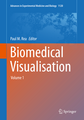
Biomedical Visualisation: Advances in Experimental Medicine and Biology, cartea 1317
Editat de Paul M. Reaen Limba Engleză Paperback – 5 mai 2022
This edited book explores the use of technology to enable us to visualise the life sciences in a more meaningful and engaging way. It will enable those interested in visualisation techniques to gain a better understanding of the applications that can be used in visualisation, imaging and analysis, education, engagement and training. The reader will also be able to learn about the use of visualisation techniques and technologies for the historical and forensic settings.
The reader will be able to explore the utilisation of technologies from a number of fields to enable an engaging and meaningful visual representation of the biomedical sciences.
In this volume, there are chapters which examine forensic and historical visualisation techniques and digital reconstruction, ultrasound, virtual learning resources and patient utilised software and hardware. The use of HoloLens as a disruptive technology is discussed as well as historical items as a feature in a modern medical curriculum. It concludes with a fascinating chapter on pulse extraction from facial videos. All in all, this volume has something for everyone whether that is faculty, students, clinicians and forensic practitioners, patients, or simply having an interest in one or more of these areas.
Din seria Advances in Experimental Medicine and Biology
- 30%
 Preț: 752.07 lei
 - 5%
 Preț: 1334.86 lei
 - 5%
 Preț: 1212.42 lei
 - 5%
 Preț: 1335.15 lei
 - 5%
 Preț: 1207.57 lei
 - 5%
 Preț: 1142.42 lei
 - 18%
 Preț: 1163.92 lei
 - 5%
 Preț: 1057.02 lei
 - 5%
 Preț: 1487.84 lei
 - 5%
 Preț: 1200.13 lei
 - 18%
 Preț: 980.33 lei
 - 5%
 Preț: 942.82 lei
 - 18%
 Preț: 992.48 lei
 - 18%
 Preț: 1274.22 lei
 - 5%
 Preț: 1275.48 lei
 - 18%
 Preț: 1157.14 lei
 - 5%
 Preț: 1138.79 lei
 - 18%
 Preț: 1165.27 lei
 - 5%
 Preț: 1206.95 lei
 - 18%
 Preț: 1268.90 lei
 - 5%
 Preț: 1347.73 lei
 - 18%
 Preț: 1462.85 lei
 - 18%
 Preț: 1459.28 lei
 - 18%
 Preț: 1283.66 lei
 - 5%
 Preț: 1679.37 lei
 - 5%
 Preț: 1352.87 lei
 - 18%
 Preț: 1166.87 lei
 - 5%
 Preț: 1138.79 lei
 - 24%
 Preț: 966.03 lei
 - 15%
 Preț: 667.86 lei
 - 5%
 Preț: 1137.79 lei
 - 18%
 Preț: 981.18 lei
 - 18%
 Preț: 980.36 lei
 - 5%
 Preț: 1199.06 lei
 - 20%
 Preț: 1742.49 lei
 - 5%
 Preț: 750.62 lei
 - 18%
 Preț: 1451.34 lei
 - 5%
 Preț: 1133.64 lei
 - 18%
 Preț: 2616.27 lei
 - 5%
 Preț: 1075.08 lei
 - 18%
 Preț: 1443.07 lei
 - 5%
 Preț: 745.85 lei
 - 5%
 Preț: 1146.99 lei
 - 5%
 Preț: 696.54 lei
 - 18%
 Preț: 1037.10 lei
 - 5%
 Preț: 1363.25 lei
 - 5%
 Preț: 1084.55 lei
 - 5%
 Preț: 701.25 lei
Preț: 929.96 lei
Preț vechi: 978.90 lei
-5%
Puncte Express: 1395
Carte tipărită la comandă
Livrare economică 28 noiembrie-04 decembrie
Livrare prin curier în România Termenul estimat este afișat lângă disponibilitate.
Transport gratuit pentru acest produs Plată online sau ramburs, în funcție de opțiunile comenzii.
Retur gratuit în 14 zile Comandă securizată și suport în română.
Specificații
ISBN-13: 9783030611279
ISBN-10: 3030611272
Pagini: 220
Ilustrații: XV, 202 p. 68 illus., 47 illus. in color.
Dimensiuni: 178 x 254 x 12 mm
Greutate: 0.47 kg
Ediția:1st ed. 2021
Editura: Springer
Colecția Advances in Experimental Medicine and Biology
Seria Advances in Experimental Medicine and Biology
Locul publicării:Cham, Switzerland
ISBN-10: 3030611272
Pagini: 220
Ilustrații: XV, 202 p. 68 illus., 47 illus. in color.
Dimensiuni: 178 x 254 x 12 mm
Greutate: 0.47 kg
Ediția:1st ed. 2021
Editura: Springer
Colecția Advances in Experimental Medicine and Biology
Seria Advances in Experimental Medicine and Biology
Locul publicării:Cham, Switzerland
V-ar putea interesa
-
 Eyes by HandDan Roche-5%Preț: 142.27 lei149.76 lei
 -
 Computer-Assisted Planning in Craniofacial SurgeryAmir H. Dorafshar-29%Preț: 785.97 lei1106.27 lei
 -
 Obstetric Imaging: Fetal Diagnosis and CareJoshua A. Copel-28%Preț: 1751.36 lei2417.89 leiRecomandat
 -
 Atlas of Orthoses and Assistive DevicesDouglas P. Murphy-28%Preț: 1169.10 lei1618.81 leiRecomandat
 -
 Sabiston Textbook of Surgery: The Biological Basis of Modern Surgical PracticeDouglas Scott Tyler-29%Preț: 1169.15 lei1645.26 leiRecomandat
 -
 Weir & Abrahams' Imaging Atlas of Human AnatomyJonathan Spratt-28%Preț: 377.69 lei525.82 lei
 -
 -32%Preț: 251.67 lei367.54 lei
 -
 Preț: 384.83 leiRecomandat
 -
 Visual Anatomy & Physiology, Global EditionEdwin Bartholomew-5%Preț: 666.36 lei701.43 lei
 -
 Visualize ThisNathan Yau-20%Preț: 233.34 lei291.67 lei
 -
 Visual Methods for Digital Research - An IntroductionGabriele ColomboPreț: 139.67 lei
 -
 -30%Preț: 234.31 lei335.86 lei
 -
 MicrocosmosBrandon BrollPreț: 142.96 lei
 -
 Putting Plastic Surgery on PaperChristine SloboginPreț: 245.12 lei
 -
 Interactive Media for Cultural HeritageFotis Liarokapis-20%Preț: 1338.28 lei1672.86 lei
 -
 -5%Preț: 1152.47 lei1213.12 lei
 -
 The NeuronomiconGrayson W. Hooper-5%Preț: 453.16 lei477.01 lei
 -
 Virtual AnthropologyFred L. Bookstein-15%Preț: 637.07 lei749.49 lei
 -
 -5%Preț: 1332.39 lei1402.52 lei
 -
 Applications of Three-dimensional Imaging for Craniofacial RegionShailendra Singh Rana-5%Preț: 1082.94 lei1139.94 lei
Cuprins
Chapter 1. Pair-Matching Digital 3D Models Of Temporomandibular Fragments Using Mesh-To-Mesh Value Comparison And Implications For Commingled Human Remain Assemblages (Alana S. Acuff, Mara A. Karell, Konstantinos E. Spanakis, And Elena F. Kranioti).- Chapter 2. Forensic Recreation And Visual Representation Of Greek Orthodox Church Saint, Eftichios of Crete (Nectarios Vidakis, Markos Petousis, Despoina Nathena, Elena F. Kranioti, Andreas Manios).- Chapter 3. Virtual Trauma Analysis Of The 19th Century Severed Head Of The Greek Outlaw Stavrou (Elena F. Kranioti, Nikos Tsiatis, Kristina Frandson, Maria Stefanidou, Konstantinos Moraitis).- Chapter 4. Using Computed Tomography (CT) Data To Build 3D Resources For Forensic Craniofacial Identification (Terrie Simmons-Ehrhardt, Catyana R.S. Falsetti, Anthony B. Falsetti).- Chapter 5. Instructional Design Of Virtual Learning Resources For Anatomy Education (Nicolette S. Birbara, Nalini Pather).- Chapter 6. Implementation Of Ultrasound In Anatomy Education (Claire Smith And Seb Barfoot).- Chapter 7. What The Tech? The Management Of Neurological Dysfunction Through The Use Of Digital Technology (Caitlin Carswell And Paul M. Rea).- Chapter 8. Teaching With Disruptive Technology: The Use Of Augmented, Virtual, And Mixed Reality (Hololens) For Disease Education (Zane Stromberga, Charlotte Phelps, Jessica Smith & Christian Moro).- Chapter 9. “Inform the Head, Give Dexterity to the Hand, Familiarise the Heart”: Seeing and Using Digitised Eighteenth-Century Specimens in a Modern Medical Curriculum (Frances Osis).- Chapter 10. Contact-Free Pulse Signal Extraction From Human Face Videos: A Review And New Optimised Filtering Approach (Muhammad Waqar, Reyer Zwiggelaar And Bernard Tiddeman).
Notă biografică
Paul is a Professor of Digital and Anatomical Education at the University of Glasgow. He is qualified with a medical degree (MBChB), an MSc (by research) in craniofacial anatomy/surgery, a Ph.D. in neuroscience, a Diploma in Forensic Medical Science (DipFMS), and an MEd with Merit (Learning and Teaching in Higher Education). He is an elected Fellow of the Royal Society for the encouragement of Arts, Manufactures and Commerce (FRSA), elected Fellow of the Royal Society of Biology (FRSB), Senior Fellow of the Higher Education Academy, a professional member of the Institute of Medical Illustrators (MIMI) and a registered medical illustrator with the Academy for Healthcare Science.
He is the Public Engagement and Outreach lead for anatomy coordinating collaborative projects with the Glasgow Science Centre, NHS, and Royal College of Physicians and Surgeons of Glasgow. Paul is also a STEM ambassador and has visited numerous schools to undertake outreach work.
His research involves a long-standing strategic partnership with the School of Simulation and Visualisation The Glasgow School of Art. This has led to multi-million-pound investment in creating world-leading 3D digital datasets to be used in undergraduate and postgraduate teaching to enhance learning and assessment. This successful collaboration resulted in the creation of the world's first taught MSc Medical Visualisation and Human Anatomy combining anatomy and digital technologies. The Institute of Medical Illustrators also accredits it. It has created college-wide, industry, multi-institutional, and NHS research linked projects for students. Paul is the Programme Director for this degree.
Paul has published widely and presented at many national and international meetings, including invited talks. He sits on the Executive Editorial Committee for the Journal of Visual Communication in Medicine, is an Associate Editor for the European Journal of Anatomy and reviews for 25 different journals/publishers.
Textul de pe ultima copertă
This edited book explores the use of technology to enable us to visualise the life sciences in a more meaningful and engaging way. It will enable those interested in visualisation techniques to gain a better understanding of the applications that can be used in visualisation, imaging and analysis, education, engagement and training. The reader will also be able to learn about the use of visualisation techniques and technologies for the historical and forensic settings.
The reader will be able to explore the utilisation of technologies from a number of fields to enable an engaging and meaningful visual representation of the biomedical sciences.
In this volume, there are chapters which examine forensic and historical visualisation techniques and digital reconstruction, ultrasound, virtual learning resources and patient utilised software and hardware. The use of HoloLens as a disruptive technology is discussed as well as historical items as a feature in a modern medical curriculum. It concludes with a fascinating chapter on pulse extraction from facial videos. All in all, this volume has something for everyone whether that is faculty, students, clinicians and forensic practitioners, patients, or simply having an interest in one or more of these areas.
Caracteristici
Makes the invisible visible Uses tools technologies and techniques to aid visualisation of the human body Applies technology to education training and engagement of the body and biological processes