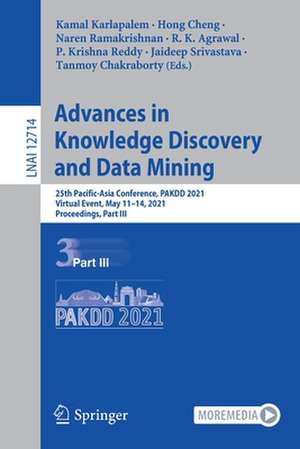
Advances in Knowledge Discovery and Data Mining: Lecture Notes in Computer Science, cartea 12714
Editat de Kamal Karlapalem, Hong Cheng, Naren Ramakrishnan, R. K. Agrawal, P. Krishna Reddy, Jaideep Srivastava, Tanmoy Chakrabortyen Limba Engleză Paperback – 8 mai 2021
Part I: Applications of knowledge discovery and data mining of specialized data;
Part II: Classical data mining; data mining theory and principles; recommender systems; and text analytics;
Part III: Representation learning and embedding, and learning from data.
Din seria Lecture Notes in Computer Science
- 20%
 Preț: 558.53 lei
 - 20%
 Preț: 617.17 lei
 - 20%
 Preț: 571.88 lei
 - 20%
 Preț: 1020.28 lei
 - 20%
 Preț: 851.78 lei
 - 20%
 Preț: 560.93 lei
 - 20%
 Preț: 633.70 lei
 - 20%
 Preț: 675.83 lei
 - 20%
 Preț: 1359.66 lei
 - 20%
 Preț: 620.33 lei
 - 20%
 Preț: 733.68 lei
 - 18%
 Preț: 945.44 lei
 - 15%
 Preț: 558.12 lei
 - 20%
 Preț: 793.92 lei
 - 20%
 Preț: 560.93 lei
 - 20%
 Preț: 748.63 lei
 - 20%
 Preț: 562.49 lei
 - 20%
 Preț: 1032.47 lei
 - 20%
 Preț: 678.21 lei
 - 20%
 Preț: 556.96 lei
 - 20%
 Preț: 1022.15 lei
 - 20%
 Preț: 562.49 lei
 - 20%
 Preț: 560.93 lei
 - 20%
 Preț: 313.10 lei
 - 20%
 Preț: 828.44 lei
 - 20%
 Preț: 560.93 lei
 - 20%
 Preț: 314.86 lei
 - 20%
 Preț: 1033.45 lei
 - 20%
 Preț: 563.29 lei
 - 20%
 Preț: 733.68 lei
 - 20%
 Preț: 1137.10 lei
 - 20%
 Preț: 735.28 lei
 - 20%
 Preț: 1079.23 lei
 - 20%
 Preț: 584.42 lei
 - 20%
 Preț: 791.54 lei
 - 15%
 Preț: 672.87 lei
 - 20%
 Preț: 606.22 lei
 - 20%
 Preț: 1246.46 lei
 - 20%
 Preț: 449.81 lei
 - 20%
 Preț: 984.64 lei
 - 20%
 Preț: 620.33 lei
 - 20%
 Preț: 402.28 lei
 - 20%
 Preț: 316.28 lei
 - 20%
 Preț: 663.69 lei
 - 20%
 Preț: 320.24 lei
 - 20%
 Preț: 343.12 lei
 - 20%
 Preț: 313.87 lei
Preț: 550.98 lei
Preț vechi: 688.73 lei
-20%
Puncte Express: 826
Carte disponibilă
Livrare economică 05-19 noiembrie
Livrare express 21-27 octombrie pentru 43.40 lei
Livrare prin curier în România Termenul estimat este afișat lângă disponibilitate.
Transport gratuit pentru acest produs Plată online sau ramburs, în funcție de opțiunile comenzii.
Retur gratuit în 14 zile Comandă securizată și suport în română.
Specificații
ISBN-13: 9783030757670
ISBN-10: 3030757676
Pagini: 460
Ilustrații: XXIII, 434 p. 142 illus., 117 illus. in color.
Dimensiuni: 155 x 235 x 25 mm
Greutate: 0.69 kg
Ediția:1st edition 2021
Editura: Springer
Colecția Lecture Notes in Computer Science
Seria Lecture Notes in Computer Science
Locul publicării:Cham, Switzerland
ISBN-10: 3030757676
Pagini: 460
Ilustrații: XXIII, 434 p. 142 illus., 117 illus. in color.
Dimensiuni: 155 x 235 x 25 mm
Greutate: 0.69 kg
Ediția:1st edition 2021
Editura: Springer
Colecția Lecture Notes in Computer Science
Seria Lecture Notes in Computer Science
Locul publicării:Cham, Switzerland
Cuprins
Representation Learning and Embedding.- Episode Adaptive Embedding Networks for Few-shot Learning.- Universal Representation for Code.- Self-supervised Adaptive Aggregator Learning on Graph.- A Fast Algorithm for Simultaneous Sparse Approximation.- STEPs-RL: Speech-Text Entanglement for Phonetically Sound Representation Learning.- RW-GCN: Training Graph Convolution Networks with biased random walk for Semi-Supervised Classification.- Loss-aware Pattern Inference: A Correction on the Wrongly Claimed Limitations of Embedding Models.- SST-GNN: Simplified Spatio-temporal Traffic forecasting model using Graph Neural Network.- VIKING: Adversarial Attack on Network Embeddings via Supervised Network Poisoning.- Self-supervised Graph Representation Learning with Variational Inference.- Manifold Approximation and Projection by Maximizing Graph Information.- Learning Attention-based Translational Knowledge Graph Embedding via Nonlinear Dynamic Mapping.- Multi-Grained Dependency Graph Neural Network for Chinese Open Information Extraction.- Human-Understandable Decision Making for Visual Recognition.- LightCAKE: A Lightweight Framework for Context-Aware Knowledge Graph Embedding.- Transferring Domain Knowledge with an Adviser in Continuous Tasks.- Inferring Hierarchical Mixture Structures: A Bayesian Nonparametric Approach.- Quality Control for Hierarchical Classification with Incomplete Annotations.- Learning from Data.- Learning Discriminative Features using Multi-label Dual Space.- AutoCluster: Meta-learning Based Ensemble Method for Automated Unsupervised Clustering.- BanditRank: Learning to Rank Using Contextual Bandits.- A compressed and accelerated SegNet for plant leaf disease segmentation: A Differential Evolution based approach.- Meta-Context Transformers for Domain-Specific Response Generation.- A Multi-task Kernel Learning Algorithm for Survival Analysis.- Meta-data Augmentation based Search Strategy through Generative Adversarial Network for AutoML Model Selection.- Tree-Capsule: Tree-Structured Capsule Network for Improving Relation Extraction.- Rule Injection-based Generative Adversarial Imitation Learning for Knowledge Graph Reasoning.- Hierarchical Self Attention Based Autoencoder for Open-Set Human Activity Recognition.- Reinforced Natural Language Inference for Distantly Supervised Relation Classification.- SaGCN: Structure-aware Graph Convolution Network for Document-level Relation Extraction.- Addressing the class imbalance problem in medical image segmentation via accelerated Tversky loss function.- Incorporating Relational Knowledge in Explainable Fake News Detection.- Incorporating Syntactic Information into Relation Representations for Enhanced Relation Extraction.