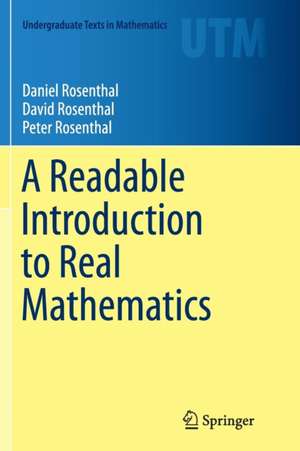
A Readable Introduction to Real Mathematics: Undergraduate Texts in Mathematics
Autor Daniel Rosenthal, David Rosenthal, Peter Rosenthalen Limba Engleză Paperback – 16 sep 2016
Observăm că tranziția de la calculul algoritmic de liceu la rigoarea demonstrațiilor universitare lasă adesea o lacună pedagogică pe care A Readable Introduction to Real Mathematics reușește să o completeze eficient. Această a doua ediție, publicată de Springer, nu se limitează la prezentarea unor rezultate, ci prioritizează formarea gândirii matematice prin expunerea frumuseții structurilor abstracte. Suntem de părere că progresia logică a conținutului — de la numere naturale și inducție, trecând prin criptografia RSA, până la cardinalitatea seturilor infinite și geometrie euclidiană — oferă o bază solidă pentru orice student la început de drum.
Comparabil cu The Art of Proof în rigurozitate, volumul scris de Daniel Rosenthal, David Rosenthal și Peter Rosenthal se distinge prin faptul că este actualizat pentru o audiență mai largă, fiind accesibil chiar și elevilor de liceu pasionați, nu doar studenților care au parcurs deja calculul diferențial. În timp ce alte lucrări din domeniu tratează demonstrația ca pe un subiect izolat, acest text o integrează organic în subiecte fundamentale precum Teorema Fundamentală a Aritmeticii sau numerele iraționale. Putem afirma că rigoarea nu este sacrificată în favoarea lizibilității; dimpotrivă, stilul precis și exercițiile cu grade diferite de dificultate forțează cititorul să participe activ la construcția matematică. Față de An Introduction to Mathematical Reasoning, care se concentrează masiv pe combinatorică și teoria seturilor, lucrarea familiei Rosenthal oferă o perspectivă mai diversificată, incluzând incursiuni în spații multidimensionale și serii infinite, pregătind terenul pentru cursuri avansate de analiză și algebră abstractă.
Din seria Undergraduate Texts in Mathematics
- 15%
 Preț: 409.62 lei
 -
 Preț: 442.25 lei
 - 15%
 Preț: 414.11 lei
 - 15%
 Preț: 409.46 lei
 -
 Preț: 445.70 lei
 - 15%
 Preț: 487.89 lei
 - 15%
 Preț: 409.72 lei
 -
 Preț: 405.09 lei
 -
 Preț: 403.29 lei
 -
 Preț: 427.91 lei
 - 15%
 Preț: 469.14 lei
 -
 Preț: 548.54 lei
 -
 Preț: 382.22 lei
 -
 Preț: 440.44 lei
 - 15%
 Preț: 507.99 lei
 -
 Preț: 377.12 lei
 - 12%
 Preț: 320.18 lei
 - 24%
 Preț: 389.19 lei
 -
 Preț: 405.42 lei
 -
 Preț: 404.41 lei
 - 15%
 Preț: 440.08 lei
 - 15%
 Preț: 463.77 lei
 -
 Preț: 320.86 lei
 - 20%
 Preț: 326.42 lei
 -
 Preț: 430.31 lei
 -
 Preț: 435.26 lei
 - 15%
 Preț: 470.34 lei
 - 20%
 Preț: 494.55 lei
 -
 Preț: 504.79 lei
 - 19%
 Preț: 390.93 lei
 -
 Preț: 440.55 lei
 - 15%
 Preț: 480.13 lei
 - 15%
 Preț: 552.56 lei
 -
 Preț: 383.31 lei
 -
 Preț: 379.51 lei
 - 15%
 Preț: 461.97 lei
 -
 Preț: 449.07 lei
 -
 Preț: 367.33 lei
 -
 Preț: 394.72 lei
 - 17%
 Preț: 415.37 lei
 -
 Preț: 380.99 lei
 -
 Preț: 388.04 lei
 -
 Preț: 470.42 lei
 -
 Preț: 370.46 lei
 -
 Preț: 366.56 lei
Preț: 298.80 lei
Carte tipărită la comandă
Livrare economică 27 noiembrie-03 decembrie
Specificații
ISBN-10: 331937950X
Pagini: 173
Dimensiuni: 155 x 235 x 10 mm
Greutate: 0.25 kg
Ediția:Softcover reprint of the original 1st ed. 2014
Editura: Springer
Colecția Springer
Seria Undergraduate Texts in Mathematics
Locul publicării:Cham, Switzerland
V-ar putea interesa
-
 Consciousness and MindDavid Rosenthal-28%Preț: 428.08 lei595.64 lei
 -
 An Introduction to Operators on the Hardy-Hilbert SpaceRuben A. Martinez-Avendano-15%Preț: 475.93 lei559.92 lei
 -
 Simultaneous TriangularizationHeydar Radjavi-15%Preț: 671.62 lei790.14 lei
 -
 CloserPatrick Marber-11%Preț: 80.08 lei89.72 lei
 -
 A Logical Introduction to ProofDaniel W. CunninghamPreț: 328.72 lei
 -
 Selected PapersJacob WolfowitzPreț: 489.91 lei
 -
 The National Theatre StoryDr Daniel Rosenthal-15%Preț: 376.65 lei444.65 lei
 -
 Rasch Models in HealthKarl Bang Christensen-9%Preț: 1065.34 lei1170.71 lei
 -
 Gesammelte Mathematische Abhandlungen: Band ILudwig SchläfliPreț: 413.82 lei
 -
 Mathematische Werke: Erster Band FunktionentheorieAdolf Hurwitz-15%Preț: 474.66 lei558.42 lei
 -
 Trends in Contemporary MathematicsVincenzo Ancona-15%Preț: 670.93 lei789.33 lei
 -
 Art Meets Mathematics in the Fourth DimensionStephen Leon Lipscomb-43%Preț: 228.09 lei398.23 lei
 -
 Invariant SubspacesHeydar Radjavi-15%Preț: 584.13 lei687.20 lei
 -
 Equations différentielles avec transformées de LaplaceMario Maïr Cohen-19%Preț: 456.95 lei564.14 lei
 -
 La programmation mathématique pour la gestion de la QOSFrédérick HenriPreț: 372.99 lei
 -
 Preț: 375.92 lei
 -
 Matematica: Si Parte!Yves BiollayPreț: 83.31 lei
 -
 Matematica NumericaAlfio QuarteroniPreț: 288.62 lei
 -
 TopologiaMarco ManettiPreț: 275.70 lei
De ce să citești această carte
Recomandăm această carte oricărui cititor care dorește să înțeleagă ce înseamnă „matematica pură” dincolo de simple calcule. Este un instrument ideal pentru auto-studiu sau pentru un curs introductiv de licență, oferind claritate asupra unor concepte complexe precum numerele complexe sau constructibilitatea geometrică. Cititorul câștigă nu doar cunoștințe teoretice, ci și capacitatea de a formula și scrie demonstrații matematice riguroase.
Despre autor
Autorii Daniel, David și Peter Rosenthal formează o echipă academică ce îmbină expertiza în cercetarea matematică cu o pedagogie rafinată, specifică seriei Undergraduate Texts in Mathematics de la Springer. Peter Rosenthal este cunoscut pentru capacitatea sa de a face matematica accesibilă, o trăsătură care definește acest volum. Interesant este contrastul cu alte lucrări ale autorilor, cum ar fi Efficient Radiology, care aplică rigoarea analitică în domenii practice precum fluxurile de lucru din radiologie, demonstrând versatilitatea gândirii matematice pe care o promovează în textele lor teoretice.
Recenzii
“The book is an introduction to real mathematics and is very readable. … The book is indeed a joy to read, and would be an excellent text for an ‘appreciation of mathematics’ course, among other possibilities.” (G. A. Heuer, Mathematical Reviews, February, 2015)
“Daniel Rosenthal and Peter Rosenthal (both, Univ. of Toronto) and David Rosenthal (St. John's Univ.) present well-chosen, basic, conceptual mathematics, suitably accessible after a K-12 education, in a detailed, self-conscious way that emphasizes methodology alongside content and crucially leads to an ultimate clear payoff. … Summing Up: Recommended. Lower-division undergraduates and two-year technical program students; general readers.” (D. V. Feldman, Choice, Vol. 52 (6), February, 2015)
Caracteristici
Includes exercises of varying difficulty to help motivate and teach the reader
Develops mathematical thinking that will be useful for future mathematics teachers and mathematics majors
Solutions to selected exercises are freely available in PDF
Cuprins
Notă biografică
Textul de pe ultima copertă
From the reviews of the first edition:
“It is carefully written in a precise but readable and engaging style… I thoroughly enjoyed reading this recent addition to the Springer Undergraduate Texts in Mathematics series and commend this clear, well-organised, unfussy text to its target audiences.” (Nick Lord, The Mathematical Gazette, Vol. 100 (547), 2016)
“The book is an introduction to real mathematics and is very readable. … The book is indeed a joy to read, and would be an excellent text for an ‘appreciation of mathematics’ course, among other possibilities.” (G.A. Heuer, Mathematical Reviews, February, 2015)
“Many a benighted book misguidedly addresses the need [to teach mathematical thinking] by framing reasoning, or narrowly, proof, not as pervasive modality but somehow as itself an autonomous mathematical subject. Fortunately, the present book gets it right.... [presenting] well-chosen, basic, conceptual mathematics, suitably accessible after a K-12 education, in a detailed, self-conscious way that emphasizes methodology alongside content and crucially leads to an ultimate clear payoff. … Summing Up: Recommended. Lower-division undergraduates and two-year technical program students; general readers.” (D.V. Feldman, Choice, Vol. 52 (6), February, 2015)