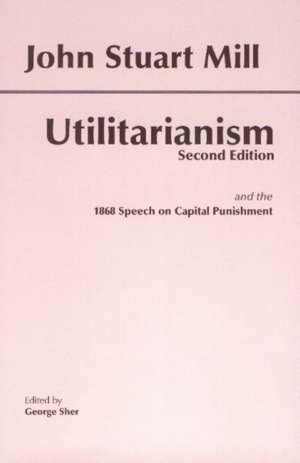
Utilitarianism: and the 1868 Speech on Capital Punishment
Autor John Stuart Mill Editat de George Sheren Limba Engleză Paperback – 15 iun 2002
Preț: 60.45 lei
Preț vechi: 73.36 lei
-18%
Puncte Express: 91
Carte disponibilă
Livrare economică 09-23 noiembrie
Livrare express 24-30 octombrie pentru 27.01 lei
Livrare prin curier în România Termenul estimat este afișat lângă disponibilitate.
Transport gratuit de la 400.00 lei Plată online sau ramburs, în funcție de opțiunile comenzii.
Retur gratuit în 14 zile Comandă securizată și suport în română.
Specificații
ISBN-13: 9780872206052
ISBN-10: 087220605X
Pagini: 88
Dimensiuni: 140 x 216 x 5 mm
Greutate: 0.09 kg
Ediția:Second Edition,2
Editura: Hackett Publishing Company,Inc
Colecția Hackett Publishing Company, Inc.
Locul publicării:United States
ISBN-10: 087220605X
Pagini: 88
Dimensiuni: 140 x 216 x 5 mm
Greutate: 0.09 kg
Ediția:Second Edition,2
Editura: Hackett Publishing Company,Inc
Colecția Hackett Publishing Company, Inc.
Locul publicării:United States
V-ar putea interesa
-
 The Art of RhetoricAristotlePreț: 28.01 lei
 -
 Letters from a StoicLucius SenecaPreț: 29.76 lei
 -
 ProgressSamuel Miller McDonaldPreț: 161.19 lei
 -
 Utilitarianism and Other EssaysJeremy Bentham-18%Preț: 64.64 lei79.27 lei
 -
 The Fable of the BeesBernard MandevillePreț: 96.41 lei
 -
 On Liberty and the Subjection of WomenJohn Stuart Mill-26%Preț: 53.76 lei72.33 lei
 -
 Utilitarianism: A Very Short IntroductionKatarzyna de Lazari-Radek-20%Preț: 57.12 lei71.12 lei
 -
 -21%Preț: 200.84 lei254.90 lei
 -
 Culture and AnarchyMatthew Arnold-19%Preț: 58.13 lei71.69 lei
 -
 On Liberty, Utilitarianism and Other EssaysJohn Stuart Mill-16%Preț: 62.86 lei74.49 lei
 -
 The Morality of LawLon L. FullerPreț: 195.53 lei
 -
 MeditationsMarcus AureliusPreț: 34.00 lei
 -
 On LibertyJohn Stuart Mill-55%Preț: 20.91 lei46.20 lei
 -
 On Liberty and UtilitarianismJohn Stuart MillPreț: 42.90 lei
 -
 Good to GreatJim Collins-24%Preț: 146.96 lei192.27 lei
 -
 -8%Preț: 91.28 lei99.72 lei
 -
 The Classical UtilitariansJeremy Bentham-17%Preț: 109.63 lei131.77 lei
 -
 BenthamMichael QuinnPreț: 150.76 lei
 -
 The Methods of EthicsHenry SidgwickPreț: 103.21 lei
 -
 Auguste Comte and PositivismJohn Stuart MillPreț: 52.91 lei
 -
 Nicomachean EthicsAristotlePreț: 44.60 lei
 -
 AutobiographyJohn Stuart MillPreț: 41.86 lei
 -
 Utilitarianism - Ed. HeydtJohn Stuart MillPreț: 135.45 lei
 -
 -25%Preț: 71.05 lei94.73 lei
 -
 Confessions of an Advertising ManDavid Ogilvy-18%Preț: 88.22 lei108.16 lei
 -
 MeditationsMarcus AureliusPreț: 45.09 lei
 -
 Utilitarianism /Der UtilitarismusJohn Stuart MillPreț: 55.69 lei
 -
 UtopiaThomas MorePreț: 33.19 lei
Descriere
This expanded edition of John Stuart Mill's Utilitarianism includes the text of his 1868 speech to the British House of Commons defending the use of capital punishment in cases of aggravated murder. The speech is significant both because its topic remains timely and because its arguments illustrate the applicability of the principle of utility to questions of large-scale social policy.
Recenzii
Adding the selections from the Speech on Capital Punishment is an excellent idea. --Mark Migotti, University of Calgary
Adding the selections from the Speech on Capital Punishment is an excellent idea. --Mark Migotti, University of Calgary
Notă biografică
John Stuart Mill (20 May 1806 - 7 May 1873) was an English philosopher, political economist, Member of Parliament (MP) and civil servant. One of the most influential thinkers in the history of classical liberalism, he contributed widely to social theory, political theory, and political economy. Dubbed "the most influential English-speaking philosopher of the nineteenth century" by the Stanford Encyclopedia of Philosophy, he conceived of liberty as justifying the freedom of the individual in opposition to unlimited state and social control.Mill was a proponent of utilitarianism, an ethical theory developed by his predecessor Jeremy Bentham. He contributed to the investigation of scientific methodology, though his knowledge of the topic was based on the writings of others, notably William Whewell, John Herschel, and Auguste Comte, and research carried out for Mill by Alexander Bain. He engaged in written debate with Whewell.A member of the Liberal Party and author of the early feminist work The Subjection of Women, Mill was also the second Member of Parliament to call for women's suffrage after Henry Hunt in 1832.
Cuprins
1. General remarks; 2. What utilitarianism is; 3. Of the ultimate sanction of the principle of utility; 4. Of that sort of proof the principle of utility is susceptible; 5. Of the connexion between justice and utility.