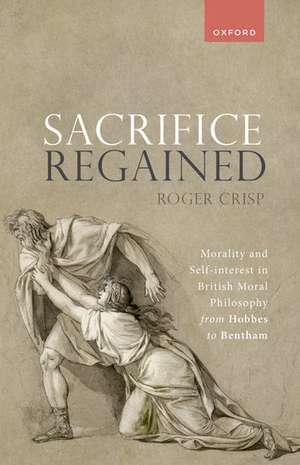
Sacrifice Regained: Morality and Self-Interest in British Moral Philosophy from Hobbes to Bentham
Autor Roger Crispen Limba Engleză Paperback – 18 oct 2023
Preț: 200.84 lei
Preț vechi: 254.90 lei
-21%
Puncte Express: 301
Carte disponibilă
Livrare economică 13-24 noiembrie
Livrare express 31 octombrie-06 noiembrie pentru 80.62 lei
Livrare prin curier în România Termenul estimat este afișat lângă disponibilitate.
Transport gratuit de la 400.00 lei Plată online sau ramburs, în funcție de opțiunile comenzii.
Retur gratuit în 14 zile Comandă securizată și suport în română.
Specificații
ISBN-13: 9780198896562
ISBN-10: 0198896565
Pagini: 256
Dimensiuni: 153 x 233 x 13 mm
Greutate: 0.39 kg
Editura: OUP OXFORD
Colecția OUP Oxford
Locul publicării:Oxford, United Kingdom
ISBN-10: 0198896565
Pagini: 256
Dimensiuni: 153 x 233 x 13 mm
Greutate: 0.39 kg
Editura: OUP OXFORD
Colecția OUP Oxford
Locul publicării:Oxford, United Kingdom
V-ar putea interesa
-
 -20%Preț: 430.04 lei537.32 lei
 -
 Reasons and PersonsDerek Parfit-15%Preț: 203.07 lei238.17 lei
 -
 Killing in WarJeff McMahan-15%Preț: 170.60 lei200.79 lei
 -
 Ethical Dilemmas in SchoolsDouglas J SimpsonPreț: 305.09 lei
 -
 Commercial Society: A Primer on Ethics and EconomicsCathleen Johnson-19%Preț: 333.08 lei409.36 lei
Recenzii
Roger Crisp's excellent book concerns the relation between morality and self-interest in the British Moralists . . . Each chapter begins with a critical account of the moral theory of the moralist, followed by a critical discussion of the moralist's view of the relation between morality and self-interest. . . . Even readers not so concerned with the relation between morality and self-interest will benefit from the state-of-the-art treatments of the moral theories. You can piece together a fine short history of utilitarianism from the chapters on Cumberland, Hutcheson, Hume, Gay, Tucker, Paley and Bentham (and a short history of objections to utilitarianism from the chapters on Butler, Smith, and Price). And you can trace histories of certain strategies, such as (remarkably common) split-level defences of psychological egoism, rational egoism, or consequentialism.
Roger Crisp offers a fresh look at the foundations and development of British moral philosophy from Hobbes to Bentham, in the process demonstrating a mastery of the writings of a legion of philosophers. . . . Sacrifice Regained is an unambiguously unique contribution to the secondary literature on modern British moral philosophy, and the reader curious about the contributions made by Crisp's selection of philosophers to our understanding of morality and its challenges, and what makes their ideas still so very interesting, will not be disappointed by his acute examination of the relevant texts.
Roger Crisp gives a fresh perspective on the debates of the British Moralists in this book that will be essential reading for anyone interested in the British Moralists or in the historical background of utilitarianism, theories of well-being, or the weight of moral reasons. Crisp uses foundational and precise contemporary conceptual distinctions to tease apart interesting differences in these historical texts. Crisp compellingly argues that this period of thought crucially advances the idea that genuine self-sacrifice for the sake of moral reasons is possible. A stimulating and informative read on its own, and it would also be useful as a companion to both Raphael's British Moralists volumes and other recent books on these figures.
Roger Crisp offers a fresh look at the foundations and development of British moral philosophy from Hobbes to Bentham, in the process demonstrating a mastery of the writings of a legion of philosophers. . . . Sacrifice Regained is an unambiguously unique contribution to the secondary literature on modern British moral philosophy, and the reader curious about the contributions made by Crisp's selection of philosophers to our understanding of morality and its challenges, and what makes their ideas still so very interesting, will not be disappointed by his acute examination of the relevant texts.
Roger Crisp gives a fresh perspective on the debates of the British Moralists in this book that will be essential reading for anyone interested in the British Moralists or in the historical background of utilitarianism, theories of well-being, or the weight of moral reasons. Crisp uses foundational and precise contemporary conceptual distinctions to tease apart interesting differences in these historical texts. Crisp compellingly argues that this period of thought crucially advances the idea that genuine self-sacrifice for the sake of moral reasons is possible. A stimulating and informative read on its own, and it would also be useful as a companion to both Raphael's British Moralists volumes and other recent books on these figures.
Notă biografică
Roger Crisp is Professor of Moral Philosophy at the University of Oxford and Uehiro Fellow and Tutor in Philosophy at St Anne's College, Oxford. He is the author of Reasons and the Good (Oxford 2006) and The Cosmos of Duty: Henry Sidgwick's Methods of Ethics (Oxford 2015), co-editor of Well-Being and Morality: Essays in Honour of James Griffin (with Brad Hooker; Clarendon Press 2000), and editor of The Oxford Handbook of the History of Ethics (Oxford 2013) and Griffin on Human Rights (Oxford 2014).
Cuprins
- 1: Introduction: The Morality Question
- 2: Hobbes: The Return of Gyges
- 3: More: An Enthusiasm for Virtue
- 4: Cumberland: Divine Utilitarianism
- 5: Locke: The Sanctions of God
- 6: Mandeville: Morality After the Fall
- 7: Shaftesbury: Stoicism and the Art of Virtue
- 8: Butler: The Supremacy of Conscience
- 9: Hutcheson: Impartial Pleasures
- 10: Clarke: Virtue and the Life Hereafter
- 11: Reid: The Goodness of Virtue, and its Limits
- 12: Hume: Morality as Utility
- 13: Smith: The Delusions of Self-Love
- 14: Price: Morality as God
- 15: Gay, Tucker, Paley, and Bentham: Variations on the Theme of Happiness