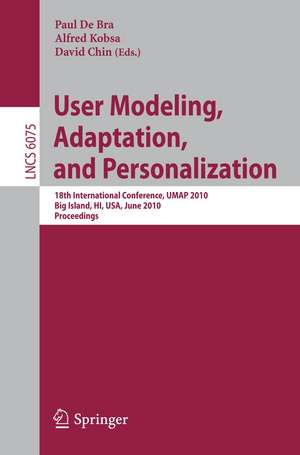
User Modeling, Adaptation, and Personalization: 18th International Conference, UMAP 2010, Big Island, HI, USA, June 20-24, 2010, Proceedings: Lecture Notes in Computer Science, cartea 6075
Editat de Paul De Bra, Alfred Kobsa, David Chinen Limba Engleză Paperback – iun 2010
Recomandăm acest volum cercetătorilor și specialiștilor în sisteme informatice care posedă deja o bază solidă în analiza datelor și interacțiunea om-calculator. Fiind rezultatul fuziunii dintre comunitățile de „User Modeling” (UM) și „Adaptive Hypermedia” (AH), lucrarea presupune familiaritatea cu algoritmii de personalizare și structurile de date complexe utilizate în adaptarea conținutului web.
Remarcăm rigoarea academică ridicată a acestei ediții, demonstrată de rata de acceptare de doar 23.2% pentru lucrările de cercetare extinse. Structura volumului User Modeling, Adaptation, and Personalization este organizată progresiv, începând cu prelegeri magistrale despre modelarea emoțiilor în entități virtuale și continuând cu aplicații practice precum modelarea difuziei influenței pentru reclamele sociale (AdHeat). Un aspect distinctiv față de alte conferințe de profil este echilibrul dintre teorie și aplicabilitate practică, evidențiat prin includerea unei secțiuni de „Industry Papers” coordonată de experți de la Google și PARC.
Complementar volumului User Modeling 2005, care punea bazele sistemelor de recomandare și navigației web suport, ediția din 2010 acoperă zone mai avansate și emergente la acea vreme, precum modelarea contextului prin senzori și Twitter pentru gestionarea întreruperilor sau utilizarea memoriei de lucru în e-learning. De asemenea, spre deosebire de Advances in User Modeling (UMAP 2011), care se concentrează pe ateliere și postere, acest volum prezintă nucleul cercetării fundamentale prin lucrări complete, oferind o perspectivă tehnică aprofundată asupra modului în care sistemele pot prezice performanța utilizatorului în medii de învățare inteligente.
Din seria Lecture Notes in Computer Science
- 20%
 Preț: 558.53 lei
 - 20%
 Preț: 571.88 lei
 - 20%
 Preț: 675.83 lei
 - 20%
 Preț: 1020.28 lei
 - 20%
 Preț: 851.78 lei
 - 20%
 Preț: 560.93 lei
 - 20%
 Preț: 633.70 lei
 - 20%
 Preț: 731.82 lei
 - 20%
 Preț: 1359.66 lei
 - 20%
 Preț: 620.33 lei
 - 20%
 Preț: 733.68 lei
 - 18%
 Preț: 945.44 lei
 - 15%
 Preț: 558.12 lei
 - 20%
 Preț: 793.92 lei
 - 20%
 Preț: 560.93 lei
 - 20%
 Preț: 748.63 lei
 - 20%
 Preț: 562.49 lei
 - 20%
 Preț: 1246.46 lei
 - 20%
 Preț: 449.81 lei
 - 20%
 Preț: 606.22 lei
 - 20%
 Preț: 620.33 lei
 - 20%
 Preț: 562.49 lei
 - 20%
 Preț: 560.93 lei
 - 20%
 Preț: 313.10 lei
 - 20%
 Preț: 828.44 lei
 - 20%
 Preț: 560.93 lei
 - 20%
 Preț: 314.86 lei
 - 20%
 Preț: 1033.45 lei
 - 20%
 Preț: 563.29 lei
 - 20%
 Preț: 733.68 lei
 - 20%
 Preț: 1137.10 lei
 - 20%
 Preț: 735.28 lei
 - 20%
 Preț: 1079.23 lei
 - 20%
 Preț: 584.42 lei
 - 20%
 Preț: 854.16 lei
 - 15%
 Preț: 672.87 lei
 - 20%
 Preț: 1032.47 lei
 - 20%
 Preț: 617.17 lei
 - 20%
 Preț: 1022.15 lei
 - 20%
 Preț: 984.64 lei
 - 20%
 Preț: 556.96 lei
 - 20%
 Preț: 402.28 lei
 - 20%
 Preț: 316.28 lei
 - 20%
 Preț: 663.69 lei
 - 20%
 Preț: 320.24 lei
 - 20%
 Preț: 343.12 lei
 - 20%
 Preț: 313.87 lei
Preț: 328.16 lei
Preț vechi: 410.20 lei
-20%
Carte disponibilă
Livrare economică 17 noiembrie-01 decembrie
Specificații
ISBN-10: 3642134696
Pagini: 428
Ilustrații: XVIII, 428 p. 115 illus.
Dimensiuni: 8 x 93 x 29 mm
Greutate: 0.66 kg
Ediția:2010
Editura: Springer Berlin, Heidelberg
Colecția Springer
Seriile Lecture Notes in Computer Science, Information Systems and Applications, incl. Internet/Web, and HCI
Locul publicării:Berlin, Heidelberg, Germany
V-ar putea interesa
-
 -39%Preț: 273.06 lei450.65 lei
 -
 Using Artificial Intelligence Absolute Beginner's GuideMichael Miller-20%Preț: 201.72 lei252.15 lei
 -
 Thinking, Fast and SlowDaniel Kahneman-27%Preț: 90.79 lei123.57 leiRecomandat
 -
 Preț: 207.88 lei
 -
 -9%Preț: 581.31 lei638.79 lei
 -
 e-Learning and the Science of InstructionRuth Colvin Clark-19%Preț: 455.68 lei562.57 lei
 -
 How Do We Learn?Hector Ruiz MartinPreț: 136.27 lei
 -
 Get Better Faster 2.0Paul Bambrick-SantoyoPreț: 249.01 lei
 -
 Agentic AI For DummiesPam Baker-20%Preț: 145.95 lei182.44 lei
 -
 Inside Digital Advertising: Platforms, Power, and Material PoliticsDonald MackenziePreț: 156.81 lei
 -
 Evaluation in e-LearningY Psaromiligkos-35%Preț: 777.99 lei1204.98 lei
 -
 Rethinking eLearning: What Works. What Doesn't. What's Missing.Michael W. Allen-20%Preț: 225.65 lei281.02 lei
 -
 10 to 25David YeagerPreț: 94.46 lei
 -
 SUMO (Shut Up, Move On)Paul McGeePreț: 78.52 lei
 -
 Grader Reader Workbook: Ready to ScoreMark BaileyPreț: 58.01 lei
 -
 -20%Preț: 911.37 lei1139.20 lei
 -
 Emotions and Personality in Personalized ServicesMarko Tkal¿i¿-20%Preț: 684.40 lei855.50 lei
 -
 Preț: 384.13 lei
 -
 Preț: 383.23 lei
Public țintă
ResearchDe ce să citești această carte
Pentru cercetătorii din domeniul data mining și HCI, acest volum din seria Lecture Notes in Computer Science oferă acces la metodologii validate de selecție riguroasă. Cititorul câștigă o înțelegere profundă a algoritmilor de personalizare, de la modelarea profilurilor de grup la sisteme mobile de modelare a utilizatorului, fiind o resursă esențială pentru dezvoltarea sistemelor adaptive moderne.