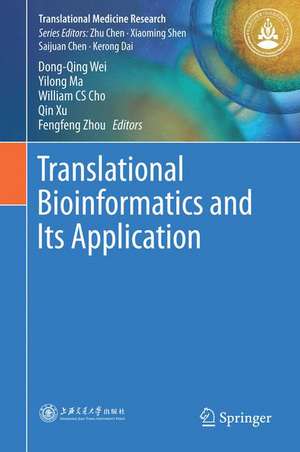
Translational Bioinformatics and Its Application: Translational Medicine Research
Editat de Dong-Qing Wei, Yilong Ma, William C.S. Cho, Qin Xu, Fengfeng Zhouen Limba Engleză Hardback – 10 apr 2017
Notăm cu interes cum Translational Bioinformatics and Its Application reușește să depășească limitele documentației tehnice standard prin integrarea directă a fluxurilor de date clinice cu cele moleculare. Ceea ce diferențiază acest volum de manualele teoretice este focalizarea pe aplicabilitatea imediată a informaticii în patologia umană, oferind soluții concrete pentru „puntea” dintre cercetarea de laborator și patul pacientului. Remarcăm o structură riguroasă, care debutează cu procesul de descoperire a medicamentelor (Drug Discovery) și avansează spre complexitatea analizei RNA-Sequencing și a epigeneticii în cancer.
Subliniem importanța studiilor de caz detaliate, de la explorarea liganzilor pe bază de plante împotriva agenților patogeni rezistenți, până la modelarea canalelor de calciu pentru studiul toxicității cadmiului. Cititorul care a aplicat ideile din Translational Bioinformatics and Systems Biology Methods for Personalized Medicine de Qing Yan va găsi aici o completare tehnică esențială, trecând de la conceptele generale de medicină personalizată la protocoale de calcul specifice și modelare farmacoforică.
În contextul operei editorilor, acest volum reprezintă o evoluție aplicată a temelor abordate în Handbook of Research on Computational and Systems Biology. Dacă lucrarea anterioară sintetiza cercetarea interdisciplinară la nivel sistemic, titlul de față rafinează aceste instrumente pentru scopuri clinice precise. Progresia capitolelor reflectă un flux logic de lucru: de la identificarea țintelor moleculare și screening virtual, la analiza rețelelor computaționale, oferind o viziune tehnică asupra modului în care datele genomice mari (Big Data) sunt transformate în informație clinică acționabilă.


Preț: 1132.52 lei
Preț vechi: 1415.65 lei
-20%
Carte disponibilă
Livrare economică 19 octombrie-02 noiembrie
Specificații
ISBN-10: 9402410430
Pagini: 466
Ilustrații: VIII, 437 p. 85 illus., 59 illus. in color.
Dimensiuni: 155 x 235 x 29 mm
Greutate: 0.98 kg
Ediția:1st ed. 2017
Editura: SPRINGER NETHERLANDS
Colecția Springer
Seria Translational Medicine Research
Locul publicării:Dordrecht, Netherlands
V-ar putea interesa
-
 -32%Preț: 821.06 lei1201.31 lei
 -
 Clinical ChemistryWilliam J. Marshall-5%Preț: 347.31 lei365.59 leiRecomandat
 -
 Network MedicineAlbert-Laszlo Barabasi-5%Preț: 400.45 lei421.53 lei
 -
 -9%Preț: 1453.19 lei1596.91 lei
 -
 Bioinformatics and Functional GenomicsJonathan Pevsner-23%Preț: 823.39 lei1069.33 lei
 -
 -23%Preț: 1277.04 lei1658.50 lei
 -
 -5%Preț: 1351.17 lei1422.29 lei
 -
 -27%Preț: 1220.69 lei1661.63 lei
 -
 New Clinical Genetics, fourth editionAndrew Read-5%Preț: 401.20 lei422.31 lei
 -
 Recent Advancements in Tuberculosis Drug DiscoveryVivek P. Chavda-5%Preț: 1411.05 lei1485.32 lei
 -
 Bioinformatics: A One Semester CourseKhalid SayoodPreț: 308.89 lei
 -
 -5%Preț: 769.88 lei810.40 lei
 -
 Transcriptomics and Gene RegulationJiaqian Wu-15%Preț: 620.97 lei730.55 lei
 -
 Application of Clinical BioinformaticsXiangdong Wang-5%Preț: 1114.75 lei1173.43 lei
 -
 Translational Biomedical InformaticsBairong Shen-5%Preț: 1114.53 lei1173.19 lei
 -
 Applied Computational GenomicsYin Yao-5%Preț: 696.96 lei733.64 lei
 -
 Translational InformaticsBairong Shen-5%Preț: 914.83 lei962.98 lei
 -
 Translational Research in Biomedical Sciences: Recent Progress and Future ProspectsKrupakar Parthasarathy-18%Preț: 751.16 lei916.05 lei
 -
 -15%Preț: 631.20 lei742.59 lei
De ce să citești această carte
Recomandăm această lucrare specialiștilor în genetică umană și bioinformatică ce au nevoie de un fundament practic pentru implementarea medicinei de precizie. Cititorul câștigă o înțelegere profundă a metodologiilor de analiză a microbiomului și a strategiilor de farmacogenomică, primind instrumente concrete pentru a interpreta volume masive de date moleculare în scopul diagnosticării și tratării bolilor complexe.
Despre autor
Editorii volumului, sub coordonarea lui Dong-Qing Wei, sunt experți recunoscuți în bioinformatică și medicină translațională. Dong-Qing Wei a contribuit semnificativ la dezvoltarea domeniului prin lucrări de referință precum Interdisciplinary Research and Applications in Bioinformatics, Computational Biology, and Environmental Sciences, axându-se pe utilizarea metodelor computaționale pentru rezolvarea problemelor biologice la nivel atomic și genomic. Experiența colectivului editorial în sisteme complexe asigură o abordare riguroasă, validată prin numeroase publicații în domeniul designului de medicamente și al analizei genomice.
Descriere scurtă
Cuprins
Recenzii
Notă biografică
Yilong Ma is an associate investigator at the Feinstein Institute for Medical Research. He is also core leader (PET) of the Imaging Core at the Feinstein Institute’s Halth Morris K. Udall Center of Excellence for Parkinson's Disease Research. Dr. Ma specializes inthe development and application of innovative brain imaging methodology for mechanistic studies of neurodegenerative diseases. He has published over 80 peer-reviewed articles and book chapters on patient-oriented translational research in neurodegenerative and neuropsychiatric disorders.
William CS Cho is a scientific officer at the Department of Clinical Oncology at Queen Elizabeth Hospital. He serves as the editor-in-chief, editor and associate editor of a number of international medical journals, such as Translational Genetics and Genomics and Clinical Medicine Insights: Oncology. His research focuses on molecular oncology, tumor marker discovery and bioinformatics, and he has published more than 200 articles in these fields.
Qin Xu is an associate investigator at the College of Life Sciences and Biotechnology, Shanghai Jiao Tong University. His research focuses on computational structural biology. Dr. Xu has published more than 20 research articles in this field.
Fengfeng Zhou is a professor at the College of Computer Science and Technology, Jilin University. He serves as the associate editor for the journal Frontiers in Bioinformatics and Computational Biology, and is a board member for a number of other international journals. His research focuses on computational characterization of genome variations and biomarkers for mammalian genetic diseases. He has published more than 40 research articles in these fields.