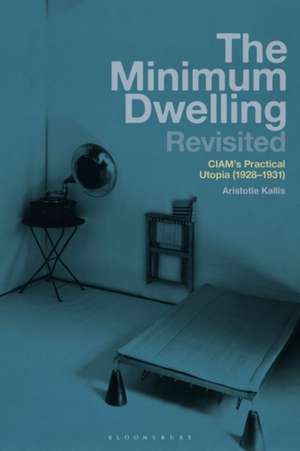
The Minimum Dwelling Revisited: CIAM's Practical Utopia (1928–31): Bloomsbury Visual Arts
Autor Professor Aristotle Kallisen Limba Engleză Paperback – 29 mai 2025
In 1929, an eclectic international group of avant-garde modernist architects, including Ernst May, Mart Stam, Walter Gropius and Le Corbusier, met in Frankfurt for the second instalment of the CIAM conferences. They discussed a design programme for cost-effective, good-quality housing, seeking new approaches and processes to maximize quality and functionality while ensuring affordability for the wider population. In exploring the meaning and form of the 'minimum dwelling', they also re-defined dwelling as the hub of a new way of living, proposing a revolutionary multi-scalar approach to urban design based on the concept of the Existenzminimum ('optimally minimal housing').
Despite the two conferences falling short of the organizer's expectations, and being overshadowed by later instalments, the participating architects sanctioned a semantic shift from minimum as bare necessity to a very different, aspirational, kind of minimalism - transforming the entire conversation on mass low-cost dwelling in design, social and ethical terms.
Split into two parts, The Minimum Dwelling Revisited first takes a genealogical approach to explore the provenance of the concept of "minimum dwelling" prior to the 2nd and 3rd CIAM conferences, it then traces the proceedings of the two conferences themselves. Addressing the origins of the "minimum dwelling" concept but also its legacies, and serving as a corrective to the overemphasis on 4th CIAM conference and the Athens Charter, the book is essential reading for scholars researching urban design during the Interwar period.
Din seria Bloomsbury Visual Arts
- 18%
 Preț: 178.39 lei
 - 24%
 Preț: 185.09 lei
 - 16%
 Preț: 162.81 lei
 - 28%
 Preț: 209.30 lei
 - 25%
 Preț: 159.42 lei
 - 28%
 Preț: 211.42 lei
 - 25%
 Preț: 174.88 lei
 - 21%
 Preț: 267.18 lei
 - 27%
 Preț: 184.73 lei
 - 31%
 Preț: 513.97 lei
 - 45%
 Preț: 154.27 lei
 - 21%
 Preț: 334.64 lei
 - 25%
 Preț: 183.43 lei
 - 32%
 Preț: 720.05 lei
 - 32%
 Preț: 587.21 lei
 - 33%
 Preț: 118.78 lei
 - 36%
 Preț: 561.76 lei
 - 28%
 Preț: 202.84 lei
 - 36%
 Preț: 562.14 lei
 - 7%
 Preț: 223.90 lei
 - nou
 Preț: 202.30 lei
 - 32%
 Preț: 563.30 lei
 - 17%
 Preț: 157.49 lei
 - 38%
 Preț: 196.60 lei
 - 27%
 Preț: 193.31 lei
 - 34%
 Preț: 231.87 lei
 - 23%
 Preț: 200.65 lei
 - 36%
 Preț: 553.77 lei
 - 26%
 Preț: 220.06 lei
 - 36%
 Preț: 553.25 lei
 - 31%
 Preț: 508.35 lei
 -
 Preț: 315.13 lei
 - 9%
 Preț: 300.87 lei
 - 24%
 Preț: 185.93 lei
 - 25%
 Preț: 220.75 lei
 - 36%
 Preț: 622.17 lei
 - 34%
 Preț: 106.70 lei
 - 19%
 Preț: 186.85 lei
 - 49%
 Preț: 119.74 lei
 - 31%
 Preț: 509.55 lei
 - 36%
 Preț: 587.87 lei
 - 24%
 Preț: 183.88 lei
 - 36%
 Preț: 554.37 lei
 - 31%
 Preț: 452.51 lei
 - 17%
 Preț: 254.37 lei
 - 19%
 Preț: 172.96 lei
 - 19%
 Preț: 176.58 lei
 - 23%
 Preț: 216.93 lei
Preț: 207.60 lei
Preț vechi: 279.03 lei
-26%
Puncte Express: 311
Carte tipărită la comandă
Livrare economică 19-25 noiembrie
Livrare prin curier în România Termenul estimat este afișat lângă disponibilitate.
Transport gratuit de la 400.00 lei Plată online sau ramburs, în funcție de opțiunile comenzii.
Retur gratuit în 14 zile Comandă securizată și suport în română.
Specificații
ISBN-13: 9781350346222
ISBN-10: 1350346225
Pagini: 242
Ilustrații: 36 bw illus
Dimensiuni: 152 x 232 x 16 mm
Greutate: 0.38 kg
Editura: Bloomsbury Publishing
Colecția Bloomsbury Visual Arts
Seria Bloomsbury Visual Arts
Locul publicării:London, United Kingdom
ISBN-10: 1350346225
Pagini: 242
Ilustrații: 36 bw illus
Dimensiuni: 152 x 232 x 16 mm
Greutate: 0.38 kg
Editura: Bloomsbury Publishing
Colecția Bloomsbury Visual Arts
Seria Bloomsbury Visual Arts
Locul publicării:London, United Kingdom
Cuprins
List of Illustrations
Acknowledgments
Abbreviations
Introduction
'Contact Zone' and 'Practical Utopia'
Structure
1. Genealogies of the Minimum
Poverty, 'Human Needs', and 'Minimum'
Habitation and 'Minimum Needs'
Early Interventions and Reform Initiatives
Existenzminimum
The Low-cost Housing Calculus
2. The 'Small Dwelling' Between Emergency and Aspiration
Size and Dwelling
The 'Small Dwelling' after WW1
From the 'Small' to the 'Smallest' Dwelling (Kleinstwohnung)
The Pioneering Cases of Vienna and Frankfurt
3. International Expert Networks and The Housing Question in the Interwar Period
The IFHTP Encounters the Question of Mass Housing: Vienna, 1926
The IFHTP Congress in Paris, 1928: The Trope of the 'Housing For the Very Poor'
The IFHTP Congress in Rome, 1929: Planning and Financing Mass Urban Housing
4. The 'Minimum Dwelling' as Utopia
WW1 as Rupture: The Space of Utopia
Interwar Modernism as Discourse: Minimum and Optimum
Architecture as Revolution
The Private Cell, The Public Sphere, and What Lies In-Between
The Soviet Experience: Pursuing the Minimum in Utopia
The 'Dwelling Ration': Social Utopia in Disguise
'Frictionless Living': The Studies of Alexander Klein
5. CIAM2: The 'Minimum Dwelling' In Focus
CIAM and its 'Lesser' Congresses
CIAM's First Steps and the Question of Dwelling
Setting Up the First 'Working Congress'
The 1929 Frankfurt Congress (CIAM2)
Language Matters: The Opacity of the Existenzminimum
The Aftermath of the Frankfurt Congress
6. CIAM3: Dwelling as the Unlikely Hub og Modern Architecture
From CIAM2 to CIAM3: Exploring Scales in Three-Dimensional Space
The Elusive Theme(s) of CIAM3: The Battle of the Scales
The Brussels Congress
The 'Minimum Dwelling' in CIAM3
7. The CIAM2 and CIAM3 Exhibitions
The Exhibition Field in Interwar Europe: Showcasing the 'Minimum'
The Minimum Dwelling on Show: Exhibiting CIAM2
Exhibiting CIAM3
Conclusions
Bibliography
Index
Acknowledgments
Abbreviations
Introduction
'Contact Zone' and 'Practical Utopia'
Structure
1. Genealogies of the Minimum
Poverty, 'Human Needs', and 'Minimum'
Habitation and 'Minimum Needs'
Early Interventions and Reform Initiatives
Existenzminimum
The Low-cost Housing Calculus
2. The 'Small Dwelling' Between Emergency and Aspiration
Size and Dwelling
The 'Small Dwelling' after WW1
From the 'Small' to the 'Smallest' Dwelling (Kleinstwohnung)
The Pioneering Cases of Vienna and Frankfurt
3. International Expert Networks and The Housing Question in the Interwar Period
The IFHTP Encounters the Question of Mass Housing: Vienna, 1926
The IFHTP Congress in Paris, 1928: The Trope of the 'Housing For the Very Poor'
The IFHTP Congress in Rome, 1929: Planning and Financing Mass Urban Housing
4. The 'Minimum Dwelling' as Utopia
WW1 as Rupture: The Space of Utopia
Interwar Modernism as Discourse: Minimum and Optimum
Architecture as Revolution
The Private Cell, The Public Sphere, and What Lies In-Between
The Soviet Experience: Pursuing the Minimum in Utopia
The 'Dwelling Ration': Social Utopia in Disguise
'Frictionless Living': The Studies of Alexander Klein
5. CIAM2: The 'Minimum Dwelling' In Focus
CIAM and its 'Lesser' Congresses
CIAM's First Steps and the Question of Dwelling
Setting Up the First 'Working Congress'
The 1929 Frankfurt Congress (CIAM2)
Language Matters: The Opacity of the Existenzminimum
The Aftermath of the Frankfurt Congress
6. CIAM3: Dwelling as the Unlikely Hub og Modern Architecture
From CIAM2 to CIAM3: Exploring Scales in Three-Dimensional Space
The Elusive Theme(s) of CIAM3: The Battle of the Scales
The Brussels Congress
The 'Minimum Dwelling' in CIAM3
7. The CIAM2 and CIAM3 Exhibitions
The Exhibition Field in Interwar Europe: Showcasing the 'Minimum'
The Minimum Dwelling on Show: Exhibiting CIAM2
Exhibiting CIAM3
Conclusions
Bibliography
Index
Recenzii
The early Modern Movement was passionately committed to addressing the housing needs of the industrial working classes. In this meticulously researched book, Aristotle Kallis presents an authoritative account of the emergence and significance of the Minimum Dwelling (Existenzminimum) as an important expression of that commitment. It supplies important new understandings to our knowledge of twentieth-century European architectural and planning history.
Notă biografică
Aristotle Kallisis Professor of Modern and Contemporary History at Keele University, UK. He is the author of Genocide and Fascism (2009), The Third Rome (2014), and Nazi Propaganda in the Second World War (2005), as well as articles and chapters on aspects of fascist violence and cultural production.