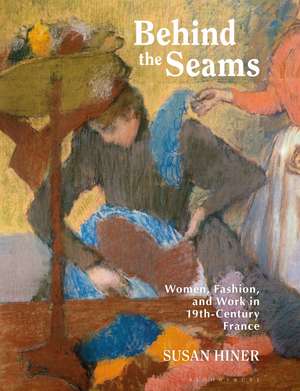
Behind the Seams
Autor Susan Hineren Limba Engleză Hardback – 5 oct 2023
Preț: 512.36 lei
Preț vechi: 653.38 lei
-22%
Puncte Express: 769
Carte disponibilă
Livrare economică 02-16 noiembrie
Livrare prin curier în România Termenul estimat este afișat lângă disponibilitate.
Transport gratuit pentru acest produs Plată online sau ramburs, în funcție de opțiunile comenzii.
Retur gratuit în 14 zile Comandă securizată și suport în română.
Specificații
ISBN-13: 9781350339804
ISBN-10: 1350339806
Pagini: 280
Ilustrații: 70 color illus
Dimensiuni: 189 x 246 x 25 mm
Greutate: 0.45 kg
Editura: BLOOMSBURY ACADEMIC
Locul publicării:London, United Kingdom
ISBN-10: 1350339806
Pagini: 280
Ilustrații: 70 color illus
Dimensiuni: 189 x 246 x 25 mm
Greutate: 0.45 kg
Editura: BLOOMSBURY ACADEMIC
Locul publicării:London, United Kingdom
V-ar putea interesa
-
 British Working Dress: Occupational Clothing 1750-1950Jayne Shrimpton-33%Preț: 45.81 lei68.14 lei
 -
 Scottish National Dress and TartanStuart Reid-32%Preț: 42.02 lei61.41 lei
 -
 Fashion in the 1920sJayne Shrimpton-32%Preț: 46.24 lei67.90 lei
 -
 Wartime Fashion: From Haute Couture to Homemade, 1939-1945Geraldine Howell-24%Preț: 646.40 lei853.50 lei
 -
 Dress, Fashion and Technology: From Prehistory to the PresentPhyllis G. Tortora-24%Preț: 710.06 lei938.92 lei
 -
 Dress History: New Directions in Theory and PracticeCharlotte Nicklas-24%Preț: 784.97 lei1039.09 lei
 -
 -14%Preț: 588.26 lei684.02 lei
 -
 -25%Preț: 248.75 lei331.21 lei
 -
 -25%Preț: 253.00 lei336.61 lei
 -
 A Cultural History of Western Fashion: From Haute Couture to Virtual CoutureProfessor Bonnie English-22%Preț: 200.82 lei258.92 lei
 -
 -27%Preț: 204.32 lei279.55 lei
 -
 Clothing in 17th-Century Provincial EnglandDanae Tankard-23%Preț: 236.20 lei307.63 lei
 -
 -25%Preț: 216.44 lei289.58 lei
 -
 -25%Preț: 209.73 lei280.22 lei
 -
 -23%Preț: 222.33 lei287.12 lei
 -
 A Cultural History of Hair in AntiquityProfessor Mary Harlow-26%Preț: 200.65 lei270.38 lei
 -
 A Cultural History of Hair in the Middle AgesProfessor Roberta Milliken-24%Preț: 199.57 lei263.40 lei
 -
 A Cultural History of Hair in the RenaissanceEdith Snook-24%Preț: 200.38 lei263.35 lei
 -
 A Cultural History of Hair in the Age of EmpireDr Sarah Heaton-24%Preț: 198.73 lei262.87 lei
 -
 A Cultural History of Hair in the Modern AgeDr Geraldine Biddle-Perry-24%Preț: 199.57 lei263.40 lei
 -
 Dress and Ideology: Fashioning Identity from Antiquity to the PresentShoshana-Rose Marzel-29%Preț: 773.04 lei1085.21 lei
 -
 -33%Preț: 834.42 lei1241.98 lei
 -
 The Dictionary of Fashion HistoryValerie Cumming-45%Preț: 689.22 lei1249.64 lei
 -
 Fashion and Masculinity in Renaissance FlorenceElizabeth Currie-33%Preț: 835.12 lei1242.40 lei
 -
 Dress and SocietyJane E. Workman-18%Preț: 172.76 lei211.89 lei
 -
 -33%Preț: 784.44 lei1166.22 lei
 -
 Fashioning Models: Image, Text and IndustryDr Joanne Entwistle-24%Preț: 656.43 lei867.02 lei
 -
 Labels of EmpireSusan Meller-8%Preț: 641.61 lei697.40 lei
 -
 Margiela. the Hermès YearsKatt Debo-11%Preț: 414.62 lei465.87 lei
Caracteristici
Explores the understudied perspective of women's engagement with the production (rather than consumption) of fashion from the early 19th century through the fin de siècle
Notă biografică
Susan Hiner is Professor of French and Francophone Studies at Vassar College working at the intersection of literature, visual culture, and cultural history of women. She is the author of Accessories to Modernity (2010) and numerous articles pertaining to nineteenth-century French culture. She was awarded an NEH grant for 2016-17 to advance her new book Behind the Seams.
Cuprins
List of IllustrationsAcknowledgements Prologue: Behind the Seams 1. Veiling Women's Work 2. Fashion's Fingers: Immodest Modistes3. Fashion's Voices: Modistes des Lettres4. Fashion's Eyes: Painting in the MirrorEpilogue: Midinettes in MotionBibliographyIndex
Recenzii
This outstanding study, rich in newly discovered archival materials, illuminates the pathways to professionalization forged by skilled women hatmakers, journalists, and illustrators. Brilliant analyses by Hiner, one of today's leading fashion scholars, make this beautifully illustrated book a must-read.
Hiner's beautifully illustrated book takes us behind the shop windows and into the workshops, salons and studios of the women who made Paris fashion famous in the nineteenth century ... A must read for everyone interested in the hidden histories of fashion.
An original and significant contribution to our understanding of women's lives in 19th-century France.
This beautifully illustrated volume explores the hidden work of women who produced or promoted female fashion in nineteenth-century France. With astute readings of text and image Hiner uncovers, in fascinating detail, a different reality beneath the frothy glamour of silk and lace.
Hiner's beautifully illustrated book takes us behind the shop windows and into the workshops, salons and studios of the women who made Paris fashion famous in the nineteenth century ... A must read for everyone interested in the hidden histories of fashion.
An original and significant contribution to our understanding of women's lives in 19th-century France.
This beautifully illustrated volume explores the hidden work of women who produced or promoted female fashion in nineteenth-century France. With astute readings of text and image Hiner uncovers, in fascinating detail, a different reality beneath the frothy glamour of silk and lace.
Descriere
Descriere de la o altă ediție sau format:
In this highly original book, Susan E. Hiner looks behind fashion's seams and focuses on the women fashion producers - both working- and middle-class - who were key to shaping the French fashion economy. Behind the Seams thus opens up the fields of both fashion and French cultural studies and explores new ways of understanding the 19th century by demonstrating that these women's complex and contradictory roles as producers of luxury items left them exploited by an oppressive fashion system even as they served as influencers within it.
In 19th-century France, fashion was a powerful and lucrative network that depended on women's expert manipulation of its raw materials. The delicate finger work of seamstresses and modistes yielded frothy dresses and ethereal hats; the subtle, persuasive rhetoric of written chronicles resulted in savvy, targeted marketing campaigns of goods and lifestyles; and the stylized visual splendour of the detailed drawing, engraving, and painting of fashion plates fed an aspirational fantasy that ended in consumption.
Yet this fashion system paradoxically effaced many of the women on whom it depended. Rather than repeating the familiar narrative of women as victims of fashion, Behind the Seams tells a more complicated story. Hiner's close examination reveals the productive women workers, writers, and artists who achieved agency, influence, and active careers even as their work and lives were masked by the ways in which they were mythologized in popular culture, rendered anonymous, and marginalized by institutional exclusion.
Beautifully illustrated in colour throughout, Behind the Seams is a rich resource and essential reading for all those interested in fashion history, 19th-century French history and visual culture, and the social history of women.
In this highly original book, Susan E. Hiner looks behind fashion's seams and focuses on the women fashion producers - both working- and middle-class - who were key to shaping the French fashion economy. Behind the Seams thus opens up the fields of both fashion and French cultural studies and explores new ways of understanding the 19th century by demonstrating that these women's complex and contradictory roles as producers of luxury items left them exploited by an oppressive fashion system even as they served as influencers within it.
In 19th-century France, fashion was a powerful and lucrative network that depended on women's expert manipulation of its raw materials. The delicate finger work of seamstresses and modistes yielded frothy dresses and ethereal hats; the subtle, persuasive rhetoric of written chronicles resulted in savvy, targeted marketing campaigns of goods and lifestyles; and the stylized visual splendour of the detailed drawing, engraving, and painting of fashion plates fed an aspirational fantasy that ended in consumption.
Yet this fashion system paradoxically effaced many of the women on whom it depended. Rather than repeating the familiar narrative of women as victims of fashion, Behind the Seams tells a more complicated story. Hiner's close examination reveals the productive women workers, writers, and artists who achieved agency, influence, and active careers even as their work and lives were masked by the ways in which they were mythologized in popular culture, rendered anonymous, and marginalized by institutional exclusion.
Beautifully illustrated in colour throughout, Behind the Seams is a rich resource and essential reading for all those interested in fashion history, 19th-century French history and visual culture, and the social history of women.