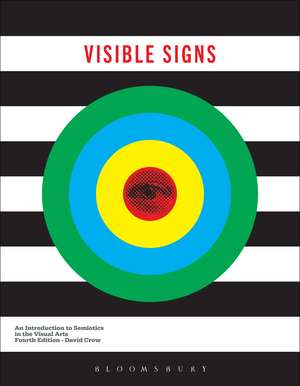
Visible Signs: An Introduction to Semiotics in the Visual Arts: Bloomsbury Visual Arts
Autor David Crowen Limba Engleză Paperback – 11 aug 2022
Each chapter provides an overview of a particular facet of semiotic theory, with inspiring examples from graphic design, typography, illustration, advertising and art to illustrate the ideas discussed in the text. Creative exercises at the end of the book will help exemplify these ideas through practical application.
The fourth edition of Visible Signs includes new imagery and updated exercises, as well as coverage of propaganda, diversity in 'neutral' communication (like emojis), and issues related to social media representation.
Din seria Bloomsbury Visual Arts
- 33%
 Preț: 118.78 lei
 - 16%
 Preț: 162.81 lei
 - 36%
 Preț: 565.96 lei
 - 36%
 Preț: 587.87 lei
 - 38%
 Preț: 196.60 lei
 - 24%
 Preț: 184.91 lei
 - 48%
 Preț: 122.69 lei
 - 27%
 Preț: 216.63 lei
 - 27%
 Preț: 193.31 lei
 - 30%
 Preț: 526.48 lei
 - 26%
 Preț: 220.06 lei
 - 23%
 Preț: 200.65 lei
 - 36%
 Preț: 554.37 lei
 - 18%
 Preț: 178.39 lei
 - 36%
 Preț: 553.25 lei
 - 34%
 Preț: 106.70 lei
 - 32%
 Preț: 720.05 lei
 - 35%
 Preț: 637.35 lei
 - 27%
 Preț: 214.46 lei
 - 27%
 Preț: 184.73 lei
 - 24%
 Preț: 185.09 lei
 - 32%
 Preț: 563.30 lei
 - 30%
 Preț: 521.94 lei
 - 21%
 Preț: 334.64 lei
 - 19%
 Preț: 172.96 lei
 - 33%
 Preț: 591.67 lei
 - 22%
 Preț: 222.27 lei
 - 36%
 Preț: 590.19 lei
 - 31%
 Preț: 455.20 lei
 - 9%
 Preț: 244.61 lei
 - 45%
 Preț: 154.27 lei
 - 36%
 Preț: 553.77 lei
 - 9%
 Preț: 303.14 lei
 - 25%
 Preț: 215.17 lei
 - 31%
 Preț: 508.35 lei
 -
 Preț: 317.03 lei
 - 28%
 Preț: 202.84 lei
 - 32%
 Preț: 601.53 lei
 - 19%
 Preț: 186.85 lei
 - 36%
 Preț: 565.15 lei
 - 21%
 Preț: 267.18 lei
 - 25%
 Preț: 211.62 lei
 - 7%
 Preț: 223.90 lei
 - 17%
 Preț: 157.49 lei
 - 30%
 Preț: 544.72 lei
 - 25%
 Preț: 212.63 lei
 - 24%
 Preț: 162.59 lei
 - 18%
 Preț: 180.93 lei
 - 34%
 Preț: 233.62 lei
Preț: 263.29 lei
Preț vechi: 327.01 lei
-19%
Puncte Express: 395
Carte disponibilă
Livrare economică 11-25 noiembrie
Livrare express 28 octombrie-03 noiembrie pentru 111.65 lei
Livrare prin curier în România Termenul estimat este afișat lângă disponibilitate.
Transport gratuit de la 400.00 lei Plată online sau ramburs, în funcție de opțiunile comenzii.
Retur gratuit în 14 zile Comandă securizată și suport în română.
Specificații
ISBN-13: 9781350164932
ISBN-10: 1350164933
Pagini: 192
Ilustrații: 200 colour illus
Dimensiuni: 210 x 270 x 18 mm
Greutate: 0.66 kg
Ediția:4
Editura: Bloomsbury Publishing
Colecția Bloomsbury Visual Arts
Seria Bloomsbury Visual Arts
Locul publicării:London, United Kingdom
ISBN-10: 1350164933
Pagini: 192
Ilustrații: 200 colour illus
Dimensiuni: 210 x 270 x 18 mm
Greutate: 0.66 kg
Ediția:4
Editura: Bloomsbury Publishing
Colecția Bloomsbury Visual Arts
Seria Bloomsbury Visual Arts
Locul publicării:London, United Kingdom
V-ar putea interesa
-
 Introducing Social Semiotics: An Introductory TextbookTheo Van LeeuwenPreț: 389.53 lei
 -
 Graphic Design TheoryMeredith DavisPreț: 228.70 lei
 -
 The Elements of Visual GrammarAngela RiechersPreț: 181.27 lei
 -
 -16%Preț: 577.94 lei688.02 lei
 -
 Reading Graphic Design in Cultural ContextGrace Lees-Maffei-14%Preț: 559.55 lei650.64 lei
 -
 Reading Graphic Design in Cultural ContextGrace Lees-Maffei-25%Preț: 189.81 lei252.46 lei
 -
 Preț: 384.83 leiRecomandat
 -
 -8%Preț: 227.63 lei247.89 lei
 -
 -14%Preț: 192.32 lei224.25 lei
 -
 The Semiotics of Performances: An Introduction to the Analysis, Interpretation, and Theory of the Performing ArtsProfessor Emeritus Paul Bouissac-17%Preț: 175.44 lei210.17 lei
 -
 -23%Preț: 264.21 lei341.66 lei
 -
 The Quest for MeaningMarcel DanesiPreț: 285.37 lei
 -
 Visual Culture 3eRichard HowellsPreț: 173.09 lei
 -
 -24%Preț: 415.57 lei545.04 lei
 -
 Visual GrammarChristian Leborg-14%Preț: 102.91 lei119.26 lei
 -
 Line Color FormJesse DayPreț: 119.75 lei
 -
 Introducing SemioticsPaul CobleyPreț: 64.46 lei
 -
 Visual CommunicationJonathan BaldwinPreț: 257.51 lei
 -
 Preț: 93.21 lei
Cuprins
Introduction
Chapter 1: Components. What is Theory?; Agreement; Portfolio; Exercises.
Chapter 2: How Meaning is Formed. Categories of Sign; Value; Portfolio; Exercises.
Chapter 3: Reading the Sign: The Reader; Convention and Motivation; Portfolio; Exercises.
Chapter 4: Text and Image: Digital and Analogue Codes; Advertising Writing; Portfolio; Exercises.
Chapter 5: Official and Unofficial Language: Habitus; The Production of Legitimate Language; The Competition for Cultural Legitimacy; Unofficial Language; Portfolio; Exercises.
Chapter 6: Politics of Semiotics: fake news, propaganda, diversity in 'neutral' communication (like emojis); Portfolio; Exercises.
Chapter 7: Junk and Culture: Dirt and Taboo; Rubbish Theory; Rubbish as a Resource; Portfolio; Exercises.
Chapter 8: Open Work: Information and Meaning; Openness and the Visual Arts; Openness and Information; Form and Openness; Portfolio; Exercises.
Glossary
Bibliography
Index
Chapter 1: Components. What is Theory?; Agreement; Portfolio; Exercises.
Chapter 2: How Meaning is Formed. Categories of Sign; Value; Portfolio; Exercises.
Chapter 3: Reading the Sign: The Reader; Convention and Motivation; Portfolio; Exercises.
Chapter 4: Text and Image: Digital and Analogue Codes; Advertising Writing; Portfolio; Exercises.
Chapter 5: Official and Unofficial Language: Habitus; The Production of Legitimate Language; The Competition for Cultural Legitimacy; Unofficial Language; Portfolio; Exercises.
Chapter 6: Politics of Semiotics: fake news, propaganda, diversity in 'neutral' communication (like emojis); Portfolio; Exercises.
Chapter 7: Junk and Culture: Dirt and Taboo; Rubbish Theory; Rubbish as a Resource; Portfolio; Exercises.
Chapter 8: Open Work: Information and Meaning; Openness and the Visual Arts; Openness and Information; Form and Openness; Portfolio; Exercises.
Glossary
Bibliography
Index
Notă biografică
David Crow, until his sudden death in 2022, was UAL's (University of the Arts, London, UK) Pro Vice-Chancellor and Head of Colleges for Camberwell, Chelsea and Wimbledon Colleges of Arts. He studied Communication Design at Manchester Metropolitan University and subsequently worked as a designer in London for Assorted iMaGes and as Art Director for Island Records before running his own consultancy. As a freelance designer he worked for a range of clients in the cultural sector including Rolling Stones Records, Virgin Records, Phonogram and The Royal Shakespeare Company. Crow then moved into academia as Head of the Department of Graphic Arts at Liverpool John Moores University, UK. He was Dean of the School of Art at Manchester Metropolitan University, UK before his move to UAL.