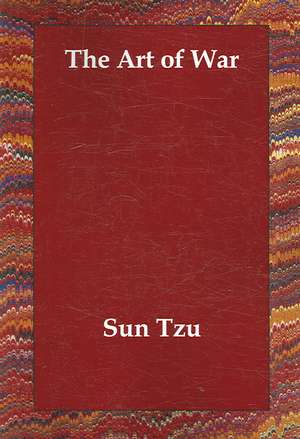
The Art of War
Autor Sun-Tzuen Limba Engleză Paperback – 30 noi 2006
Vezi toate premiile Carte premiată
Preț: 88.53 lei
Nou
15.67€ • 18.37$ • 13.76£
Carte tipărită la comandă
Livrare economică 31 ianuarie-06 februarie 26
Specificații
ISBN-10: 1406831417
Pagini: 116
Dimensiuni: 152 x 229 x 7 mm
Greutate: 0.18 kg
Editura: Echo Library
Locul publicării:United Kingdom
V-ar putea interesa
-
 A Game of ThronesGeorge R. R. MartinPreț: 64.75 lei
 -
 We Should All Be FeministsChimamanda Ngozi AdichiePreț: 53.60 lei
 -
 Who Moved My Cheese?Spencer Johnson-21%Preț: 69.44 lei88.23 lei
 -
 Outliers: The Story of SuccessMalcolm Gladwell-20%Preț: 60.38 lei75.62 leiRecomandat
 -
 The PrinceNiccolo MachiavelliPreț: 67.71 lei
 -
 The Library of Greek MythologyApollodorusPreț: 55.60 lei
 -
 Six Thinking HatsEdward de Bono-22%Preț: 58.29 lei74.36 lei
 -
 -18%Preț: 75.65 lei92.00 lei
 -
 She-WolvesHelen CastorPreț: 90.76 lei
 -
 -26%Preț: 49.79 lei67.14 lei
 -
 Awaken the Giant WithinTony Robbins-22%Preț: 60.61 lei77.36 lei
 -
 Unlimited PowerAnthony Robbins-23%Preț: 59.23 lei76.52 lei
 -
 Mentoring 101: What Every Leader Needs to KnowJohn C. MaxwellPreț: 85.34 lei
 -
 Leadership Promises for Every DayJohn C MaxwellPreț: 56.40 lei
 -
 -20%Preț: 57.61 lei71.88 lei
 -
 Unshakeable: Your Guide to Financial FreedomTony Robbins-24%Preț: 88.12 lei116.25 lei
 -
 Katherine of Aragon, The True QueenAlison Weir-25%Preț: 58.66 lei77.96 lei
 -
 Annne Boleyn A King's ObsessionAlison Weir-26%Preț: 57.50 lei77.24 lei
 -
 The InfernoDante AlighieriPreț: 42.04 lei
 -
 Malleus MaleficarumHeinrich KramerPreț: 126.14 lei
 -
 Rich Dad's Before You Quit Your JobRobert T KiyosakiPreț: 89.38 lei
 -
 Preț: 180.90 lei
 -
 The Power of HabitCharles DuhiggPreț: 82.70 lei
 -
 The PrinceNiccolo MachiavelliPreț: 34.21 lei
 -
 The 48 Laws Of PowerRobert GreenePreț: 119.42 lei
Descriere
The Art of War is the collection of leadership and military strategies composed by the esteemed Chinese general, Sun Tzu. Divided into 13 distinct chapters, each category gives clarity and voice to varying subjects pertaining to the intricacies of war and wartime strategy.
Having inspired generations of readers,The Art of War continues to be perceived as a kind of spiritual lighthouse for all those seeking sage leadership advice. Though Sun Tzu's expertise was considered to be professing wartime strategy, the principals enumerated within the text extend far beyond the logistics of a battlefield. Having lived during the Warring States Period, Sun Tzu understood conflict and political strife.
Sun Tzu, using the culmination of decades worth of knowledge inspired generations of leaders with his words. His insight was not wasted on the bloodshed of lives lost in battle, yet it was composed into beautifully succinct proverbs and adages that make up the whole of The Art of War. Perhaps his most well-known axiom is, “Know the enemy and know yourself, and you can fight a hundred battles with no danger of defeat.”
With proverbs as popular as the one above, the entirety of his work is composed of this level of insight. As pertinent as it was when it was written over 2,000 year ago, The Art of War is a true work of philosophical mastery. With eye-catching new covers and a professionally typeset manuscript, this edition of The Art of War is both modern and readable.
Notă biografică
Sun Tzu was a Chinese general, military strategist, writer and philosopher who lived in the Eastern Zhou period of ancient China. Sun Tzu is traditionally credited as the author of The Art of War, an influential work of military strategy that has affected both Western and East Asian philosophy and military thinking. His works focus much more on alternatives to battle, such as stratagem, delay, the use of spies and alternatives to war itself, the making and keeping of alliances, the uses of deceit and a willingness to submit, at least temporarily, to more powerful foes.[3] Sun Tzu is revered in Chinese and East Asian culture as a legendary historical and military figure. His birth name was Sun Wu (Chinese: ¿¿) and he was known outside of his family by his courtesy name Changqing (Chinese: ¿¿ The name Sun Tzu by which he is best known in the Western World is an honorific which means "Master Sun".
Sun Tzu's historicity is uncertain. The Han dynasty historian Sima Qian and other traditional Chinese historians placed him as a minister to King Helü of Wu and dated his lifetime to 544-496 BC. Modern scholars accepting his historicity place the extant text of The Art of War in the later Warring States period based on its style of composition and its descriptions of warfare.[4] Traditional accounts state that the general's descendant Sun Bin wrote a treatise on military tactics, also titled The Art of War. Since Sun Wu and Sun Bin were referred to as Sun Tzu in classical Chinese texts, some historians believed them identical, prior to the rediscovery of Sun Bin's treatise in 1972.
Sun Tzu's work has been praised and employed in East Asian warfare since its composition. During the twentieth century, The Art of War grew in popularity and saw practical use in Western society as well. It continues to influence many competitive endeavors in the world, including culture, politics, business and sports, as well as modern warfare.
Cuprins
Introduction
A Note on the Text
Suggestions for Further Reading
A List of Chinese Commentators
Cronologies
Dyanasties
Historical Events
The Art of War
Chapter 1: Making of Plans
Chapter 2: Waging of War
Chapter 3: Strategic Offensive
Chapter 4: Forms and Dispositions
Chapter 5: Potential Energy
Chapter 6: Empty and Full
Chapter 7: The Fray
Chapter 8: The Nine Changes
Chapter 9: On the March
Chapter 10: Forms of Terrain
Chapter 11: The Nine Kinds of Ground
Chapter 12: Attack by Fire
Chapter 13: Espionage
The Art of War with Commentary
Chapter 1: Making of Plans
Chapter 2: Waging of War
Chapter 3: Strategic Offensive
Chapter 4: Forms and Dispositions
Chapter 5: Potential Energy
Chapter 6: Empty and Full
Chapter 7: The Fray
Chapter 8: The Nine Changes
Chapter 9: On the March
Chapter 10: Forms of Terrain
Chapter 11: The Nine Kinds of Ground
Chapter 12: Attack by Fire
Chapter 13: Espionage
Recenzii
"An exhilarating experience. The principles of translation are among the best I have ever encountered. They have a collective genius. . . ."—Victor H. Mair, Professor, Department of Asian and Middle Eastern Studies, University of Pennsylvania
"The Denma Group show us how to apply Sun Tzu's wisdom in everyday situations."—James A. Autry, co-author of Real Wisdom: Business Lessons from the Tao Te Ching
Premii
- Audies Winner, 1997