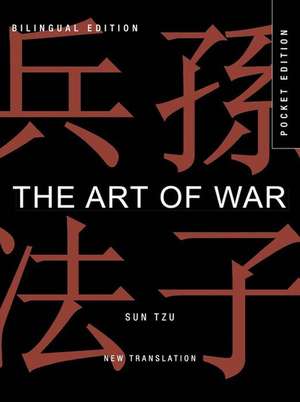
The Art of War: Mini Encyclopedias
Autor Sun Tzuen Limba Engleză Paperback – 14 apr 2023
Din seria Mini Encyclopedias
- 16%
 Preț: 60.95 lei
 - 18%
 Preț: 58.20 lei
 - 18%
 Preț: 58.20 lei
 - 18%
 Preț: 58.20 lei
 - 17%
 Preț: 58.65 lei
 - 17%
 Preț: 58.65 lei
 - 18%
 Preț: 57.73 lei
 - 18%
 Preț: 57.73 lei
 - 18%
 Preț: 58.20 lei
 - 17%
 Preț: 58.65 lei
 - 18%
 Preț: 57.73 lei
 - 18%
 Preț: 57.73 lei
 - 18%
 Preț: 57.26 lei
 - 18%
 Preț: 58.09 lei
 - 18%
 Preț: 58.46 lei
 - 18%
 Preț: 57.19 lei
 - 18%
 Preț: 58.15 lei
 - 19%
 Preț: 55.99 lei
 - 18%
 Preț: 57.19 lei
 - 20%
 Preț: 55.43 lei
 - 18%
 Preț: 58.36 lei
 -
 Preț: 96.18 lei
 -
 Preț: 69.44 lei
 -
 Preț: 69.42 lei
 -
 Preț: 70.98 lei
 -
 Preț: 71.04 lei
 -
 Preț: 70.92 lei
 -
 Preț: 71.04 lei
 -
 Preț: 70.98 lei
 -
 Preț: 70.98 lei
 -
 Preț: 70.77 lei
 -
 Preț: 70.49 lei
Preț: 58.00 lei
Preț vechi: 70.64 lei
-18% Nou
10.26€ • 12.04$ • 9.00£
Carte disponibilă
Livrare economică 06-13 ianuarie 26
Livrare express 20-26 decembrie pentru 39.39 lei
Specificații
ISBN-10: 1838862978
Pagini: 224
Ilustrații: 75 photos and maps; 75 Illustrations, unspecified
Dimensiuni: 134 x 169 x 20 mm
Greutate: 0.38 kg
Editura: Amber Books Ltd
Seria Mini Encyclopedias
V-ar putea interesa
-
 A Game of ThronesGeorge R. R. MartinPreț: 64.75 lei
 -
 We Should All Be FeministsChimamanda Ngozi AdichiePreț: 53.60 lei
 -
 Who Moved My Cheese?Spencer Johnson-21%Preț: 69.44 lei88.23 lei
 -
 Outliers: The Story of SuccessMalcolm Gladwell-20%Preț: 60.38 lei75.62 leiRecomandat
 -
 The PrinceNiccolo MachiavelliPreț: 67.71 lei
 -
 The Library of Greek MythologyApollodorusPreț: 55.60 lei
 -
 Six Thinking HatsEdward de Bono-22%Preț: 58.29 lei74.36 lei
 -
 -18%Preț: 75.65 lei92.00 lei
 -
 The Tipping Point: New York Times BestsellerMalcolm GladwellPreț: 79.82 lei
 -
 She-WolvesHelen CastorPreț: 90.76 lei
 -
 -26%Preț: 49.79 lei67.14 lei
 -
 Awaken the Giant WithinTony Robbins-22%Preț: 60.61 lei77.36 lei
 -
 Unlimited PowerAnthony Robbins-23%Preț: 59.23 lei76.52 lei
 -
 Mentoring 101: What Every Leader Needs to KnowJohn C. MaxwellPreț: 74.86 lei
 -
 Leadership Promises for Every DayJohn C MaxwellPreț: 56.40 lei
 -
 -20%Preț: 57.61 lei71.88 lei
 -
 UnshakeableTony Robbins-24%Preț: 88.12 lei116.25 lei
 -
 Katherine of Aragon, The True QueenAlison Weir-25%Preț: 58.66 lei77.96 lei
 -
 Annne Boleyn A King's ObsessionAlison Weir-26%Preț: 57.50 lei77.24 lei
 -
 The InfernoDante AlighieriPreț: 42.04 lei
 -
 Malleus MaleficarumHeinrich KramerPreț: 126.14 lei
 -
 Rich Dad's Before You Quit Your JobRobert KiyosakiPreț: 89.11 lei
 -
 Preț: 180.90 lei
 -
 The Power of HabitCharles DuhiggPreț: 82.70 lei
 -
 The PrinceNiccolo MachiavelliPreț: 34.21 lei
 -
 The 48 Laws Of PowerRobert GreenePreț: 119.42 lei
Notă biografică
Descriere
The Art of War is the collection of leadership and military strategies composed by the esteemed Chinese general, Sun Tzu. Divided into 13 distinct chapters, each category gives clarity and voice to varying subjects pertaining to the intricacies of war and wartime strategy.
Having inspired generations of readers,The Art of War continues to be perceived as a kind of spiritual lighthouse for all those seeking sage leadership advice. Though Sun Tzu's expertise was considered to be professing wartime strategy, the principals enumerated within the text extend far beyond the logistics of a battlefield. Having lived during the Warring States Period, Sun Tzu understood conflict and political strife.
Sun Tzu, using the culmination of decades worth of knowledge inspired generations of leaders with his words. His insight was not wasted on the bloodshed of lives lost in battle, yet it was composed into beautifully succinct proverbs and adages that make up the whole of The Art of War. Perhaps his most well-known axiom is, “Know the enemy and know yourself, and you can fight a hundred battles with no danger of defeat.”
With proverbs as popular as the one above, the entirety of his work is composed of this level of insight. As pertinent as it was when it was written over 2,000 year ago, The Art of War is a true work of philosophical mastery. With eye-catching new covers and a professionally typeset manuscript, this edition of The Art of War is both modern and readable.
Recenzii
"An exhilarating experience. The principles of translation are among the best I have ever encountered. They have a collective genius. . . ."—Victor H. Mair, Professor, Department of Asian and Middle Eastern Studies, University of Pennsylvania
"The Denma Group show us how to apply Sun Tzu's wisdom in everyday situations."—James A. Autry, co-author of Real Wisdom: Business Lessons from the Tao Te Ching
Cuprins
Foreword by Marc Benioff ix
Preface by Thomas Cleary xv
Introduction xxiii
A Note on the Translation xxxvii
1. Calculations 3
2. Doing Battle 17
3. Planning Attacks 29
4. Formation 47
5. Force 57
6. Weakness and Strength 67
7. Armed Struggle 83
8. Nine Changes 99
9. Army Maneuvers 111
10. Ground Formation 131
11. Nine Grounds 149
12. Fire Attacks 179
13. Using Spies 189
Acknowledgments 201
Notes 205
Suggestions for Further Reading 209