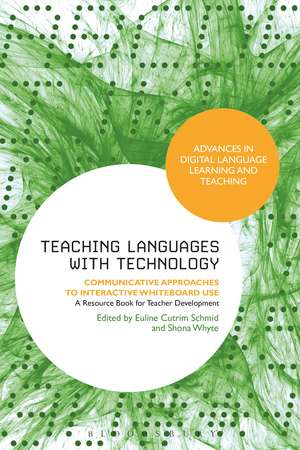
Teaching Languages with Technology: Communicative Approaches to Interactive Whiteboard Use: Advances in Digital Language Learning and Teaching
Editat de Euline Cutrim Schmid, Shona Whyteen Limba Engleză Paperback – 25 sep 2014
In recent years new technologies have been incorporated into second and foreign language education as tools for implementing teaching methodologies. IWBs have established their role in the field of computer-assisted language learning (CALL) and are an effective and inspiring tool which motivates both teachers and learners. Although the number of IWBs in classrooms has rapidly increased over the past decade in many parts of the world, teacher training materials and pedagogical support for the design, evaluation and implementation of IWB-based materials in the foreign language classroom has not kept pace. Research also shows that language teachers do not always use IWBs in pedagogically sound ways. There is a real need for the development of training models and examples of good practice which can support teachers in developing the necessary competencies for exploiting the IWB in ways consistent with current theories of language teaching pedagogy.This book provides that best practice and gives a full account of in-depth research in an accessible manner.
Din seria Advances in Digital Language Learning and Teaching
- 16%
 Preț: 278.27 lei
 - 25%
 Preț: 258.32 lei
 - 25%
 Preț: 248.78 lei
 - 25%
 Preț: 253.73 lei
 - 24%
 Preț: 281.04 lei
 - 23%
 Preț: 253.30 lei
 - 27%
 Preț: 278.99 lei
 - 30%
 Preț: 216.31 lei
 - 28%
 Preț: 208.46 lei
 - 25%
 Preț: 209.30 lei
 - 28%
 Preț: 208.89 lei
 - 26%
 Preț: 206.34 lei
 - 33%
 Preț: 614.39 lei
 - 32%
 Preț: 633.60 lei
 - 33%
 Preț: 616.33 lei
 - 33%
 Preț: 615.16 lei
 - 33%
 Preț: 550.36 lei
Preț: 257.82 lei
Preț vechi: 305.22 lei
-16%
Puncte Express: 387
Carte tipărită la comandă
Livrare economică 27 noiembrie-11 decembrie
Livrare prin curier în România Termenul estimat este afișat lângă disponibilitate.
Transport gratuit de la 400.00 lei Plată online sau ramburs, în funcție de opțiunile comenzii.
Retur gratuit în 14 zile Comandă securizată și suport în română.
Specificații
ISBN-13: 9781623560850
ISBN-10: 1623560853
Pagini: 288
Ilustrații: illustrations
Dimensiuni: 156 x 234 x 15 mm
Greutate: 0.43 kg
Editura: Bloomsbury Publishing
Colecția Bloomsbury Academic
Seria Advances in Digital Language Learning and Teaching
Locul publicării:London, United Kingdom
ISBN-10: 1623560853
Pagini: 288
Ilustrații: illustrations
Dimensiuni: 156 x 234 x 15 mm
Greutate: 0.43 kg
Editura: Bloomsbury Publishing
Colecția Bloomsbury Academic
Seria Advances in Digital Language Learning and Teaching
Locul publicării:London, United Kingdom
V-ar putea interesa
-
 Phraseology: Theory, Analysis, and ApplicationsA. P. Cowie-28%Preț: 432.35 lei603.12 lei
 -
 Phonological Knowledge: Conceptual and Empirical IssuesNoel Burton-Roberts-28%Preț: 361.80 lei502.49 lei
 -
 -28%Preț: 347.37 lei483.16 lei
 -
 Foundations of Language: Brain, Meaning, Grammar, EvolutionRay Jackendoff-10%Preț: 374.30 lei418.09 lei
 -
 Child Language: The Parametric ApproachWilliam Snyder-19%Preț: 358.15 lei442.87 lei
 -
 -10%Preț: 345.47 lei384.66 lei
 -
 The Linguistic Cycle: Language Change and the Language FacultyElly van Gelderen-25%Preț: 455.10 lei610.44 lei
 -
 -35%Preț: 405.64 lei626.13 lei
 -
 Second Language IdentitiesDavid Block-16%Preț: 180.66 lei215.18 lei
 -
 Teaching and Learning in Multilingual ContextsAgnieszka OtwinowskaPreț: 349.68 lei
 -
 Multilingual Universities in South AfricaLiesel HibbertPreț: 288.19 lei
 -
 The Multilingual Turn in Languages EducationJean ContehPreț: 417.67 lei
 -
 Cognate Vocabulary in Language Acquisition and UseAgnieszka OtwinowskaPreț: 409.09 lei
 -
 English Language Teaching MattersMichael P BermanPreț: 133.27 lei
Cuprins
Notes on Contributors
Editorial Advisory Board
Foreword - Interactive Whiteboards: against the odds? Jozef Colpaert
Introduction - Theory and practice in second language teaching with interactive technologies, Shona Whyte
Part 1: Case Studies
1. IWB in Language Education for learners with special educational needs: learning Welsh at primary school, Emily Hillier & Gary Beauchamp
2. A task-based approach to videoconferencing with the IWB: a French-German primary EFL class exchange, Shona Whyte & Euline Cutrim Schmid
3. Digital Storytelling in the primary EFL classroom, Anika Kegenhof
4. The IWB in the CLIL classroom: using visuals to foster active learning with young beginners, Helene Sailer, Euline Cutrim Schmid & Ton Koenraad
5. Using the IWB to support gamification in order to enhance writing fluency in the secondary language classroom, Graham Stanley
6. Exploring IWB use for language instruction in Turkish higher education settings, Serkan Çelik
7. Academic teacher training and the IWB: coaching pre-service teachers in Belgium, Margret Oberhofer, Mathea Simons & Tom Smits
Part 2: Final Recommendations
8. Ongoing professional development in IWB-mediated language teaching: evening up the odds, Euline Cutrim Schmid & Shona Whyte
Part 3: Glossary
Index
Editorial Advisory Board
Foreword - Interactive Whiteboards: against the odds? Jozef Colpaert
Introduction - Theory and practice in second language teaching with interactive technologies, Shona Whyte
Part 1: Case Studies
1. IWB in Language Education for learners with special educational needs: learning Welsh at primary school, Emily Hillier & Gary Beauchamp
2. A task-based approach to videoconferencing with the IWB: a French-German primary EFL class exchange, Shona Whyte & Euline Cutrim Schmid
3. Digital Storytelling in the primary EFL classroom, Anika Kegenhof
4. The IWB in the CLIL classroom: using visuals to foster active learning with young beginners, Helene Sailer, Euline Cutrim Schmid & Ton Koenraad
5. Using the IWB to support gamification in order to enhance writing fluency in the secondary language classroom, Graham Stanley
6. Exploring IWB use for language instruction in Turkish higher education settings, Serkan Çelik
7. Academic teacher training and the IWB: coaching pre-service teachers in Belgium, Margret Oberhofer, Mathea Simons & Tom Smits
Part 2: Final Recommendations
8. Ongoing professional development in IWB-mediated language teaching: evening up the odds, Euline Cutrim Schmid & Shona Whyte
Part 3: Glossary
Index
Recenzii
This volume is a timely addition to the growing body of work on digital language learning and teaching. I would strongly recommend this book ... [It,] undeniably, will be of great use to those that are interested in this topic and will turn out a powerful driving force in the further development of IWB-facilitated teaching and researching in the future.
Euline Cutrim Schmid and Shona Whyte's collection of case studies compiled in this volume is a timely addition to the growing body of work on digital language learning and teaching. I would strongly recommend this book as it can serve as a reference book for teachers to find ways to integrate IWBs in different teaching contexts, for trainers to notice aspects to pay special attention to when training pre-service teachers, and for researchers to acquire inspiration to locate an interesting research topic . this volume, undeniably, will be of great use to those that are interested in this topic and will turn out a powerful driving force in the further development of IWB-facilitated teaching and researching in the future.
Given the controversies which continue to surround our understanding of how to use the Interactive whiteboard (IWB), I warmly welcome the publication of this important new resource book. It successfully combines theory and practice, drawing on the research while at the same time providing practical insights for language teachers on getting the most out of this powerful tool. The cases studies cover a range of contexts, and crucially inform practitioners on maximising the potential of the IWB, and describe how to use it in communicative ways.
Euline Cutrim Schmid and Shona Whyte's collection of case studies compiled in this volume is a timely addition to the growing body of work on digital language learning and teaching. I would strongly recommend this book as it can serve as a reference book for teachers to find ways to integrate IWBs in different teaching contexts, for trainers to notice aspects to pay special attention to when training pre-service teachers, and for researchers to acquire inspiration to locate an interesting research topic . this volume, undeniably, will be of great use to those that are interested in this topic and will turn out a powerful driving force in the further development of IWB-facilitated teaching and researching in the future.
Given the controversies which continue to surround our understanding of how to use the Interactive whiteboard (IWB), I warmly welcome the publication of this important new resource book. It successfully combines theory and practice, drawing on the research while at the same time providing practical insights for language teachers on getting the most out of this powerful tool. The cases studies cover a range of contexts, and crucially inform practitioners on maximising the potential of the IWB, and describe how to use it in communicative ways.