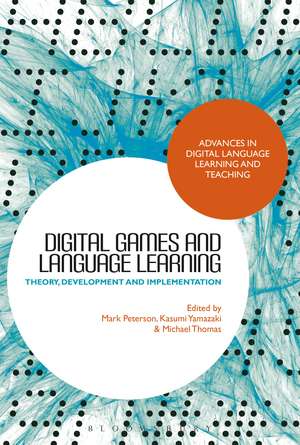
Digital Games and Language Learning: Theory, Development and Implementation: Advances in Digital Language Learning and Teaching
Editat de Dr Mark Peterson, Dr Kasumi Yamazaki, Professor Michael Thomasen Limba Engleză Paperback – 20 oct 2022
The book firstly lays the theoretical foundations and outlines various rationales for using digital games, incorporating contemporary theories of second language acquisition. It also explores the development and impact of digital games designed specifically for language learning, giving due consideration to design principles, pedagogical requirements and student health. Chapters then draw on case studies from Europe and Japan to analyse in-game interaction, attitudes and participation in both institutional and out-of-classroom settings.
Seamlessly combining theory with practical application, this book outlines recent developments in the field and the direction of future research, and is a valuable resource for instructors, researchers and practitioners who are designing games or looking to use them in their classrooms.
Din seria Advances in Digital Language Learning and Teaching
- 16%
 Preț: 278.27 lei
 - 16%
 Preț: 257.82 lei
 - 24%
 Preț: 266.06 lei
 - 24%
 Preț: 254.23 lei
 - 24%
 Preț: 257.25 lei
 - 23%
 Preț: 289.50 lei
 - 23%
 Preț: 253.30 lei
 - 27%
 Preț: 278.99 lei
 - 27%
 Preț: 215.53 lei
 - 25%
 Preț: 209.30 lei
 - 28%
 Preț: 208.89 lei
 - 26%
 Preț: 206.34 lei
 - 33%
 Preț: 614.39 lei
 - 32%
 Preț: 633.60 lei
 - 33%
 Preț: 616.33 lei
 - 33%
 Preț: 615.16 lei
 - 33%
 Preț: 550.36 lei
Preț: 223.64 lei
Preț vechi: 313.94 lei
-29%
Puncte Express: 335
Carte disponibilă
Livrare economică 14-28 noiembrie
Livrare prin curier în România Termenul estimat este afișat lângă disponibilitate.
Transport gratuit de la 400.00 lei Plată online sau ramburs, în funcție de opțiunile comenzii.
Retur gratuit în 14 zile Comandă securizată și suport în română.
Specificații
ISBN-13: 9781350233171
ISBN-10: 135023317X
Pagini: 300
Ilustrații: 21 bw illus
Dimensiuni: 232 x 154 x 18 mm
Greutate: 0.47 kg
Editura: Bloomsbury Publishing
Colecția Bloomsbury Academic
Seria Advances in Digital Language Learning and Teaching
Locul publicării:London, United Kingdom
ISBN-10: 135023317X
Pagini: 300
Ilustrații: 21 bw illus
Dimensiuni: 232 x 154 x 18 mm
Greutate: 0.47 kg
Editura: Bloomsbury Publishing
Colecția Bloomsbury Academic
Seria Advances in Digital Language Learning and Teaching
Locul publicării:London, United Kingdom
Cuprins
Preface
Foreword, Jozef Colpert (The University of Antwerp, Belgium)
Acknowledgements
1. Digital Games and Language Learning: The State of Play, Mark Peterson (Kyoto University Japan), Kasumi Yamazaki (University of Toledo, USA) and Michael Thomas (Liverpool John Moores University, UK)
Part I: Theory and Research
2. A Critical Review of Game-Based Learning, Gamification and Second Language Acquisition,
Silvia Benini (University of Limerick, Ireland) and Michael Thomas (Liverpool John Moores University, UK)
3. Second Language Development in the Context of Massively Multiplayer Online Games: Theoretical Perspectives, Nasser Jabbari (University of Essex, UK)
4. Not All MMOGs are Created Equal: A Design-Informed Approach to the Study of L2 Learning in Multiplayer Online Games, Jonathon Reinhardt (University of Arizona, USA)
5. Human Linguistics as a Framework for Analyzing Simulation-Gaming, Douglas W. Coleman (University of Toledo, USA)
Part II: Development and Implementation of Digital Games in CALL
6. Playing with Digital Game Pedagogies, Alex Bacalja and Kate Euphemia Clark (University of Melbourne, Australia)
7. The Use of Avatars in Digital Role-Playing Games (RPGS ) in Computer-Assisted Language Learning (CALL), Charly Harbord, Euan Dempster and Darshana Jayemanne (Abertay University, UK)
8. Reinforcing International Students' Language Skills for Disaster Preparedness, Kazuhiro Yonemoto (Tokyo Medical and Dental University, Japan)
9.The Relationship between Extramural Digital Gameplay and 21st Century Skills in the Language Classroom, Daniel J. Mills and Benjamin Thanyawatpokin (Ritsumeikan University, Japan)
10. Gaming as a Gateway to L2 English Learning, Liss Kerstin Sylven (University of Gothenburg, Sweden)
Part III: Towards the Future of Game-Based Language Learning
11. Issues in the Current State of Teaching Languages with Games, Benjamin Thanyawatpokin (Ritsumeikan University, Japan) and James York (Tokyo Denki University, Japan)
12. Is Game-Based Language Teaching "Vaporware"?, Jonathan deHaan (University of Shizuoka, Japan)
Index
Foreword, Jozef Colpert (The University of Antwerp, Belgium)
Acknowledgements
1. Digital Games and Language Learning: The State of Play, Mark Peterson (Kyoto University Japan), Kasumi Yamazaki (University of Toledo, USA) and Michael Thomas (Liverpool John Moores University, UK)
Part I: Theory and Research
2. A Critical Review of Game-Based Learning, Gamification and Second Language Acquisition,
Silvia Benini (University of Limerick, Ireland) and Michael Thomas (Liverpool John Moores University, UK)
3. Second Language Development in the Context of Massively Multiplayer Online Games: Theoretical Perspectives, Nasser Jabbari (University of Essex, UK)
4. Not All MMOGs are Created Equal: A Design-Informed Approach to the Study of L2 Learning in Multiplayer Online Games, Jonathon Reinhardt (University of Arizona, USA)
5. Human Linguistics as a Framework for Analyzing Simulation-Gaming, Douglas W. Coleman (University of Toledo, USA)
Part II: Development and Implementation of Digital Games in CALL
6. Playing with Digital Game Pedagogies, Alex Bacalja and Kate Euphemia Clark (University of Melbourne, Australia)
7. The Use of Avatars in Digital Role-Playing Games (RPGS ) in Computer-Assisted Language Learning (CALL), Charly Harbord, Euan Dempster and Darshana Jayemanne (Abertay University, UK)
8. Reinforcing International Students' Language Skills for Disaster Preparedness, Kazuhiro Yonemoto (Tokyo Medical and Dental University, Japan)
9.The Relationship between Extramural Digital Gameplay and 21st Century Skills in the Language Classroom, Daniel J. Mills and Benjamin Thanyawatpokin (Ritsumeikan University, Japan)
10. Gaming as a Gateway to L2 English Learning, Liss Kerstin Sylven (University of Gothenburg, Sweden)
Part III: Towards the Future of Game-Based Language Learning
11. Issues in the Current State of Teaching Languages with Games, Benjamin Thanyawatpokin (Ritsumeikan University, Japan) and James York (Tokyo Denki University, Japan)
12. Is Game-Based Language Teaching "Vaporware"?, Jonathan deHaan (University of Shizuoka, Japan)
Index
Recenzii
This edited book is an ideal choice for readers willing to learn about the status quo of digital games in language education. It is particularly informative and valuable for language teachers who attempt to use digital games in their instructional practices ... this book makes a timely contribution to this research area as it demonstrates the breadth of topics for investigation and the pedagogical potential of digital games for language education.
A timely and comprehensive book, it encompasses important aspects of theory, research, design and application of digital games as an extension of CALL . [Digital Games and Language Learning] can be an ideal choice for researchers, practitioners and game developers alike, who want to have a more profound understanding of current state in theory, research and practice of language learning in the context of digital games.
Provid[es] a timely boost to several areas of CALL . This book would make a good starting point for those wishing to become involved in the field, as well as scholars and practitioners wanting to consider the theory and future direction of digital games and language learning.
This collection of work by both recognized and emerging scholars is a significant contribution towards the wider understanding of the important role that digital games play in CALL. The combination of theoretical background and practical examples of development and application will be invaluable for researchers and instructors in foreign language teaching and learning.
A timely and comprehensive book, it encompasses important aspects of theory, research, design and application of digital games as an extension of CALL . [Digital Games and Language Learning] can be an ideal choice for researchers, practitioners and game developers alike, who want to have a more profound understanding of current state in theory, research and practice of language learning in the context of digital games.
Provid[es] a timely boost to several areas of CALL . This book would make a good starting point for those wishing to become involved in the field, as well as scholars and practitioners wanting to consider the theory and future direction of digital games and language learning.
This collection of work by both recognized and emerging scholars is a significant contribution towards the wider understanding of the important role that digital games play in CALL. The combination of theoretical background and practical examples of development and application will be invaluable for researchers and instructors in foreign language teaching and learning.