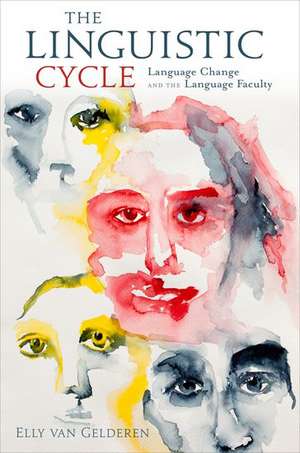
The Linguistic Cycle: Language Change and the Language Faculty
Autor Elly van Gelderenen Limba Engleză Paperback – 26 mai 2011
Preț: 470.38 lei
Preț vechi: 621.18 lei
-24%
Puncte Express: 706
Carte tipărită la comandă
Livrare economică 04-15 decembrie
Livrare prin curier în România Termenul estimat este afișat lângă disponibilitate.
Transport gratuit pentru acest produs Plată online sau ramburs, în funcție de opțiunile comenzii.
Retur gratuit în 14 zile Comandă securizată și suport în română.
Specificații
ISBN-13: 9780199756049
ISBN-10: 019975604X
Pagini: 464
Ilustrații: 36 illustrations
Dimensiuni: 155 x 231 x 33 mm
Greutate: 0.61 kg
Editura: Oxford University Press
Colecția OUP USA
Locul publicării:New York, United States
ISBN-10: 019975604X
Pagini: 464
Ilustrații: 36 illustrations
Dimensiuni: 155 x 231 x 33 mm
Greutate: 0.61 kg
Editura: Oxford University Press
Colecția OUP USA
Locul publicării:New York, United States
V-ar putea interesa
-
 Phonological Knowledge: Conceptual and Empirical IssuesNoel Burton-Roberts-27%Preț: 373.93 lei511.31 lei
 -
 -27%Preț: 356.51 lei490.22 lei
 -
 Preț: 160.95 lei
 -
 Preț: 97.74 lei
 -
 Preț: 127.83 lei
 -
 Preț: 79.38 lei
 -
 Preț: 131.41 lei
 -
 Grammaire bilingue française et basque 3e éd.Jean-Baptiste ArchuPreț: 137.72 lei
 -
 Preț: 105.44 lei
 -
 Preț: 166.69 lei
 -
 Abrégé de la grammaire française, ou Extrait de l'ouvrage intituléFrançois-Joseph-Michel NoëlPreț: 97.92 lei
 -
 Corrigé Des Exercices Français Sur l'Orthographe, La Syntaxe Et La Ponctuation, Seconde ÉditionFrançois-Joseph-Michel NoëlPreț: 128.62 lei
 -
 Preț: 128.22 lei
 -
 Preț: 166.69 lei
 -
 Preț: 231.48 lei
 -
 Preț: 113.15 lei
 -
 Preț: 143.62 lei
 -
 Grammaire pratique adoptée par l'Université pour l'usage des écoles primairesVictor Augustin VanierPreț: 98.15 lei
 -
 Preț: 89.99 lei
 -
 Dictionnaire François-Celtique Ou François-BretonGrégoire de RostrenenPreț: 393.38 lei
Notă biografică
Elly van Gelderen is Regents' Professor in the Department of English at Arizona State University.
Cuprins
Preface
List of Tables
List of Figures
Abbreviations
1 Introduction
1 What is the linguistic cycle?
2 What kinds of cycles exist?
3 How and why to study cyclical change
3.1 The practical side
3.2 The theoretical side
4 Major questions in the study of cycles
5 Terminology
6 Conclusion and outline
Suggestions for further reading
Review questions and exercises
2 History
1 The late eighteenth and early nineteenth centuries
2 The late nineteenth and early twentieth centuries
3 The mid and late twentieth century
4 Recent generative work
5 Recent functionalist work
6 Conclusion
Suggestions for further reading
Review questions
3 Micro cycles: Determiner and Verbal Cycles
1 Definition of a micro cycle
2 Determiner Cycles
3 Copula Cycles
4 Tense and Aspect Cycles
4.1 The Imperfective Cycle
4.2 The Perfective Cycle
4.3 Imperfective and perfective renewal in Basque
5 Mood Cycles
6 Voice Cycles
7 Conclusion
Suggestions for further reading
Review questions and exercises
4 Micro cycles: Polarity and Discourse Cycles
1 Negative Cycles
1.1 Jespersen’s Negative Cycle
1.2 Givón’s Negative Cycle
1.3 Croft’s Negative Cycle
2 Interrogative Cycles
3 Complementizer Cycles
4 Pragmatic Cycles
4.1 A definition
4.2 Temperal adverbs as sources
4.3 Emphatic Pronoun Cycles
5 Interactions between micro cycles
6 Conclusions
Suggestions for further reading
Review questions and exercises
5 Macro cycles
1 Definition of a macro cycle
2 Analytic to synthetic to analytic
3 Pronoun Cycles
3.1 Subject Cycle
3.2 Object Cycle
3.3 Morpheme Order
4 Case Cycles
5 Interactions involving macro cycles
6 Conclusions
Suggestions for further reading
Review questions and exercises
Appendix
6 Explanations and mechanisms
1 Clarity vs comfort
2 External factors
3 Construction Grammar
4 Early Minimalism: structural and featural economy
5 Later Minimalism: labeling and determinacy
6 Attractor states
7 Conclusions
Suggestions for further reading
Review questions and exercises
7 Conclusions and future directions
1 Insights from cycles
2 Criticisms of the cycle
3 Future directions
Suggested answers to the review questions and exercises
References
Indices
List of Tables
List of Figures
Abbreviations
1 Introduction
1 What is the linguistic cycle?
2 What kinds of cycles exist?
3 How and why to study cyclical change
3.1 The practical side
3.2 The theoretical side
4 Major questions in the study of cycles
5 Terminology
6 Conclusion and outline
Suggestions for further reading
Review questions and exercises
2 History
1 The late eighteenth and early nineteenth centuries
2 The late nineteenth and early twentieth centuries
3 The mid and late twentieth century
4 Recent generative work
5 Recent functionalist work
6 Conclusion
Suggestions for further reading
Review questions
3 Micro cycles: Determiner and Verbal Cycles
1 Definition of a micro cycle
2 Determiner Cycles
3 Copula Cycles
4 Tense and Aspect Cycles
4.1 The Imperfective Cycle
4.2 The Perfective Cycle
4.3 Imperfective and perfective renewal in Basque
5 Mood Cycles
6 Voice Cycles
7 Conclusion
Suggestions for further reading
Review questions and exercises
4 Micro cycles: Polarity and Discourse Cycles
1 Negative Cycles
1.1 Jespersen’s Negative Cycle
1.2 Givón’s Negative Cycle
1.3 Croft’s Negative Cycle
2 Interrogative Cycles
3 Complementizer Cycles
4 Pragmatic Cycles
4.1 A definition
4.2 Temperal adverbs as sources
4.3 Emphatic Pronoun Cycles
5 Interactions between micro cycles
6 Conclusions
Suggestions for further reading
Review questions and exercises
5 Macro cycles
1 Definition of a macro cycle
2 Analytic to synthetic to analytic
3 Pronoun Cycles
3.1 Subject Cycle
3.2 Object Cycle
3.3 Morpheme Order
4 Case Cycles
5 Interactions involving macro cycles
6 Conclusions
Suggestions for further reading
Review questions and exercises
Appendix
6 Explanations and mechanisms
1 Clarity vs comfort
2 External factors
3 Construction Grammar
4 Early Minimalism: structural and featural economy
5 Later Minimalism: labeling and determinacy
6 Attractor states
7 Conclusions
Suggestions for further reading
Review questions and exercises
7 Conclusions and future directions
1 Insights from cycles
2 Criticisms of the cycle
3 Future directions
Suggested answers to the review questions and exercises
References
Indices