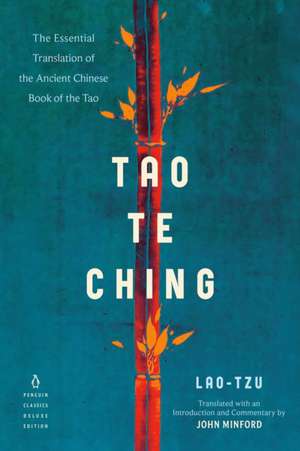
Tao Te Ching
Autor Lao-Tzu Comentarii de John Minforden Limba Engleză Paperback – 12 noi 2019
The most translated book in the world after the Bible, the Tao Te Ching, or 'Book of the Way', is the essential text of Taoism, one of the three great religions of China. Through aphorisms and parable, it guides its readers toward the Tao, or the 'Way': living in harmony with the life force of the universe. Traditionally attributed to Lao Tzu, a Chinese philosopher who was a contemporary of Confucius, it offers a practical model for living based on modesty, self-restraint and balance and is an insightful guide for anyone seeking to open their minds, free their thoughts, and attain greater self-awareness.
John Minford's celebrated translation emphasises the calm, meditative quality of the Tao Te Ching, as well as its use as a guide to everyday living. This edition is accompanied by illuminating commentary and interpretation, as well as beautifully illustrated Chinese characters.
Preț: 104.60 lei
Carte disponibilă
Livrare economică 17 noiembrie-01 decembrie
Livrare express 03-07 noiembrie pentru 29.74 lei
Specificații
ISBN-10: 0143133802
Pagini: 368
Dimensiuni: 144 x 213 x 30 mm
Greutate: 0.34 kg
Editura: Penguin Publishing Group
Locul publicării:London, United Kingdom
V-ar putea interesa
-
 The Monk Who Sold His FerrariRobin SharmaPreț: 62.12 lei
 -
 Everyday TaoMing-Dao DengPreț: 103.05 lei
 -
 -17%Preț: 102.18 lei123.29 lei
 -
 On the Shortness of LifeLucius Annaeus Seneca-20%Preț: 44.96 lei56.45 lei
 -
 The Pocket Oracle and Art of PrudenceBalthasar GracianPreț: 85.14 lei
 -
 Preț: 112.94 lei
 -
 Tao Te ChingLao TzuPreț: 27.89 lei
 -
 -16%Preț: 67.17 lei80.39 lei
 -
 A Course in Miracles - Original Edition TextHelen SchucmanPreț: 127.01 lei
 -
 The Art of WarNiccolo MachiavelliPreț: 41.07 lei
 -
 The Four GospelsAmerican Bible SocietyPreț: 153.54 lei
 -
 -17%Preț: 114.91 lei139.23 lei
 -
 The DhammapadaGil FronsdalPreț: 71.05 lei
 -
 Preț: 212.38 lei
 -
 The Whole-Brain Child: 12 Proven Strategies to Nurture Your Child's Developing MindDr. Tina Payne Bryson-26%Preț: 90.19 lei121.70 lei
 -
 -19%Preț: 63.98 lei78.67 lei
 -
 Wishes FulfilledWayne Dyer-19%Preț: 109.99 lei136.30 lei
 -
 -18%Preț: 58.40 lei71.50 lei
 -
 Preț: 43.29 lei
 -
 Think and Grow Rich - Original EditionNapoleon HillPreț: 67.92 lei
Notă biografică
Lao Tzu, whose name means 'Old Master', was a contemporary of Confucius in the sixth century BCE and the founder of the philosophical tradition of Taoism.
John Minford (Translator)
John Minford is an emeritus professor of Chinese at the Australian National University. He has produced renowned translations of some of the most beloved works of Chinese literature, including The Story of the Stone, The Art of War and the Tao Te Ching.
Recenzii
Ancient wisdom for those facing twenty-first-century perplexities . . . Minford writes for ordinary people seeking guidance in everyday life . . . In simple but resonantly phrased language, he somehow does unfold the Tao's message
A wonderful translation - clear and deep
Elegant and poetic, John Minford's translation of the Tao Te Ching probably comes the closest of any to the essence of the mystical, ineffable Taoist classic
John Minford's translation . . . has the mark of the craftsman: its choice of words is not just judicious but also poetic, refreshing the at once limpid and ambiguous original and making it new. The result is a metaphysical feast for those willing to slow down and read this text as it was meant to be read: meditatively
Descriere
Cuprins
" cellpadding="0" cellspacing="5" border="0"Introduction
LAO TZU
Book One
Book Two
List of Passages for Comparison
Appendices:
1. The Problem of Authorship
2. The Nature of the Work
Chronological Table
Glossary
Notes
Textul de pe ultima copertă
The Tao Te Ching, the esoteric but infinitely practical book written most probably in the sixth century B.C. by Lao Tsu, has been translated more frequently than any work except the Bible. This translation of the Chinese classic, which was first published twenty-five years ago, has sold more copies than any of the others. It offers the essence of each word and makes Lao Tsu's teaching immediate and alive. The philosophy of Lao Tsu is simple: Accept what is in front of you without wanting the situation to be other than it is. Study the natural order of things and work with it rather than against it, for to try to change what is only sets up resistance. Nature provides everything without requiring payment or thanks, and also provides for all without discrimination - therefore let us present the same face to everyone and treat all men as equals, however they may behave. If we watch carefully, we will see that work proceeds more quickly and easily if we stop "trying", if we stop putting in so much extra effort, if we stop looking for results. In the clarity of a still and open mind, truth will be reflected. We will come to appreciate the original meaning of the word "understand", which means "to stand under". We serve whatever or whoever stands before us, without any thought for ourselves. Te - which may be translated as "virtue, or "strength" - lies always in Tao, or "natural law". In other words: Simply be.
Extras
The Tao that can be told is not the eternal Tao. The name that can be named is not the eternal name. The nameless is the beginning of heaven and earth. The named is the mother of ten thousand things. Ever desireless, one can see the mystery. Ever desiring, one can see the manifestations. These two spring from the same source but differ in name; This appears as darkness. Darkness within darkness. The gate to all mystery.
TWO
Under heaven all can see beauty as beauty only because there is ugliness. All can know good as good only because there is evil. Therefore having and not having arise together; Difficult and easy complement each other; Long and short contrast each other; High and low rest upon each other; Voice and sound harmonize each other; Front and back follow each other. Therefore the wise go about doing nothing, teaching -no--talking. The ten thousand things rise and fall without cease, Creating, yet not possessing, Working, yet not taking credit. Work is done, then forgotten. Therefore it lasts forever.
THREE
Not exalting the gifted prevents quarreling. Not collecting treasures prevents stealing. Not seeing desirable things prevents confusion of the heart. The wise therefore rule by emptying hearts and stuffing bellies, By weakening ambitions and strengthening bones. If people lack knowledge and desire, Then it is best not to interfere. If nothing is done, then all will be well.
FOUR
The Tao is an empty vessel; it is used, but never filled. Oh, unfathomable source of ten thousand things! Blunt the sharpness, Untangle the knot, Soften the glare, Merge with dust. Oh, hidden deep but ever present! I do not know from whence it comes. It is the forefather of the ancestors.
FIVE
Heaven and earth are impartial; They see the ten thousand things as they are. The wise are impartial; They see the people as they are. The space between heaven and earth is like a bellows. The shape changes but not the form; The more it moves, the more it yields. More words count less. Hold fast to the center.