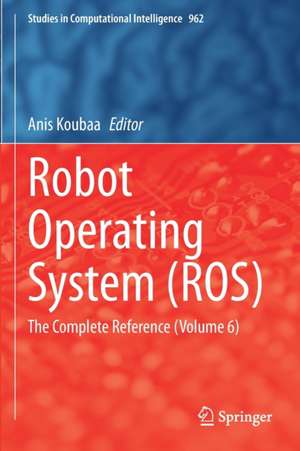
Robot Operating System (ROS)
Editat de Anis Koubâaen Limba Engleză Paperback – 19 iul 2022
Subliniem faptul că acest volum se definește prin resursele practice și codul sursă abundent, facilitând replicarea sistemelor robotice descrise direct în mediul de dezvoltare. Ca al treilea volum din seria Robot Operating System (ROS), lucrarea editată de Anis Koubâa extinde referința completă Springer, concentrându-se pe integrarea ROS în platforme embedded și sisteme multi-robot. Reținem că structura celor 16 capitole este organizată progresiv, de la simularea algoritmilor de patrulare în Partea 1, până la dezvoltarea sistemelor aeriene fără pilot în Partea 2 și soluții avansate pentru ROS2 și securitate în Partea 4.
Abordarea diferă de A Systematic Approach to Learning Robot Programming with ROS prin caracterul său enciclopedic și orientat spre cercetare aplicată — este mai puțin un manual introductiv abstract și mai mult un ghid de implementare pentru tehnologii emergente, precum utilizarea GPU. În comparație cu Mastering Ros for Robotics Programming, care se axează pe manipulatoare și senzori, volumul de față prioritizează sistemele autonome complexe și cooperarea între roboți. Recomandăm atenția asupra secțiunii de 'Software Engineering with ROS', un element distinctiv care ridică standardul de dezvoltare în domeniu.
Această lucrare consolidează expertiza editorului în vehicule autonome, fiind o continuare naturală a temelor explorate în Unmanned Aerial Vehicles Applications: Challenges and Trends. Dacă lucrările sale anterioare, precum Deep Learning for Unmanned Systems, puneau accent pe inteligența artificială, prezentul volum oferă infrastructura software necesară pentru a pune acești algoritmi în mișcare pe hardware real, utilizând standardele actuale ale industriei.
Preț: 753.42 lei
Preț vechi: 918.81 lei
-18%
Carte tipărită la comandă
Livrare economică 27 noiembrie-11 decembrie
Specificații
ISBN-10: 303075474X
Pagini: 276
Ilustrații: V, 269 p. 120 illus., 109 illus. in color.
Dimensiuni: 155 x 235 x 16 mm
Greutate: 0.42 kg
Ediția:1st ed. 2021
Editura: Springer
Locul publicării:Cham, Switzerland
V-ar putea interesa
-
 -39%Preț: 402.67 lei660.61 lei
 -
 Deep LearningIan Goodfellow-21%Preț: 684.46 lei865.01 lei
 -
 Probabilistic Machine LearningKevin P. Murphy-21%Preț: 854.63 lei1080.57 lei
 -
 Image Processing and Acquisition using PythonRavishankar Chityala-18%Preț: 1034.06 lei1261.06 lei
 -
 -20%Preț: 418.89 lei523.61 lei
 -
 Numerical Geometry of Non-Rigid ShapesAlexander M. Bronstein-20%Preț: 515.64 lei644.54 lei
 -
 Multiple View Geom Comp Vision 2edRichard Hartley-14%Preț: 766.84 lei891.67 lei
 -
 -20%Preț: 1266.67 lei1583.33 lei
 -
 The Cyber Risk HandbookDomenic Antonucci-8%Preț: 516.27 lei561.16 lei
 -
 Database SystemsRamez Elmasri-20%Preț: 552.09 lei690.12 lei
 -
 Digital Image Processing, Global EditionRafael Gonzalez-11%Preț: 663.18 lei745.14 lei
 -
 Geometric Methods and ApplicationsJean Gallier-15%Preț: 726.41 lei854.59 lei
 -
 Guide to Computational Geometry ProcessingJ. Andreas Bærentzen-15%Preț: 555.00 lei652.95 lei
 -
 Programming Robots with ROSMorgan Quigley-20%Preț: 260.82 lei326.02 lei
 -
 Bridging Relational and NoSQL DatabasesDrazena Gaspar-20%Preț: 1091.20 lei1364.00 lei
 -
 Docker in ActionBret Fisher-20%Preț: 302.80 lei378.50 lei
 -
 -20%Preț: 285.05 lei356.31 lei
 -
 Robot Operating System CookbookPackt Publishing-20%Preț: 274.91 lei343.64 lei
 -
 Mastering ROS for Robotics Programming - Second EditionLentin Joseph-19%Preț: 477.95 lei590.06 lei
 -
 Hands-On Computer Vision with TensorFlow 2Benjamin Planche-20%Preț: 214.62 lei268.28 lei
 -
 -20%Preț: 297.64 lei372.04 lei
 -
 Python Image Processing CookbookSandipan Dey-20%Preț: 269.83 lei337.28 lei
 -
 Computer Graphics and Geometric ModellingMax K. Agoston-20%Preț: 396.47 lei495.59 lei
 -
 Mathematical Image ProcessingKristian Bredies-15%Preț: 563.05 lei662.41 lei
 -
 Principles of Distributed Database SystemsM. Tamer Özsu-20%Preț: 637.99 lei797.49 lei
 -
 Foundations of Computer VisionJames F. Peters-20%Preț: 687.07 lei858.83 lei
 -
 SQL & NoSQL DatabasesAndreas Meier-20%Preț: 321.18 lei401.48 lei
 -
 -20%Preț: 306.98 lei383.73 lei
 -
 Geometry of Deep LearningJong Chul Ye-15%Preț: 449.02 lei528.26 lei
De ce să citești această carte
Recomandăm acest volum inginerilor și cercetătorilor care au depășit nivelul de bază și au nevoie de soluții pentru sisteme multi-agent și securitate în ROS2. Cititorul câștigă acces la studii de caz documentate tehnic, de la quadrocoptere la rovere universitare, beneficiind de un transfer direct de cunoștințe prin codul sursă inclus. Este resursa ideală pentru a trece de la simulare la implementări industriale robuste.
Despre autor
Anis Koubâa este un expert recunoscut în robotică și sisteme inteligente, activând ca profesor și cercetător cu un portofoliu vast de lucrări publicate la Springer. Expertiza sa acoperă o plajă largă de tehnologii, de la vehicule aeriene fără pilot (UAV) la integrarea inteligenței artificiale în economia digitală. În calitate de editor al seriei dedicate Robot Operating System (ROS), el coordonează contribuții de la specialiști globali pentru a oferi o viziune unitară asupra evoluției acestui cadru de lucru. Lucrările sale, precum cele dedicate învățării profunde pentru sisteme autonome, reflectă angajamentul de a conecta teoria academică de aplicațiile practice din ingineria electrică și energetică.
Cuprins
Notă biografică
Textul de pe ultima copertă
There are seven chapters organized into three parts.
Part I presents two chapters on the emerging ROS 2.0 framework; in particular, ROS 2.0 is become increasingly mature to be integrated into the industry. The first chapter from Amazon AWS deals with the challenges that ROS 2 developers will face as they transition their system to be commercial-grade. The second chapter deals with reactive programming for both ROS1 and ROS. In Part II, two chapters deal with advanced robotics, namely on the usage of robots in farms, and the second deals with platooning systems. Part III provides three chapters on ROS navigation. The first chapter deals with the use of deep learning for ROS navigation. The second chapter presents a detailed tuning guide on ROS navigation and the last chapter discusses SLAM for ROS applications. I believe that this book is a valuable companion for ROS users and developers to learn more ROS capabilities and features.